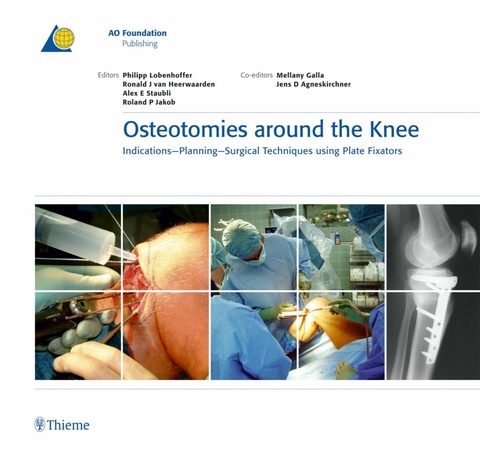
Osteotomies around the Knee (eBook)
Georg Thieme Verlag KG
978-3-13-257990-3 (ISBN)
Authors Roland P Jakob, Matthias Jacobi, Philipp Lobenhoffer
The history of osteotomy
1 Introduction
Osteotomies are now an important and accepted treatment of different pathologies of the knee joint. The development of osteotomy from the 19th to the 21st century was only possible due to the introduction of anesthesia [1, 2], blood spearing surgical techniques [3] and asepsis [4, 5], as well as the detection of radiography [6–8]. Indications for osteotomy have changed fundamentally: Whereas osteotomy is now mainly used to treat unicompartmental osteoarthritis, in the past the main indications were severe genu valgum, posttraumatic deformities, rickets, and other bowing deformities [9, 10].
2 Osteotomy in the 16th century
It was only in the 16th century that the armourer's art first made the development of surgical equipment possible. “Osteoclasia” was a common treatment for malalignment at that time. It consisted of breaking the bone in a controlled manner to correct deformity. Originally this was done manually, but as precision was not high enough, machines were developed to control and guide the force. A machine made by Bosch, which was an ordinary bookbinder press, became the prototype for following instruments. It was first used to treat a malunited femoral fracture. As these instruments became more sophisticated, they were not only used for bony anklyosis but also for genu valgum and varum (Fig 1).
Fig 1 “Osteoclasia”. This apparatus was developed by Lorenz and was the best of its time [11].
3 Osteotomy before the 20th century
In literature, the first modern osteotomy is commonly contributed to the American John Rhea Barton (1794-1871) from Pennsylvania [12].
On November 22, 1826, Barton performed a subtrochanteric osteotomy on a 21-year-old sailor with flexion/adduction ankylosis—an osteotomy therefore to loosen up a flexion deformity of the hip and meant to create a pseudarthrosis which became also the first arthroplasty [13]. The operation was done with a keyhole saw without anesthesia and asepsis, and took only seven minutes (Fig 3). Bone healing was avoided through daily mobilization and led to the intended pseudarthrosis which was successful for 6 years. Thereafter the pseudarthrosis ankylosed again. In 1835 Barton performed a supracondylar wedge osteotomy of the femur for bony ankylosis of the knee curved at a right angle. The osteotomy healed with only minor complications such as “minor infection and extrusion of some small sequestra”.
Fig 2 John Rhea Barton (1794-1871) from Pennsylvania [12].
Fig 3a-b
a Barton's first osteotomy for hip ankylosis [12].
b Wedge osteotomy for knee ankylosis by Barton [12].
August Friedrich Wasserfuhr, a German military surgeon, performed a corrective osteotomy of a 90° malunited femoral fracture on a 5-year-old boy in 1828 [14].
John Karney Rodgers from New York was the first to perform a wedge osteotomy in 1830 [14].
Joseph Anton von Mayer from Würzburg, Professor of Morbid Anatomy, was the first German to perform an osteotomy. Mayer named the operation “resectio tibiae cuneiformis” and avoided the term osteotomy because with “resectio” it was easier to convince patients to agree to this type of surgery. From 1839-1854 he performed 20 osteotomies in rickets-induced deformities. All osteotomies healed with no or only minor complications. He used a variety of osteotomy instruments such as different kinds of saws, sizzles, and osteotomes. Most of his cases were performed using open surgery, but he also performed three subcutaneous surgeries [9, 10].
In the same city worked the famous instrument maker Joseph G Heine (1770-1838). For the first time the skills of an instrument maker were combined with the surgeon's science. Heine took his nephew Bernhard Heine (1800-1846) into apprenticeship, and he would later develop the “Osteotome”, an instrument designed to perform an osteotomy. This made him famous throughout Europe when Heine, now a Professor in Würzburg, presented this medical tool to his colleagues in 1830. It was a bone saw which revolutionized surgical treatment (Fig 4), and was a great success among medical experts. Heine travelled to other parts of Germany, France, and even Russia to present it to other surgeons. By 1836 a doctoral thesis on the “Osteotome and its application” had been published in Munchen, Germany [14, 15].
Fig 4 Bernhard Heine's osteotome.
Bernhard Rudolf Konrad von Langenbeck (1810-1887) professor in Göttingen, Kiel, and Berlin, Germany, was the first to describe a subcutaneous osteotomy technique. He specialized in military surgery. In 1848, he experimentally osteotomized a humerus during the war between Prussia and Denmark in Schleswig-Holstein. In 1854 he described two cases of rickets with varus deformity and a case of fracture malunion in which he performed a subcutaneous osteotomy under chloroform anesthesia. He made a stab wound, then a short skin incision straight to the bone on the inner aspect of the tibia. A drill hole was made passing this incision in transverse direction through the tibia. A fret saw was introduced into this hole, and the tibia was subtotally cut. After that, the tibia could be broken and placed in a straight position either immediately or later—the method of subcutaneous osteotomy was born. All cases suffered from osteomyelitis in the follow-up but subsequently healed [16].
Theodor Billroth (1829-1894) Professor in Zürich, Switzerland and Wien, Austria is known as the originator of modern abdominal surgery [17]. In March 1868 Billroth performed his first osteotomy using the subcutaneous technique of Langenbeck with a chisel in a patient with a malunited tibial fracture. In his publication of the case he advised the use of a chisel (Fig 5). In his opinion this instrument was more useful than both the Heine osteotome (see Fig 4) and the fret saw used by Langenbeck [16].
Fig 5 Chisel as used by Billroth for his osteotomies [11].
Sir William Macewen (1848-1924), Professor in Glasgow, performed the first antiseptic osteotomy in Great Britain on April 11, 1875. In 1884, he presented his series of 1,800 cases without major complications except for three deaths not related to surgery [19]. Of these cases, 810 were done in the “proper” supracondylar closed-wedge technique of Macewen (Fig 6) [3, 18, 19], In 1880 Macewen published a book on osteotomy [19]. This book was probably the first one exclusively on osteotomies. He used for most of his osteotomies either the open- or closed-wedge technique (Fig 7).
Fig 6 SirWilliam Macewen, 1848–1924 [19].
Fig 7a-d Description of varization osteotomy on distal femur from Macewen [19].
Table 1 Different options for osteotomy described by Hoffa [11].
Fig 8a-k Osteotomy options described in Hoffa's book [11].
4 Osteotomy since the 20th century
Although osteotomies were performed regularly in the first half of the 20th century the real breakthrough came only with the publications of Jackson, Waugh, Gariépy, Coventry, and others in the late 1950s and 60s [20-23] (Fig 9). Osteotomy became a standard treatment option for unicompartmental osteoarthritis of the knee. Whereas Jackson operated distal to the tibial tuberosity [20, 21], the classic osteotomy of Coventry was a closed-wedge valgization type including a fibula osteotomy, and was performed proximal to the tibial tuberosity [23]. This was the most widely used technique for a long time.
Fig 9 Staple fixation as used by Coventry and others. This fixation needed additional casting and therefore a functional rehabilitation protocol was not possible [23].
Open-wedge osteotomy was first described by Lexer 1931 and Brett 1935 in cases of genu recurvatum [24,25]. Brett performed the first osteotomy immediately below the joint surface.
Osteotomy of the tibia combined with division of the fibula has been practiced in Liverpool since 1928 by Wardle [26]. The operation was repopularized by Jackson and Waugh [20, 21]. Their original osteotomy was performed just below the tibial tubercle. Wardle reported on the osteotomy at the junction of the upper and middle third of the tibia [27]. The operative site was next moved proximally to the tibial tubercle. In Germany, Steindler [28] recommended 1940 osteotomy as a treatment of osteoarthritis.
In France the first official description of open-wedge correction in the frontal plane dates from 1961 by Debeyre [29, 30]. Publication of a larger series did not appear until 1987 (Hernigou), although the technique has been regularly performed since 1951 [31]. Maquet's technique of barrel vault osteotomy was reported in 1976 [32]. In this period postoperative stabilization was routinely done with cast fixation alone, and sometimes augmented with staples (Fig 9). Stable fixation of osteotomy around the knee was not standard until the 1970s [33],
When the AO was founded in 1958, the...
| Erscheint lt. Verlag | 19.11.2008 |
|---|---|
| Reihe/Serie | AO-Publishing | AO-Publishing |
| Verlagsort | Stuttgart |
| Sprache | englisch |
| Themenwelt | Medizin / Pharmazie ► Medizinische Fachgebiete ► Orthopädie |
| Medizin / Pharmazie ► Naturheilkunde | |
| Schlagworte | accident surgery • Knee • Knee Operations • Orthopedics • osteotomies • plate osteosynthesis • revisions |
| ISBN-10 | 3-13-257990-4 / 3132579904 |
| ISBN-13 | 978-3-13-257990-3 / 9783132579903 |
| Informationen gemäß Produktsicherheitsverordnung (GPSR) | |
| Haben Sie eine Frage zum Produkt? |
 EPUB (Wasserzeichen)
DRM: Digitales Wasserzeichen
Dieses eBook enthält ein digitales Wasserzeichen und ist damit für Sie personalisiert. Bei einer missbräuchlichen Weitergabe des eBooks an Dritte ist eine Rückverfolgung an die Quelle möglich.
Dateiformat: EPUB (Electronic Publication)
EPUB ist ein offener Standard für eBooks und eignet sich besonders zur Darstellung von Belletristik und Sachbüchern. Der Fließtext wird dynamisch an die Display- und Schriftgröße angepasst. Auch für mobile Lesegeräte ist EPUB daher gut geeignet.
Systemvoraussetzungen:
PC/Mac: Mit einem PC oder Mac können Sie dieses eBook lesen. Sie benötigen dafür die kostenlose Software Adobe Digital Editions.
eReader: Dieses eBook kann mit (fast) allen eBook-Readern gelesen werden. Mit dem amazon-Kindle ist es aber nicht kompatibel.
Smartphone/Tablet: Egal ob Apple oder Android, dieses eBook können Sie lesen. Sie benötigen dafür eine kostenlose App.
Geräteliste und zusätzliche Hinweise
Buying eBooks from abroad
For tax law reasons we can sell eBooks just within Germany and Switzerland. Regrettably we cannot fulfill eBook-orders from other countries.
aus dem Bereich