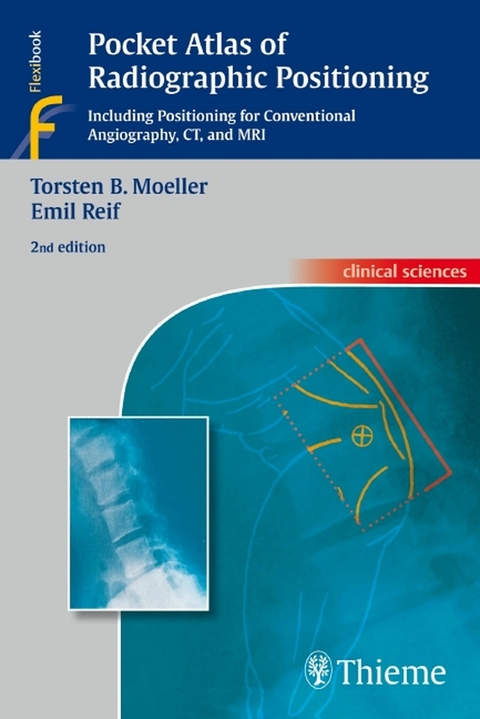
Pocket Atlas of Radiographic Positioning (eBook)
577 Seiten
Thieme (Verlag)
978-3-13-257969-9 (ISBN)
1 Skull
Lines of Projection
a Vertical auricular line (connects the two external auditory meatus, divides skull into two halves)
b Eye–ear line (orbitomeatal line, extends from the outer canthus of the orbit to the external auditory meatus)
c Horizontal infraorbitomeatal line (from the bony inferior orbital rim to the external auditory meatus)
A = Median line
Skull: PA
Criteria for a Good Radiographic View
............................................................................................
– Skull symmetrical and completely visualized
– Skull PA: superior petrous ridge (1) projects into mid-orbit (2)
– Skull AP: superior petrous ridge projects into the lower third of the orbit
– Outer table of the skull visible
Imaging Technique
............................................................................................
Image receiver (e. g., film): size 24 × 30 cm (10 × 12″), portrait
Image receiver dosage (sensitivity class): ≤ 5 μGy (SC 400)
SID: 115 cm (40″)
Bucky: yes (under the table, r 8 [12])
Focal spot size: large (focal spot nominal value: 0.6 [≤ 1.3])
Exposure: 70–85 kV, automatic, center cell
Patient Preparation
............................................................................................
– Remove dentures, glasses; open braids
– Remove jewelry (necklace, earrings, hairpins, glasses, hearing aid)
– Open clothes (buttons, zipper)
Positioning
............................................................................................
– Prone, arms along sides of the body
– Forehead supported on a sponge wedge, tip of the nose rests on the table, chin is flexed (horizontal infraorbitomeatal line is vertical)
– Supine position, head flexed so that the horizontal infraorbitomeatal line is vertical, support the head if necessary
– Tilt tube to align the central ray parallel to the horizontal infraorbitomeatal line, median plane in middle of the film, skull straight
– Head immobilized with weighted band
– Skull filter, “keyhole,” long portion over the region of the cervical spine
– Gonads shielded (large lead apron)
Alignment
............................................................................................
– Projection: (1) PA, or (2) AP, perpendicular to the film at the middle of the skull
– Central ray directed to occipital protuberance at the center of the film
– Centering and collimation, side identification
– No breathing or swallowing during the exposure
Tips & Tricks
............................................................................................
– The skull is straight when both auditory meatus are projected at the same level
Skull: Lateral Projection
Criteria for a Good Radiographic View
............................................................................................
– Complete visualization of the entire skull
– Both temporomandibular joints superimposed
– Lesser and greater sphenoid wings of the two sides superimposed (1)
– Sella linear (2) (no double line)
– Clinoid processes superimposed (3)
Imaging Technique
............................................................................................
Image receiver (e. g., film): size 24 × 30 cm (10 × 12″), landscape
Image receiver dosage (sensitivity class): ≤ 5 μGy (SC 400)
SID: 115 cm (40″)
Bucky: yes (under the table, r 8 [12])
Focal spot size: small (focal spot nominal value: 0.6 [≤ 1.3])
Exposure: 70–80 kV, automatic, center cell
Patient Preparation
............................................................................................
– Remove dentures, glasses, hearing aids, etc.
– Remove jewelry (necklace, earrings, hairpins)
– Open clothes (buttons, zipper)
Positioning
............................................................................................
– Prone (or seated), side of the skull to be examined adjacent to the film
– Upper arm along the side of the body, forearm rests on the table
– Anterior shoulder and chin supported with sponge wedge so that the median plane of the skull is parallel to the film
– Upper border of the cassette 2 FB above the skin line (or simply: middle of the cassette = middle of the skull)
– Skull immobilized with weighted band
– Skull filter
– Gonads shielded (long lead apron)
Alignment
............................................................................................
– Projection: lateral, perpendicular to the film
– Central ray directed to the middle of the skull (about 1 cm above and in front of the external auditory meatus, center of the film)
– Centering and collimation, side identification
– No breathing or swallowing during the exposure
Tips & Tricks
............................................................................................
– Put a pillow wedge under the chest of thin patients and children so that the median sagittal plane of the skull is parallel to the table
Paranasal Sinuses: Occipitomental Projection
Criteria for a Good Radiographic View
............................................................................................
– Both orbits symmetrical (1)
– Superior petrous ridges (3) below antral floors (2)
– Sphenoid sinus (4) projected through the open mouth
Imaging Technique
............................................................................................
Image receiver (e. g., film): size 13 × 18 cm (5 × 7″) or 18 × 24 cm (8 × 10″), portrait
Image receiver dosage (sensitivity class): ≤ 5 μGy (SC 400)
SID: 115 cm (40″)
Bucky: yes (under the table, r 8 [12])
Focal spot size: small/large (focal spot nominal value: 0.6 [≤ 1.3])
Exposure: 70–85 kV, automatic, center cell
Patient Preparation
............................................................................................
– Remove dentures, glasses; open braids
– Remove jewelry (necklace, earrings, hairpins)
– Open clothes (buttons, zipper)
Positioning
............................................................................................
– Facing the film (seated erect)
– Head straight (median sagittal plane perpendicular to the table)
– Head extended backwards so that the chin touches and the tip of the nose is about 1 FB from the vertical cassette
– Mouth wide open
– Extension cone may be used
– Gonads shielded (large lead apron)
Alignment
............................................................................................
– Projection: occipitonasal
– Central ray enters 2 FB above occipital protuberance, emerges at the level of the upper lip (directed at maxillary antrum or inferior orbital rim) in the center of the film
– Centering and collimation, side identification
– No breathing or swallowing during the exposure
Tips & Tricks
............................................................................................
– Before taking the exposure, tape a paper towel to the cassette holder to put chin and mouth against (hygiene)
– If the patient cannot extend the head far enough, have him or her rest it on the chin and nose, move the tube cephalad and angle the central ray correspondingly, craniocaudad (mostly 12°, but possibly up to 30°)
– The cross in the center of the upright Bucky may be used as a centering aid: center of the cross directly below the nose
Paranasal Sinuses: Occipitofrontal (PA) Projection
Criteria for a Good Radiographic View
............................................................................................
– Frontal sinuses completely visualized (1)
– Both superior petrous ridges (2) projected over the upper third of the orbit
Imaging Technique
............................................................................................
Image receiver (e. g., film): size 13 × 18 cm (5 × 7″) or 18 × 24 cm (8 × 10″), portrait
Image receiver dosage (sensitivity class): ≤ 5 μGy (SC 400)
SID: 115 cm (40″)
Bucky: yes (under the table, r 8 [12])
Focal spot size: large (focal spot nominal value: 0.6 [≤ 1.3])
Exposure: 77 kV, automatic, center cell
Patient...
| Erscheint lt. Verlag | 19.11.2008 |
|---|---|
| Sprache | englisch |
| Themenwelt | Medizinische Fachgebiete ► Radiologie / Bildgebende Verfahren ► Radiologie |
| Studium ► 2. Studienabschnitt (Klinik) ► Anamnese / Körperliche Untersuchung | |
| Schlagworte | anatomy • Angiography • Computed tomography • CT • imaging procedures • Magnetic Resonance Imaging • Mammography • MRI • nuclear spin tomography • Positioning • Radiograph • radiograph positioning • X-Ray |
| ISBN-10 | 3-13-257969-6 / 3132579696 |
| ISBN-13 | 978-3-13-257969-9 / 9783132579699 |
| Informationen gemäß Produktsicherheitsverordnung (GPSR) | |
| Haben Sie eine Frage zum Produkt? |
 EPUB (Wasserzeichen)
DRM: Digitales Wasserzeichen
Dieses eBook enthält ein digitales Wasserzeichen und ist damit für Sie personalisiert. Bei einer missbräuchlichen Weitergabe des eBooks an Dritte ist eine Rückverfolgung an die Quelle möglich.
Dateiformat: EPUB (Electronic Publication)
EPUB ist ein offener Standard für eBooks und eignet sich besonders zur Darstellung von Belletristik und Sachbüchern. Der Fließtext wird dynamisch an die Display- und Schriftgröße angepasst. Auch für mobile Lesegeräte ist EPUB daher gut geeignet.
Systemvoraussetzungen:
PC/Mac: Mit einem PC oder Mac können Sie dieses eBook lesen. Sie benötigen dafür die kostenlose Software Adobe Digital Editions.
eReader: Dieses eBook kann mit (fast) allen eBook-Readern gelesen werden. Mit dem amazon-Kindle ist es aber nicht kompatibel.
Smartphone/Tablet: Egal ob Apple oder Android, dieses eBook können Sie lesen. Sie benötigen dafür eine kostenlose App.
Geräteliste und zusätzliche Hinweise
Buying eBooks from abroad
For tax law reasons we can sell eBooks just within Germany and Switzerland. Regrettably we cannot fulfill eBook-orders from other countries.
aus dem Bereich