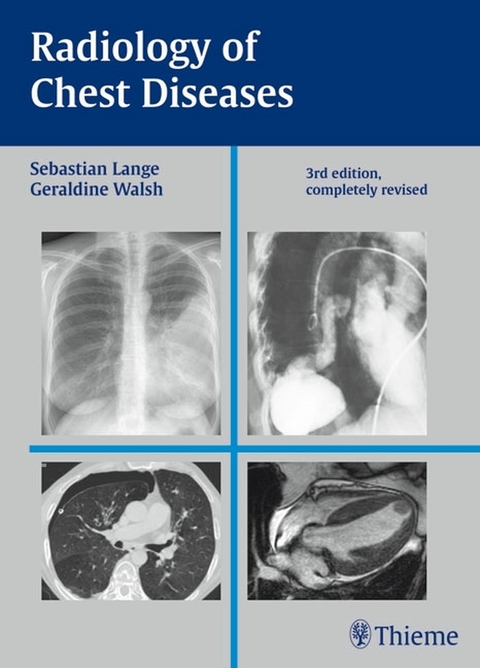
Radiology of Chest Diseases (eBook)
Georg Thieme Verlag KG
978-3-13-257803-6 (ISBN)
Sebastian Lange, Geraldine Walsh
Sebastian Lange, Geraldine Walsh
1 Examination Technique and Normal Findings
Indication and radiation exposure: All radiographic examinations should be medically indicated, and stricter criteria should be applied in selecting patients for thoracic CT—which gives a radiation dose in the range of 6–10 mSv—than for standard chest radiographs where the dosage is much lower at 0.02–0.05 mSv. In addition, the risk of side effects from contrast agents used in CT, angiography, radionuclide imaging, and magnetic resonance imaging (MRI) should always be weighed against the expected gain in diagnostic information.
Use of imaging studies: The frontal posteroanterior (PA) and lateral chest radiographs constitute the basic radiologic examination of the thorax. Radiographs should be acquired at full inspiration in the upright position, although in sick or debilitated patients supine or semisupine anteroposterior (AP) views at functional residual capacity may be the only option.
Plain radiographic findings together with the presumptive clinical diagnosis will determine the need for further imaging studies. In current clinical practice, the most commonly requested second-line imaging investigations are CT, ventilation-perfusion scintigraphy (VQS), and ultrasound. Magnetic resonance imaging increasingly is being used in cardiac/myocardial assessment, and angiography continues to play a role in diagnosis as well as intervention.
Reading: Meticulous image interpretation is important. The “five D's” provide an effective strategy for reading all thoracic imaging procedures: detect, describe, discuss, differential diagnosis, and decide.
The five D's for reading thoracic images
Detect
Describe
Discuss
Differential diagnosis
Decide
Detect: A methodical approach is important in image interpretation. In evaluation of the chest radiograph, the heart size, shape and contour, mediastinal/hilar contour and widening/size, the lungs, pleura, bony and soft tissue structures of the chest wall should be systematically assessed. Review areas include the apices, costophrenic angles, retrocardiac lung, and posterior mediastinum.
Describe and Discuss: If a pulmonary abnormality is detected, it may be assigned to one of the radiographic patterns in Chapter 13.
Differential diagnosis: Good results have been achieved with the “gamut approach” (Reeder and Felson 2003). Just as a musician deliberately strikes each note while practicing scales on a piano, every possible interpretation of a pattern should be considered when reading an image. At the very least, the reader should consider the various main disease categories. These include congenital malformations, inflammatory disorders, chronic obstructive pulmonary disease (COPD), inhalational diseases and pneumoconioses, neoplasia, vascular disorders, and trauma.
Decide: The ultimate goal of imaging is to make a definitive diagnosis. The clinical data frequently are important in making a definitive diagnosis. Sometimes, however, this is not possible and the radiologist can do no more than offer a differential diagnosis in which diagnoses are listed in order of probability. In this case cytology/histology may be required to make a definitive diagnosis.
Disease categories that should be considered in making a differential diagnosis (acronym: Victim)
Vascular disease
Inflammation
Cancer and other tumors
Trauma
Inhalational disease
Malformation
Radiographic Examination
Frontal Chest Radiograph
The upright patient positions his anterior chest against the film cassette (Fig. 1.1a, b). The dorsal aspects of the hands are placed on the hips, and the shoulders are rolled forward to project the scapulae outside the lungs. For better support, weak patients may place their arms around the cassette stand.
Fig. 1.1a–e Chest radiographs in PA and AP projections. a, b Standing PA radiograph. c, d Sitting AP radiograph. e Supine AP radiograph.
The patient wears a short lead apron. The upper border of the cassette is at the level of C7, and 35 × 35 to 40 × 40 cm size film is used, depending on patient size. The roentgen beam is collimated laterally on the skin surface over the lower ribs and is centered on the fourth thoracic vertebra (T4).
The radiograph is taken at full inspiration using, for example, a film-focus distance (FFD) of 185 cm and exposure parameters of approximately 125 kV, 5 mA, or automatic exposure control.
The AP projection is useful for imaging sick patients (Fig. 1.1c, d). Bedridden patients are filmed in the supine position, and internal rotation of the shoulders aids in separating the scapulae (Fig. 1.1e).
Characteristics of a technically acceptable frontal chest radiograph:
The spinous process of T3 is projected midway between the sternoclavicular joints, indicating the absence of chest rotation.
The medial borders of the scapulae project outside the rib cage or touch the lateral aspects of the ribs.
The thorax is completely imaged if the larynx and both costophrenic angles are visible.
The degree of inspiration is adequate if the dome of the diaphragm projects caudal to the posterior part of the 9th rib.
Exposure time is appropriate if the heart, diaphragm, and large pulmonary vessels are sharply defined. Overexposure is excluded if vascular shadows can be seen in the lung periphery.
Underexposure is excluded if the larger lower lobe vessels and the thoracic vertebrae still are visible through the cardiac silhouette.
The technical parameters recommended for chest radiographs are listed in Table 1.1.
Table 1.1 Technical parameters for chest radiographs (Zimmer and Zimmer-Brossy 1992)
| Technical specifications | Grid technique, wall cassette holder |
| Automatic exposure control: |
| • PA | Side chamber |
| • Lateral | Central chamber |
| Film format | 40 × 40 (30 × 40, 35 × 35) |
| Film-screen system | Film speed 400 (200) |
| Focus-film distance | 150–200 cm |
| Kilovoltage | 110–150 kV |
| Exposure: |
| • PA | < 20 ms |
| • Lateral | < 40 ms |
| Scatter reduction grid | r/2(8) |
Lateral Chest Radiograph
The patient, wearing a lead apron, stands sideways against the cassette with arms raised. The roentgen beam is centered approximately 10 cm caudal to the axilla (Fig. 1.2a, b).
The radiograph is taken at full inspiration using film size 30 × 40 or 35 × 35 cm. A FFD of 185 cm and settings of 125 kV, approximately 8 mA, or automatic exposure control are appropriate.
Debilitated patients are radiographed in the sitting position (Fig. 1.2c, d) or, if necessary, in the lateral decubitus position with the head supported, the arms drawn forward and upward, and the legs slightly flexed to improve stability (Fig. 1.2e).
Criteria for a technically acceptable lateral chest radiograph:
The entire lung is visible.
The view is not rotated if the right and left posterior rib margins are superimposed.
The arms are not superimposed on pulmonary structures.
The image is not overexposed if the pulmonary vessels in the retrocardiac space are well defined.
The image is not underexposed if the large pulmonary vessels are visible through the cardiac silhouette.
Fig. 1.2a–e Lateral chest radiographs. a, b Standing lateral radiograph. c, d Sitting lateral radiograph. e Supine lateral radiograph.
Oblique Views
The patient is rotated in the frontal plane to approximately 45° with either the right (right anterior oblique or “fencer” position; Fig. 1.3a) or left anterior chest wall (left anterior oblique or “boxer” position; Fig. 1.3b) in contact with the cassette. The depth of inspiration, film size, FFD, and exposure parameters are the same as for the PA view.
Fig. 1.3a, b Oblique chest radiographs. a Right anterior oblique (fencer) position, b left anterior oblique (boxer) position.
Apical Lordotic View
The patient stands about 4 cm from the chest stand and arches the upper body backward until the shoulders touch the cassette. A FFD of 100 cm and 35–45° of cephalad tube angulation are appropriate. The beam is centered on the manubrium sterni (Fig. 1.4).
A technically acceptable image shows the lung apices projected clear of the scapulae.
Fig. 1.4a, b Apical lordotic views. a Standing, b supine.
Fluoroscopy
Fluoroscopy is used occasionally today and is a valuable adjunct to the chest radiograph. It analyzes...
| Erscheint lt. Verlag | 22.11.2006 |
|---|---|
| Verlagsort | Stuttgart |
| Sprache | englisch |
| Themenwelt | Medizinische Fachgebiete ► Radiologie / Bildgebende Verfahren ► Radiologie |
| Studium ► 2. Studienabschnitt (Klinik) ► Anamnese / Körperliche Untersuchung | |
| Schlagworte | Chest • Diseases • Radiology |
| ISBN-10 | 3-13-257803-7 / 3132578037 |
| ISBN-13 | 978-3-13-257803-6 / 9783132578036 |
| Informationen gemäß Produktsicherheitsverordnung (GPSR) | |
| Haben Sie eine Frage zum Produkt? |
 EPUB (Wasserzeichen)
DRM: Digitales Wasserzeichen
Dieses eBook enthält ein digitales Wasserzeichen und ist damit für Sie personalisiert. Bei einer missbräuchlichen Weitergabe des eBooks an Dritte ist eine Rückverfolgung an die Quelle möglich.
Dateiformat: EPUB (Electronic Publication)
EPUB ist ein offener Standard für eBooks und eignet sich besonders zur Darstellung von Belletristik und Sachbüchern. Der Fließtext wird dynamisch an die Display- und Schriftgröße angepasst. Auch für mobile Lesegeräte ist EPUB daher gut geeignet.
Systemvoraussetzungen:
PC/Mac: Mit einem PC oder Mac können Sie dieses eBook lesen. Sie benötigen dafür die kostenlose Software Adobe Digital Editions.
eReader: Dieses eBook kann mit (fast) allen eBook-Readern gelesen werden. Mit dem amazon-Kindle ist es aber nicht kompatibel.
Smartphone/Tablet: Egal ob Apple oder Android, dieses eBook können Sie lesen. Sie benötigen dafür eine kostenlose App.
Geräteliste und zusätzliche Hinweise
Buying eBooks from abroad
For tax law reasons we can sell eBooks just within Germany and Switzerland. Regrettably we cannot fulfill eBook-orders from other countries.
aus dem Bereich