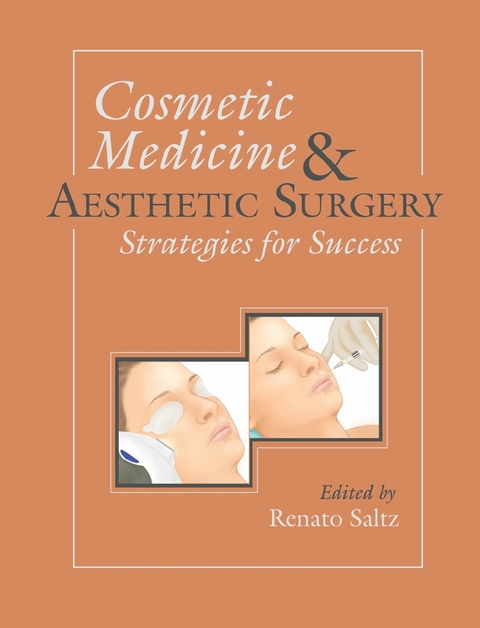
Cosmetic Medicine and Aesthetic Surgery (eBook)
550 Seiten
Thieme Medical Publishers (Verlag)
978-1-63853-595-9 (ISBN)
CHAPTER 1
COSMETIC MEDICINE:
THE WRITING ON
THE WALL
Renato Saltz
It is not the strongest of the species who survive, not the most intelligent, but the one most responsive to change.
CHARLES DARWIN
Seismic changes are shaking up the field of cosmetic surgery and cosmetic medicine. The globalization of beauty, changing demographics, cultural preferences, patient demands, and advances in technology are shaping and transforming the aesthetic marketplace. For plastic surgeons, these developments have a major impact on the way we practice. We face a changing patient population as baby boomers (persons born during the dramatic post–World War II birth rate increase from 1946 through 1964) increasingly seek cosmetic enhancements. There are pressures from the media, the cosmetic industry, and from patients who want optimal results with minimal downtime. These trends mandate change; they require us to reevaluate the way we do business and to grasp the big picture. Today the number of nonsurgical cosmetic procedures performed far exceeds that of traditional surgical procedures.
For plastic surgeons practicing cosmetic surgery in today’s competitive environment, cosmetic medicine offers exciting options for practice growth and patient retention. By incorporating cosmetic medicine into our practices we can appeal to a broader range of patients over the long term. Aesthetic surgery should be seen as a continuum in which nonsurgical cosmetic treatments provide an opportunity to establish a relationship with a patient that will lead to invasive surgical rejuvenation as the patient ages. Thus it is crucial to understand the forces shaping our specialty and to plan the best way to embrace them.
In today’s competitive environment, cosmetic medicine offers exciting options for practice growth and patient retention and an exciting opportunity for appealing to a broader range of patients over the long term.
BEAUTY REVOLUTION
The globalization of beauty has increased the demand for cosmetic enhancement and rejuvenation by individuals throughout the world. This beauty revolution is not limited to the Western world, nor is it reserved for the wealthy and privileged; it includes individuals from all income levels and walks of life. Brazil, Western Europe, Iran, Australia, Russia, the United States—the impact of this revolution is pervasive. Recent trends in Asia demonstrate that cosmetic surgery is rapidly gaining acceptance in mainstream society worldwide. Improved social and economic conditions, shifts in cultural norms, exposure to Western culture through the media, and increased travel have all contributed to this trend in countries worldwide.
The marketplace is establishing new patterns and new cultural outlooks to propel this revolution, in which aesthetics and beauty occupy a much more important position. This demographic and cultural driver is going to increase the practice and volume of business for plastic surgeons, because, as Dr. Jay Ian Morrison, President Emeritus of the Institute for the Future, observed, “The world is becoming old, fat, and vain.”
It is also clear that globalization is helping to transform traditional cultural concepts of beauty, sweeping aside cultural stereotypes that may have favored large, full-bodied, Rubinesque figures in one area of the world, in contrast to tall, slender blondes in another. An international standard of beauty is starting to emerge. Society is developing norms that are reinforced by cultural industries and by multinational corporations through their extensive branding and advertising campaigns. As Thomas Friedman so aptly observed in his book, The World Is Flat, globalization, through increased interaction and integration among societies around the world, is flattening the barriers that separate and often define us. With this flattening, the definition of beauty is becoming standardized as well. The expansion of European and American corporations into new markets and their heavy advertising of their products using beautiful women contribute to this standardization of beauty. Movies and television also project a Western ideal of beauty.
An international standard of beauty is starting to emerge that is reinforced by cultural industries and by multinational corporations through their extensive branding and advertising campaigns.
With wide dissemination of this Western ideal, we also observe that men and women are looking more alike, often aspiring to look more like celebrities. This gradual loss of cultural and racial characteristics is helping to establish a single pattern of beauty. As Dr. Morrison observes, the celebrity appearance has been mainstreamed and has led to the general acceptance of cosmetic enhancement.
A recent worldwide survey of plastic surgeons investigated the influence that celebrities have on the decisions that patients make about their own plastic surgery. interestingly, it was demonstrated that patients often seek to emulate the appearance of celebrities such as Angelina Jolie and Brad Pitt, who have features they want to mimic.
PATIENT DEMOGRAPHICS
Another factor influencing the practice of cosmetic surgery and the interest in cosmetic medicine has been the dramatic change in demographics of patients seeking cosmetic procedures. This is largely a result of baby boomers demanding quick, safe, and effective solutions for reversing the aging process. They realize that more than just plastic surgery is needed when the glow begins to fade and the skin begins to relax. They want real and immediate results that last. They also want to be pampered and taken care of. They want to be educated and continually advised, “This is what’s next.” They accept and want to be part of a maintenance program. Many of today’s patients are not prepared to have surgery—not yet! Thus the appeal of nonsurgical cosmetic treatments and medical spas is obvious; the patients get a short-term fix in an atmosphere that is both soothing and reassuring.
There has been a dramatic change in demographics of patients seeking cosmetic procedures largely as a result of baby boomers demanding quick, safe, and effective solutions for reversing the aging process. Nonsurgical cosmetic treatments and medical spas appeal to this demographic segment.
COSMETIC MEDICINE INDUSTRY
The cosmetic medicine industry is expected to grow 9% per year to a $2.7 billion industry by 2010. Nonsurgical procedures account for 82% of all cosmetic procedures performed. The number of procedures performed is expected to increase to 17.5 million over the same period, with the most rapid growth seen in laser and light therapies, neurotoxin injections, dermal filler injections, and nonablative skin rejuvenation.
With nonsurgical procedures now accounting for most of the cosmetic procedures performed, these noninvasive procedures have been responsible for much of the expansion in the industry in recent years. The numbers are expected to continue to grow as consumers seek less-invasive and more cost-effective solutions to their cosmetic needs. Most women want the “magic pill” to slow down aging and keep them young and beautiful. Although this magic pill does not exist, many patients view nonsurgical cosmetic procedures such as injectables, laser resurfacing, and neurotoxins as acceptable short-term solutions.
Nonsurgical procedures account for most of the cosmetic procedures performed, and they have been responsible for much of the expansion in the industry in recent years.
The incredible growth of cosmetic surgical and nonsurgical procedures was recently documented in a survey published in the journal Plastic and Reconstructive Surgery. This survey reported that cosmetic surgery procedures are projected to exceed 55 million in 2015. The study’s authors analyzed plastic surgery statistics from 1992 through 2005 (from the national clearinghouse of the American Society of Plastic Surgeons statistics) as well as a number of economic and noneconomic variables to predict the volume of cosmetic surgery procedures. They used growth rate analysis to construct models to predict future growth of cosmetic surgery and cosmetic medicine. Not surprisingly, the study found that the growth in cosmetic surgery in the next decade would continue to be driven by the demand for nonsurgical procedures. Between 1992 and 2005, the compound annual growth rate was 7.5% for surgical procedures and 27.9% for nonsurgical procedures. In 2005, 34% of procedures performed by board-certified plastic surgeons were surgical and 66% were nonsurgical. In 2005, 9.5% of procedures performed by non-board-certified physicians were surgical, whereas 90.5% were nonsurgical.
THE ROLE OF MEDICAL SPAS
Medical spas are also a rapidly growing segment of the marketplace. Although there were only 750 medical spas in 2004, that number grew to 2500 facilities in 2006. Medical spas are an ideal venue for hosting the range of nonsurgical services that compose cosmetic medicine. A recent survey of 1000 women by the American Academy of Cosmetic Surgery revealed that women between the ages of 18 and 34 were more than three times as likely as women aged 35 to 64 to have noninvasive cosmetic procedures, such as Botox injections, performed at a medical spa.
Another survey conducted by the Cosmetic Medicine Task Force surveyed 1015 women who had undergone a cosmetic procedure or were considering having one within 2 years. of these...
| Erscheint lt. Verlag | 31.5.2009 |
|---|---|
| Sprache | englisch |
| Themenwelt | Medizin / Pharmazie ► Medizinische Fachgebiete ► Chirurgie |
| Medizin / Pharmazie ► Medizinische Fachgebiete ► Dermatologie | |
| ISBN-10 | 1-63853-595-7 / 1638535957 |
| ISBN-13 | 978-1-63853-595-9 / 9781638535959 |
| Informationen gemäß Produktsicherheitsverordnung (GPSR) | |
| Haben Sie eine Frage zum Produkt? |
 EPUB (Wasserzeichen)
DRM: Digitales Wasserzeichen
Dieses eBook enthält ein digitales Wasserzeichen und ist damit für Sie personalisiert. Bei einer missbräuchlichen Weitergabe des eBooks an Dritte ist eine Rückverfolgung an die Quelle möglich.
Dateiformat: EPUB (Electronic Publication)
EPUB ist ein offener Standard für eBooks und eignet sich besonders zur Darstellung von Belletristik und Sachbüchern. Der Fließtext wird dynamisch an die Display- und Schriftgröße angepasst. Auch für mobile Lesegeräte ist EPUB daher gut geeignet.
Systemvoraussetzungen:
PC/Mac: Mit einem PC oder Mac können Sie dieses eBook lesen. Sie benötigen dafür die kostenlose Software Adobe Digital Editions.
eReader: Dieses eBook kann mit (fast) allen eBook-Readern gelesen werden. Mit dem amazon-Kindle ist es aber nicht kompatibel.
Smartphone/Tablet: Egal ob Apple oder Android, dieses eBook können Sie lesen. Sie benötigen dafür eine kostenlose App.
Geräteliste und zusätzliche Hinweise
Buying eBooks from abroad
For tax law reasons we can sell eBooks just within Germany and Switzerland. Regrettably we cannot fulfill eBook-orders from other countries.
aus dem Bereich