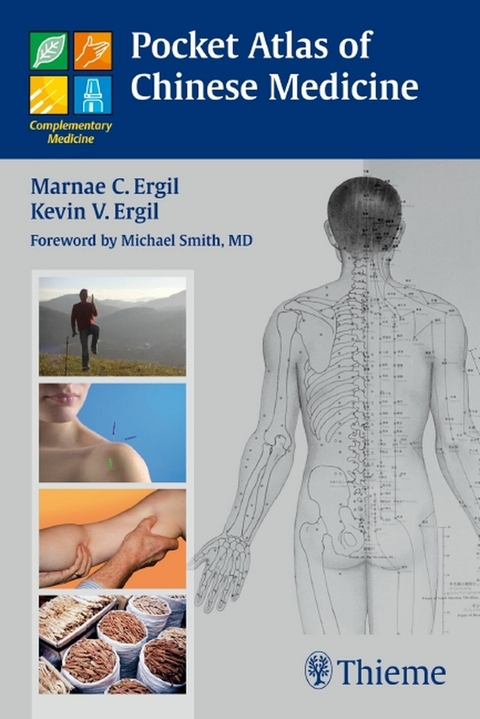
Pocket Atlas of Chinese Medicine (eBook)
Thieme (Verlag)
978-3-13-257986-6 (ISBN)
2
Fundamental Theory of Chinese Medicine
Kevin V. Ergil
The Four Cycles of the Five Phases
Qi, Blood, Fluids, Essence, and Spirit
The Pathology of Qi, Blood, and Body Fluids
The Eight Extraordinary Vessels
The Spleen, Stomach, and Intestines
The Kidney and Urinary Bladder
Development, Reproduction, and Aging
External Causes: The Six Evils
Internal Causes: The Seven Affects
Neither Internal Nor External Causes
The Healthy Body as an Orderly Landscape
Introduction
When students in colleges of Traditional Chinese Medicine begin their studies, one of their first courses addresses what is called “Fundamental Theory” (). This course presents the core theoretical models that underlie every aspect of Traditional Chinese Medicine practice. It is intriguing to note that, while these courses are taught in modern classrooms to students who graduate to practice in hospital settings furnished with conventional biomedical diagnostic and therapeutic resources, every element of the course can be directly mapped onto the 2000 years of Chinese medical practice and scholarship that precedes this modern age.
The reorganization of traditional medical education by the Marxist-Maoist educators of the 1950s made it possible to systematically educate thousands of young men and women as TCM physicians. However, the basis for this educational program was and is the classic texts of Chinese medicine, such as The Yellow Emperor's Classic of Medicine, On Cold Damage, and others.
This chapter presents the core ideas of Chinese medicine: yin and yang, the five phases, the bodily substances (qi, blood, essence, and fluids), spirit, the channels, the viscera and bowels, the extraordinary organs, the triple burner, and the causes of disease. The Chinese medicine understanding of an embodied mind is discussed as well. These ideas are essential to understanding all aspects of Chinese medicine diagnosis and treatment. In some cases these ideas will seem easy enough to grasp at once; in other cases these ideas will re-emerge with greater clarity in later chapters.
Fundamental Theory (see A for an outline) is just that, fundamental. As we begin our discussion of yin and yang, and as the ideas strike us as at once simple and profound we may confuse the ease with which we understand these ideas with mastery. I have frequently experienced lectures presented by senior teachers of Chinese medicine who, in teaching their colleagues, begin with a recapitulation of such fundamental ideas: yin and yang, the natural rhythm of sun and shade, or hot and cold. Chinese members of the audience listen carefully; others often listen carelessly, wondering why such basic ideas are being recapitulated to an audience that must already know them well. What the scholars and senior clinicians know, and the neophytes do not, is that the deeper truths of the core theory of Chinese medicine reveal themselves only through years of application and experience.
As a former student once said to me as we sat on a park bench together and admired the spring weather: “When I began my studies, yin and yang were simply words to understand, now everywhere I look I see that the interplay of yin and yang and the five phases surround me on every side.”
| Fundamental Theory Outline | Topics Discussed |
| Yin and yang | • Yin and yang in medicine |
| The five phases | • The four cycles of the five phases |
| Qi, blood, fluids, essence, and spirit | • Qi • Blood and fluids • Essence and spirit • The pathology of qi, blood, and body fluids |
| The channels | • The eight extraordinary vessels |
| Viscera and bowels | • The heart and pericardium • The lung • The spleen, stomach, and intestines • The liver and gallbladder • The kidney and urinary bladder • The triple burner • The extraordinary organs • Development, reproduction, and aging |
| The three causes of disease | • External causes: the six evils • Internal causes: the seven affects • Neither internal nor external causes |
| The healthy body as an orderly landscape |
|
A Fundamental Theory outline: topics discussed in this chapter.
Yin and Yang
Yin and yang express the idea that any given phenomenon can be understood to exist in balance in relation to a given complementary phenomenon. These phenomena then exist in a state of dynamic equilibrium. From alterations in that dynamic relationship, different conditions arise. As was discussed in Chapter 1, the idea of yin and yang was first expressed with the image of the contrasting climates of sunny and shady hillsides. Imagine, for a moment, the different environments that exist on either side of that hill: on the bright, sunny side, plants and animals that enjoy light are more prevalent, the air is drier, and the rocks are warm; on the dim, shaded side, the air is moist and cool, animals take refuge from the heat of the day. Yin and yang exist in relationship (A, see also p. 20).
Yin phenomena are characterized as moist, cool, passive, nurturing, interior, dark, and deep, while yang phenomena are warm, active, consuming, exterior, light, and superficial. Yin and yang are used to describe the cycle of the seasons, the cycle of a day as it moves from dawn to dusk and then to dawn again, the viscera and bowels, and the acupuncture channels.
This type of analysis depends on the continuously divisible nature of yin and yang. The cycle of the seasons can be analyzed in this way (B). Summer is yang within yang, fall is yin within yang, winter is yin within yin, and spring is yang within yin. Thus, the coldest, darkest, and most yin period is yin within yin, whereas spring, when the yang begins to emerge from the yin,is yang within yin.
A world that is seen through the lens of yin and yang is seen in ecological perspective: each phenomenon is seen in relation to its surroundings, and it is expected that each phenomenon will exert upon, and receive from its surroundings, influences that can be understood in yin and yang terms. “Just as the language of ecology is the language of interrelation and interdependence, the language of Chinese medicine is a language of interrelation and interdependence. The external landscape, or human environment, is understood to be in profound and dynamic relationship with the internal landscape, or human organism” (Ergil 2006, p. 384).
Human beings have a nature and structure inseparable from yin and yang and as such are inseparable from the world around them. Every aspect of life partakes of a yin or a yang aspect. Understanding of this fact and living life in accord with yin and yang supports life itself. According to the ancient physician-sages, “To follow (the laws of) yin and yang means life; to act contrary (to the laws of yin and yang) means death” (Huang Di Nei Jing Su Wen Chapter 2 in Unschuld 1988, p. 13).
| Yang | Yin |
| South side of a hill | North side of a hill |
| North side of a river | South side of a river |
| 3, 7, 9 | 2, 6,... |
| Erscheint lt. Verlag | 22.4.2009 |
|---|---|
| Sprache | englisch |
| Themenwelt | Medizin / Pharmazie ► Naturheilkunde |
| Schlagworte | acupuncture • acupuncture and chinese medicine • acupuncture Microsystems • acupuncture research • Basics • CAM • channel and network theory • Channels • channel theory • Chinese dietetics • chinese dynasties • Chinese Herbal Medicine • chinese herbs • chinese massage • Chinese Medicine • chinese medicine history • chinese medicine research • complementary medicine • Diagnosis • diagnosis chinese medicine • Dietetics • Eastern medicine • five phases • four examinations • fundamental theory chinese medicine • german acupuncture studies • history of chinese medicine • how it works • medicine modern china • Nutritional Therapy • Oriental medicine • origin • pattern diagnosis • point selection strategies • Practice • Qi Gong • Research • research findings • Taiji • Tai Ji Quan • TCM • theory chinese medicine • tongue diagnosis • Traditional Chinese Medicine • traditional chinese pharmacotherapy • Tui Na • Yin and Yang |
| ISBN-10 | 3-13-257986-6 / 3132579866 |
| ISBN-13 | 978-3-13-257986-6 / 9783132579866 |
| Informationen gemäß Produktsicherheitsverordnung (GPSR) | |
| Haben Sie eine Frage zum Produkt? |
 EPUB (Wasserzeichen)
DRM: Digitales Wasserzeichen
Dieses eBook enthält ein digitales Wasserzeichen und ist damit für Sie personalisiert. Bei einer missbräuchlichen Weitergabe des eBooks an Dritte ist eine Rückverfolgung an die Quelle möglich.
Dateiformat: EPUB (Electronic Publication)
EPUB ist ein offener Standard für eBooks und eignet sich besonders zur Darstellung von Belletristik und Sachbüchern. Der Fließtext wird dynamisch an die Display- und Schriftgröße angepasst. Auch für mobile Lesegeräte ist EPUB daher gut geeignet.
Systemvoraussetzungen:
PC/Mac: Mit einem PC oder Mac können Sie dieses eBook lesen. Sie benötigen dafür die kostenlose Software Adobe Digital Editions.
eReader: Dieses eBook kann mit (fast) allen eBook-Readern gelesen werden. Mit dem amazon-Kindle ist es aber nicht kompatibel.
Smartphone/Tablet: Egal ob Apple oder Android, dieses eBook können Sie lesen. Sie benötigen dafür eine kostenlose App.
Geräteliste und zusätzliche Hinweise
Buying eBooks from abroad
For tax law reasons we can sell eBooks just within Germany and Switzerland. Regrettably we cannot fulfill eBook-orders from other countries.
aus dem Bereich