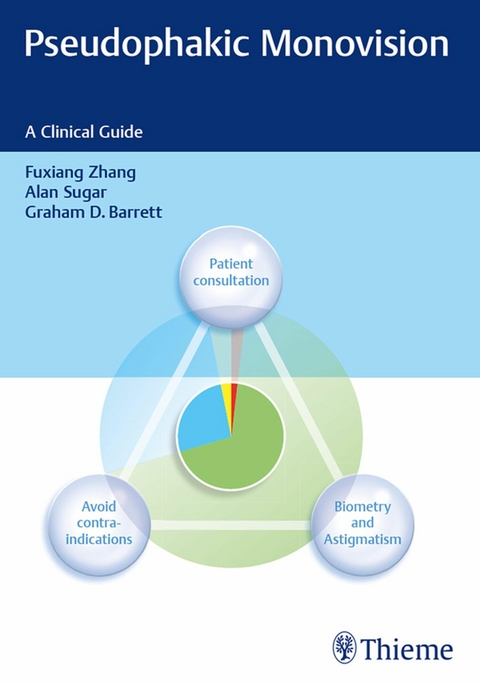
Pseudophakic Monovision (eBook)
102 Seiten
Georg Thieme Verlag KG
978-1-63853-568-3 (ISBN)
1 Introduction
Abstract
Presbyopic patients spend money and time to have contact lens monovision or laser vision correction monovision. So why do we cataract surgeons not use intraocular lenses (IOLs) more often to create monovision? For a cataract patient with a desire for spectacle independence after surgery, there are different ways to create monovision. If it were like buying a car, where the prospective buyers can try different models before they make a choice, then IOL monovision might be favored by many more, if not the vast majority of patients, due to the quality of vision from monofocal lenses, low cost, convenience of back up of glasses if needed, and close to negligible downsides.
Monovision as a method of prescribing optical aids was first proposed in 1958 by Richard West-smith. The first clinical report was from Fonda in 1966. The first known IOL monovision paper was published by Boerner and Thrasher in 1984. IOL monovision is now the most common surgical management of presbyopia for cataract patients. IOL monovision not only can meet patient needs for spectacle independence, but can also build up one’s surgical practice and lay a strong foundation for premium IOL refractive cataract surgery. Integrating IOL monovision into premium IOL practice is very helpful or even essential for successful premium refractive cataract surgery. Crossed IOL monovision can be used to rescue one’s outcome when the first eye refractive target is missed with accommodative and extended depth of focus IOLs.
Keywords: IOL monovision, pseudophakic monovision, refractive cataract surgery, premium IOL and IOL monovision, clinical outcome of IOL monovision, nighttime driving and monovision, depth perception and monovision, patient satisfaction and monovision, pseudophakic monovision book, IOL monovision book
1.1 Introduction
Monovision is a term used when one eye is intentionally corrected for far and the fellow eye for near. Monovision is a misnomer. It gives the impression of using one eye only or that the two eyes do not work together. The name itself potentially can be a barrier, preventing some patients from considering it as a presbyopia management modality. Blended vision may be a better term. When both eyes work together, monovision provides increased depth of focus but maintains good binocular vision with decreased spectacle independence.
1.2 Why This Book Was Written?
1.2.1 Killing Two Birds with One Stone
People who do not want to wear reading glasses, or cannot wear bifocals, may intentionally use monovision with contact lenses, or may spend thousands of dollars to have laser corneal refractive surgery correction with monovision. Many studies in the literature have demonstrated its validation. Why then do we not use intraocular lenses (IOLs) more often for monovision, one stone killing two birds, when we do cataract surgery? That is the rationale for IOL monovision.
1.2.2 One of the Most Popularly Used Modalities
Increasingly, premium IOLs have become available in the last two decades with the same goal of increasing spectacle independence after cataract surgery, and most of them do well with high patient satisfaction. IOL monovision, however, still stands out with quality of vision, easy adaptation, fewer complications, and less out-of-pocket cost for patients. Modest monovision continues to be an attractive presbyopic solution and, in our opinion, should be considered a “premium” solution. It requires expert surgery, lens selection, and the utilization of toric implants or corneal incisions to reduce astigmatism. From a surgeon’s perspective, myopic defocus is one of the two bases of refractive cataract surgery, as expressed in the pyramid scheme in Fig. 1.1. From a patient perspective, choosing the type of IOL is not like buying a car, where one can try different models and then pick the best. No one will argue that monovision is perfect, with compromises such as fine stereovision, but the truth is that in real life, the negative impact is minimal. (See the section “What Benefits Can IOL Monovision Bring to Your Practice?”)
Before we have an ideal accommodating IOL, IOL monovision is still one of the best choices, if not the best, in the management of presbyopia among the cataract population. IOL monovision was the number one modality for the management of presbyopia in cataract surgery according to the 2013 ASCRS clinical survey.1 What is more, the trend of choosing IOL monovision increased between 2013 and 2014.2
Fig. 1.1 The two main components of refractive cataract surgery. (Courtesy of Alcon Laboratories, Inc., Fort Worth, TX, USA, 2016 AAO Meeting in Chicago, IL.)
1.2.3 Residency Education
Most ophthalmology residencies in the United States and the rest of world do not provide formal training for monovision. IOL monovision may not be easy to adopt if one never intentionally has tried it, even though he or she might be a very experienced cataract surgeon. The questions we sometimes get are “How do you know who are good candidates and who are not?” “How much anisometropia should I target?” “What are the contraindications?” From our own learning curve in the practice of IOL monovision, we wished there was a book available which could have provided us some suggestions, pearls, and pitfalls so that we did not have to learn many lessons the hard way.
1.2.4 Making One’s Surgical Practice Prosperous
A surgeon who does a large proportion of pseudophakic monovision in cataract surgery for those who desire glasses independence can be expected to have a busy and happy, no-advertisement-needed, prosperous practice, mainly from word of mouth of satisfied patients.
The above are the four main reasons why this book was written. To our knowledge, this is the first book exclusively designated to address IOL monovision.
1.3 A Brief History of Monovision
Monovision as a method of prescribing optical aids was first proposed in 1958 by Richard Westsmith, MD, of San Mateo, California, for presbyopic monocular contact lens wearers.3 In his paper, he revealed that he had a contact lens of + 1.50 D for his own left eye for reading. He did not need any correction for distance with a vision of 20/20 in each eye. He was unable to tolerate a bifocal for his office work. With monocular contact lens monovision, Westsmith experienced “I have had the contact lens about a month now and I find that I am able to wear it comfortably all day and I have complete clarity of near vision. I am undisturbed by the slight blur in my left eye at distance. With the corneal lens in place, my vision in the left eye is 20/50. However, with both eyes I am able to read J1 at 18 inches. There is no trouble with the ophthalmoscope, retinoscope, or slit lamp.”
The first clinical report was from Fonda in 1966 with 13 cases of monovision corrected by spectacles and contact lenses.4 He also described himself as a monovision user. “I have been wearing a + 3.00 D reading addition before my right eye, and a + 1.50 D reading addition before my left eye for two years. I adjusted immediately to this difference, which does not affect my reading comfort regardless of the circumstances or duration of reading. I can wear a + 2.50 reading addition before one eye and no addition before the other. I have worn a + 2.50 D reading addition before both my dominant left eye and nondominant right eye on different occasions which was accepted equally well. I was conscious of the new correction for less than four hours. I never experienced diplopia, and evidenced fusion by the four-dot test and the Wirt stereo-quantitative test.”
The first known pseudophakic monovision paper was published by Boerner and Thrasher in 1984.5 In that study, among the 100 IOL monovision patients, the need to have bifocals after the surgery decreased 50%. And IOL monovision is now the most common surgical management of presbyopia for cataract patients.1,2
For the last half century, monovision has been increasingly used for presbyopia management with an impressive success rate. There are different ways to provide monovision: spectacles, contact lenses, refractive lasers, intraocular implants, etc. This book concentrates on the discussion of IOL monovision, or pseudophakic monovision, but at the same time, other methods will be briefly discussed, since most of the monovision studies in the literature were with contact lens and laser vision correction. IOL monovision is barely discussed in the literature considering how widely it is used in our profession.
1.4 What Benefits Can Pseudophakic Monovision Bring to Your Practice?
1.4.1 To Meet Patients’ Needs
We used to be satisfied with regular telegraphy and then telephones, but now we are happier with smart phones and the internet. Science and technology will continue to advance. Cataract surgery was simply a vision rehabilitation procedure a few decades ago, but it is not so any more. Just from a spectacle independence point of view, our clinical survey (all the 441 cataract patients’ 697 eyes in 2016) noted that 44% of our cataract patients would like to have some level of freedom from glasses and nearly one-fourth would like to have complete glasses independence. If financial factors were not considered, these percentages would be expected to be much higher.
1.4.2 To Build Up Practice
About 10 years ago, one of my junior staff members called me (F. Z.) at home. He was wondering why his practice was not as busy since he had joined our health...
| Erscheint lt. Verlag | 23.1.2019 |
|---|---|
| Sprache | englisch |
| Themenwelt | Medizin / Pharmazie ► Medizinische Fachgebiete ► Augenheilkunde |
| Schlagworte | Cataract Surgery • distance vision • eye dominance • Intraocular lens monvision • near vision • ophthalmologic surgery • Ophthalmology • pseudophakic lens • refraction • vision testing |
| ISBN-10 | 1-63853-568-X / 163853568X |
| ISBN-13 | 978-1-63853-568-3 / 9781638535683 |
| Informationen gemäß Produktsicherheitsverordnung (GPSR) | |
| Haben Sie eine Frage zum Produkt? |
 EPUB (Wasserzeichen)
DRM: Digitales Wasserzeichen
Dieses eBook enthält ein digitales Wasserzeichen und ist damit für Sie personalisiert. Bei einer missbräuchlichen Weitergabe des eBooks an Dritte ist eine Rückverfolgung an die Quelle möglich.
Dateiformat: EPUB (Electronic Publication)
EPUB ist ein offener Standard für eBooks und eignet sich besonders zur Darstellung von Belletristik und Sachbüchern. Der Fließtext wird dynamisch an die Display- und Schriftgröße angepasst. Auch für mobile Lesegeräte ist EPUB daher gut geeignet.
Systemvoraussetzungen:
PC/Mac: Mit einem PC oder Mac können Sie dieses eBook lesen. Sie benötigen dafür die kostenlose Software Adobe Digital Editions.
eReader: Dieses eBook kann mit (fast) allen eBook-Readern gelesen werden. Mit dem amazon-Kindle ist es aber nicht kompatibel.
Smartphone/Tablet: Egal ob Apple oder Android, dieses eBook können Sie lesen. Sie benötigen dafür eine kostenlose App.
Geräteliste und zusätzliche Hinweise
Buying eBooks from abroad
For tax law reasons we can sell eBooks just within Germany and Switzerland. Regrettably we cannot fulfill eBook-orders from other countries.
aus dem Bereich