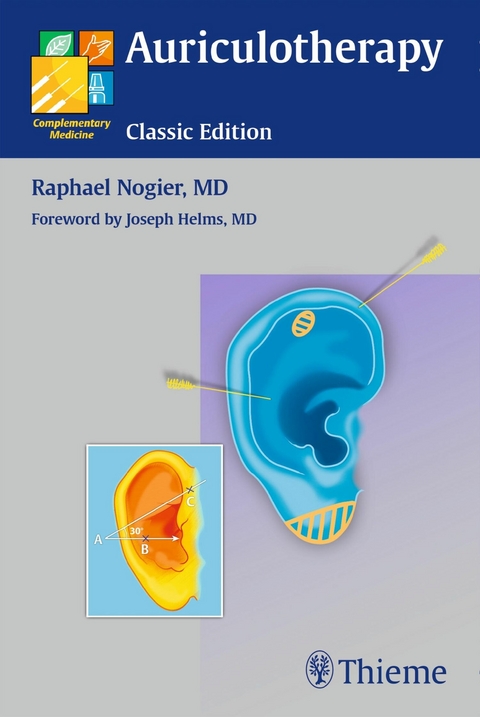
Auriculotherapy (eBook)
Georg Thieme Verlag KG
978-3-13-257942-2 (ISBN)
Auriculotherapy in Medicine
The three factors determining health are:)
- The way people live, which is culturally determined
- Hygiene
- Medicine, whose beneficial contribution is especially important during the perinatal period
Disorders are mainly caused by:
- The way people live—road traffic accidents, heart attacks, tuberculosis, hepatitis, acquired immune deficiency syndrome (AIDS), etc. These disorders are managed by the teaching or community hospitals.
- Repression of natural instincts—functional disorders, bulimia, anorexia, disorders of sexuality, depression, etc. These disorders are treatable by alternative modalities.
Fig. 2 The effects of cultural conditioning on health and medicine.
The Two Types of Ear Points
The concept of auriculotherapy is based on an understanding of the nature of the points.
It seems that on the ear there are two kinds of points:
1. Points linked directly to the nervous system (the pressure points)
These points are located with a pressure probe, and are painful when an organ is diseased.
In therapy, the points are treated with needles or massage (see Figs. 3a, b).
2. Neurohumoral-type points
These points are located by electrodetection and they are formed by specific structures—the neurovascular complexes.1–3
These points are treated with infrared lasers (see Fig. 3c).
Fig. 3a–c
a A disorder in the body generates a pathological zone or point on the ear.
b Using the pain response to locate a pathological point on the ear (pressure probe).
c Using the Diascope to locate a pathological point on the ear (locating the neurovascular complexes).4
Points Linked Directly to the Nervous System: Reflex Points
These points are painful on pressure when a corresponding organ or region of the body is painful. This phenomenon is explained by the way in which the nervous system is organized.
The points on the ear are linked to various regions of the body through the spinothalamic and reticular systems. If a peripheral zone is distressed, the corresponding point on the ear point becomes sensitive, i.e., painful under pressure.
These reflex points are used to provide pain relief.
Fig. 4a, b
a Neurological basis of auricular reflex points.
b Locating sensitive ear points: The “grimace” sign.4
Neurohumoral-Type Points: the Neurovascular Complexes
J. E. H. Niboyet (1963) determined that:
- On the surface of the skin there are points of lower cutaneous electrical resistance (CER).
- These points are independent of skin secretions since they can be observed even after the skin has been thoroughly cleaned with a solution of alcohol, ether, and acetone.
- They correspond to acupuncture points described in Chinese medicine and can be detected on the body in living persons as well as cadavers.
From the work of Sénélar, Auziech, and Terral (1970–1980)
These authors studied the ear points with lower CER in humans and rabbits, and examined them under optical microscopy.
They have found specific histologic features under the points of lower CER, combining:
- An arteriole
- A venule
- A lymphatic vessel
- A free nerve ending
Myelin-sheathed nerve fibers are distributed among the vascular elements and may come into close proximity to the vascular structures.
This coexistence of nerves and thin-walled vessels in close proximity is not a random structuring, and we should note the release of hormonal or related factors by endocrine constituents following stimulation of the points. These formations are called neurovascular complexes.
- The neurohormonal points are detected by the use of instruments that measure variations in electrical resistance.
- They are detectable when there are peripheral functional disorders.
- These points can be treated by laser therapy.
- Some authors 5,6 have hypothesized that the neurovascular complexes have an active role in organ thermoregulation.
Fig. 5a, b Example of an ear “point” (magnified approximately × 300).
[Reference 6, with permission of the author].
a E = Epidermis
D = Dermis
M = China ink
C = Auricular cartilage
CNV = Neurovascular complexes are consistently found in the tissue substrate below the points used in auriculotherapy (v, venule; a, arteriole; ly, lymphatic vessel; n, cutaneous nerve). The neurovascular structures have a relatively constant pattern.
b Using the Diascope to locate a pathological point on the ear (locating the neurovascular complexes).4
Anatomy of the Ear
Fig. 6 a–e Anatomy of the external ear.
Innervation of the Ear
There are four distinct zones on the external ear:
- The central concha—innervated by the parasympathetic fibers of the vagus nerve.
- The middle auricle—innervated by the mandibular branch of the trigeminal nerve (sympathetic fibers).
- The helical-lobular region—innervated by the superficial cervical plexus (mixed innervation).
- The tragal region—mixed innervation.
Fig. 7 Innervation of the ear according to J. Bossy,7 by permission of the author.
Representation of the Organs on the Ear
The somatotopy of the ear is logical:
- In the center, the concha, innervated by the vagus nerve, contains the point locations of the tissues derived from the endoderm.
- In the middle region, the antihelix and a part of the helix innervated by the trigeminal nerve, contain the point locations of the tissues derived from the mesoderm.
- In the peripheral area, a part of the helix and the lobe innervated by the superficial cervical plexus contain the point locations of the tissues derived from the ectoderm.
Fig. 8a, b
a Auricular locations (Paul Nogier, 1977).
b The auricle and the corresponding fetal image (Paul Nogier, 1969).
Representation of the Vertebral Column
- The spine is represented on the antihelix.
- The vertebral bodies are represented on the antihelix ridge.
- The muscles and ligaments of the spine are represented on the exterior aspect of the antihelix.
- The sympathetic chain is represented on the antihelix wall.
Fig. 9a, b Point locations of the limbs and the spinal column on the ear.
Ear Locations
- Mesodermic
- Endodermic
- Ectodermic
Mesodermic Tissues
Fig. 10a, b Locations (Paul Nogier, 1987).
a Mesoderm: visible locations.
b Mesoderm: hidden locations.
Endodermic Tissues
Fig. 11a, b Locations (Paul Nogier, 1987).
a Endoderm: visible locations.
b Endoderm: hidden locations.
Ectodermic Tissues
Fig. 12a, b Locations (Paul Nogier, 1987).
a Ectoderm: visible locations.
b Ectoderm: hidden locations.
Other Locations
Some points on the ear have a general effect. These points are known as master points.
- They are detectable mainly by means of electrodetection.
- They are best treated by infrared laser stimulation.
- Some organs are represented at more than one location on the ear. This is accounted for by the phase theory introduced by Paul Nogier in 1981. (See “Paul Nogier's Phase Theory,” p. 106.)
Fig. 13 Locations of some master points (Paul Nogier, 1987).
Methods of Point Detection
Pressure (Pain) Detection
Technique:
- Palpation by hand. The patient is lying on a table. The physician sits behind the patient and palpates both ears, searching for painful areas.
- Eliciting the “grimace” sign using a 250 g (blue) pressure probe.
Indications:
Indications for use of the pressure (pain) detection technique are peripheral disorders such as:
- Osteoarthritis
- Low back pain
- Gout (acute)
- Neuralgias
Fig. 14 Searching for points using a pressure probe.4
Electrodetection
Technique:
The procedure consists of locating a neurovascular complex in a pathological state. The instruments (punctoscope or electrodetector and stimulator [Agiscop DT]) utilize a differential measurement technique.
The instrument measures:
- Skin resistance in the area surrounding point R1
- Resistance of point R2
- Resistance of the hand (RH)
Fig. 15 Diagrammatic representation of an electrodetector.
When the relationship (RH–R1)/(RH–R2) varies from a value of 1, it indicates a drop in resistance at the...
| Erscheint lt. Verlag | 10.9.2008 |
|---|---|
| Sprache | englisch |
| Themenwelt | Medizin / Pharmazie ► Medizinische Fachgebiete |
| Medizin / Pharmazie ► Naturheilkunde | |
| Schlagworte | ACR • anatomy of ear • auricual cardiac reflex • auricular acupuncture • auricular microsystem • auriculomedicine • auriculotherapy • cutaneous photoperception • Ear Acupuncture • ear locations • ear points • ectodermic • electro-conductivity • Electromagnetic Signature • endodermic • External Ear • indications auriculotherapy • internal ear • joseph helms • mesodermic • neurovascular complex • nogier frequencies • Phase Theory • point detection • posterior ear • principles of auriculomedicine • radiant light frequencies • reflex points • VAS • vascular autonomic signal • viscerosomatic |
| ISBN-10 | 3-13-257942-4 / 3132579424 |
| ISBN-13 | 978-3-13-257942-2 / 9783132579422 |
| Informationen gemäß Produktsicherheitsverordnung (GPSR) | |
| Haben Sie eine Frage zum Produkt? |
 EPUB (Wasserzeichen)
DRM: Digitales Wasserzeichen
Dieses eBook enthält ein digitales Wasserzeichen und ist damit für Sie personalisiert. Bei einer missbräuchlichen Weitergabe des eBooks an Dritte ist eine Rückverfolgung an die Quelle möglich.
Dateiformat: EPUB (Electronic Publication)
EPUB ist ein offener Standard für eBooks und eignet sich besonders zur Darstellung von Belletristik und Sachbüchern. Der Fließtext wird dynamisch an die Display- und Schriftgröße angepasst. Auch für mobile Lesegeräte ist EPUB daher gut geeignet.
Systemvoraussetzungen:
PC/Mac: Mit einem PC oder Mac können Sie dieses eBook lesen. Sie benötigen dafür die kostenlose Software Adobe Digital Editions.
eReader: Dieses eBook kann mit (fast) allen eBook-Readern gelesen werden. Mit dem amazon-Kindle ist es aber nicht kompatibel.
Smartphone/Tablet: Egal ob Apple oder Android, dieses eBook können Sie lesen. Sie benötigen dafür eine kostenlose App.
Geräteliste und zusätzliche Hinweise
Buying eBooks from abroad
For tax law reasons we can sell eBooks just within Germany and Switzerland. Regrettably we cannot fulfill eBook-orders from other countries.
aus dem Bereich