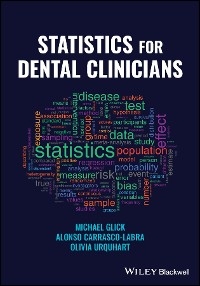
Statistics for Dental Clinicians (eBook)
John Wiley & Sons (Verlag)
978-1-119-81018-6 (ISBN)
Enables clinicians to understand how biostatistics relate and apply to dental clinical practice??
Statistics for Dental Clinicians??helps dental practitioners to understand and interpret the scientific literature and apply the concepts to their clinical practice. Written using clear, accessible language, the book breaks down complex statistical and study design principles and demonstrates how statistics can inform clinical practice.
Chapters cover the basic building blocks of statistics, including clinical study designs, descriptive and inferential statistical concepts, and interpretation of study results, including differentiating between clinical and statistical significance. An extensive glossary of statistical terms, as well as graphs, figures, tables, and illustrations are included throughout to improve reader comprehension. Select readings accompany each chapter.??
Statistics for Dental Clinicians??includes information on:??
- How to understand and interpret the scientific language used in the biomedical literature and statistical concepts that underlie evidence-based dentistry
- What is statistics and why do we need it, and how to effectively apply study results to clinical practice
- Understanding and interpreting standard deviations, standard errors, p-values, confidence intervals, sample sizes, correlations, survival analyses, probabilistic-based diagnosis, regression modeling, and patient-reported outcome measures
- Understanding and interpreting absolute risks, relative risks and odds ratios, as well as randomized controlled trials, cohort studies, case-control studies, cross-sectional studies, meta-analysis, bias and confounding
With comprehensive coverage of a broad topic, written using accessible language and shining light on statistical complexity often found in writings related to clinical topics, Statistics for Dental Clinicians??is an essential guide for any dental practitioner wishing to improve their understanding of the biomedical literature.
The authors
Michael Glick, DMD, FDS RCSEd, is Professor of Oral Medicine and Executive Director, Center for Integrative Global Oral Health in the School of Dental Medicine at the University of Pennsylvania in Philadelphia, Pennsylvania, USA.
Alonso Carrasco-Labra, DDS, MSc, PhD, is an Associate Professor in the Department of Preventive & Restorative Sciences and Director, Cochrane Oral Health Collaborating Center at Penn Dental Medicine, Center for Integrative Global Oral Health in the School of Dental Medicine at the University of Pennsylvania in Philadelphia, Pennsylvania, USA.
Olivia Urquhart, MPH, is an Instructor in the Department of Preventive & Restorative Sciences, Center for Integrative Global Oral Health in the School of Dental Medicine at the University of Pennsylvania in Philadelphia, Pennsylvania, USA.
Michael Glick, DMD, FDS RCSEd, is Professor of Oral Medicine and Executive Director, Center for Integrative Global Oral Health in the School of Dental Medicine at the University of Pennsylvania in Philadelphia, Pennsylvania, USA. Alonso Carrasco-Labra, DDS, MSc, PhD, is an Associate Professor in the Department of Preventive & Restorative Sciences and Director, Cochrane Oral Health Collaborating Center at Penn Dental Medicine, Center for Integrative Global Oral Health in the School of Dental Medicine at the University of Pennsylvania in Philadelphia, Pennsylvania, USA. Olivia Urquhart, MPH, is an Instructor in the Department of Preventive & Restorative Sciences, Center for Integrative Global Oral Health in the School of Dental Medicine at the University of Pennsylvania in Philadelphia, Pennsylvania, USA.
1
What is statistics and why do we need it?
Paraphrasing from H. G. Wells’s Mankind in the Making (1903), where Wells wrote, “The time may not be very remote when it will be understood that for complete initiation as an efficient citizen of one of the new great complex worldwide States that are now developing, it is as necessary to be able to compute, to think in averages and maxima and minima, as it is now to be able to read and write,” S. S. Wilks, in his presidential address to the American Statistical Association, declared, “Statistical thinking will one day be as necessary for efficient citizenship as the ability to read and write.” Moving forward 70 years, this statement has never been more relevant or germane.
Claims are made constantly about miracle cures for cancer, diets that promise 20‐pound weight loss in one week, daily wine consumption either adding years to one’s life or ushering in an early death, medication A lowering blood pressure better than medication B, toothpaste X cleaning better than toothpaste Y, and so forth. What to believe? Being able to understand and interpret the basis for these and similar claims is an important skill that many of us lack but can easily learn.
We are inundated with a vast array of scientific publications, easily available to anyone with a computer and internet connection. However, more is not always better, as many articles present diverse and, at times, contradictory information that must be appraised and interpreted to inform clinical practice. Data by themselves are not very useful and must be analyzed to generate meaningful information, which then needs to be further contextualized to a particular clinical setting and a patient’s condition and need. An understanding of how data from scientific articles are generated, analyzed, presented, and interpreted has become essential to the informed clinician. This is where statistics comes in.
Statistics is essentially the scientific language the purpose of which is to describe, understand, and communicate scientific findings. An understanding of this language is needed to critically read, interpret, and understand the biomedical literature, with the ultimate goal of using scientific information for making informed decisions about etiology, diagnosis, prevention, treatment planning, prognosis, public policy, and much more. If statistics is a language, statistical concepts are the grammar (the rules of a language), while generation, organization, analysis, presentation of data, and the words used in this scientific language make up the syntax (the structure of sentences). Many statistical concepts can be similarly exemplified by using language as a comparison. For example, two important notions in statistics are confounders and bias. A confounder can be compared to a prejudice (known and unknown), while bias is similar to putting forth an argument but unintentionally using an incorrect definition (e.g., using usurping power when describing a democratic election).
This book does not cover how to apply and perform statistical analyses but instead focuses on the understanding and interpretation of statistical concepts used in clinical research that are meaningful to health care professionals. An understanding of statistics, like learning a new language, starts with a grasp of commonly encountered statistical terms and concepts.
One main obstacle to understanding statistics is the field’s specialized terminology. Words used in statistics do not always have the same meaning as in everyday language and must be interpreted correctly. For example, in statistics a population represents all members in a group of interest, while a sample is a representative subset of a population. The word risk, often used in everyday language to refer to something that reflects a potential threat, in statistics has neither a positive nor a negative connotation and represents simply the probability for an event, whether desirable or undesirable, to happen. Another example is the word “error,” which in statistical vernacular sometimes means “variation” but can also be used to illustrate a mistake. Statistical terminology is explained and defined throughout this book; most italicized words can be found in the glossary.
Statistics is a homonym, a word that is spelled and pronounced one way but has multiple meanings. Statistics is a discipline involved with the collection, organization, analysis, interpretation, and presentation of data (statistical model). Statistics, the discipline, has subdivisions, such as biostatistics, the application of statistical concepts and techniques to topics in the biomedical sciences. Statistics is also the method utilized in the discipline of statistics. Furthermore, statistics is the collection of data through statistical methods. Lastly, statistics can be numbers that are computed from data in a sample. Statistics from data in samples are represented by Latin letters and mathematical symbols; for example, (x‐bar) denotes a sample mean, and “s,” “Std Dev,” or “SD” denotes standard deviation. Data generated from or applied to a population are called parameters. Parameters are represented by Greek letters; for example, μ (mu) denotes the population mean and σ (sigma) signifies the population standard deviation.
Methods to summarize and analyze data in statistics are generally divided into two major categories—descriptive statistics and inferential statistics (Figure 1.1). Descriptive statistics (the category) is the analysis that helps describe and summarize statistics or parameters from samples and populations from which data have been collected. Examples of descriptive statistics (here statistics means data collected with statistical methods) include measures of central tendency (mean, median, or mode), measures of variability (e.g., standard deviation, range, variance), distributions of the data, and confidence intervals. As stated by Grimes and Schulz, “Descriptive studies often represent the first scientific toe in the water in new areas of inquiry. A fundamental element of descriptive reporting is a clear, specific, and measurable definition of the disease or condition in question. Like newspapers, good descriptive reporting answers the five basic W questions: who, what, why, when, where … and a sixth: so what?”1 By itself, descriptive statistics cannot be used to form a conclusion about associations or intervention effects (e.g., a difference in disease status as a result of a treatment) and can therefore not answer a research hypothesis. Descriptive statistics does not infer, i.e., cannot induce, what the population from which a sample was drawn may look like.
Figure 1.1 Descriptive and inferential statistics.
As it is rarely feasible to collect data on a particular aspect of interest from everyone in a population, such as mean body weight of all men in New York City, a representative sample of men is drawn from the population of interest; from the statistics generated by this sample, we can use special statistical methods to estimate what the “true” (actual) mean weight might be if we had measured all men in the population (all men in New York City). The method used to estimate a parameter, differences between parameters, or associations between parameters based on sample statistics is called inferential statistics. In inferential statistics sample data are used to induce (infer, derive) what an unknown population parameter, from which the represented sample has been drawn, may look like—we basically extrapolate from the sample data to make an estimated induction about the population. It is even possible to make a claim for statistics being the science that tells whether something we observe can be generalized or applied to a new or different but similar situation. Obviously, inferential statistics is what we are mostly interested in to inform clinical care, and statistics (the discipline) helps us quantify the uncertainty or certainty of our generalizations and the probability of making an incorrect or correct conclusion.
It is important to realize that statistics can never provide absolute certainty. For example, if we want absolute certainty of what the mean body weight is among all adult men in New York City, we need to weigh each individual and then calculate the mean weight. If we could do this, we would have no use for inferential statistics. However, if we draw a representative sample from all men in New York City, we must take into consideration many uncertainties. With this in mind, statistics has been described as the “science of learning from data, and of measuring, controlling, and communicating uncertainty; and it thereby provides the navigation essential for controlling the course of scientific and societal advances.”2 One major goal of statistics is to enable decision making in the face of uncertainty. How and why these decisions are made form the basis for being an informed clinician.
Uncertainties can be reduced by utilizing specific statistical methods. For example, to get a representative sample of the population, we select men for our samples in a randomized manner; that is, every member of a population will have an equal chance of being selected into our sample. Nonrepresentative samples would, for example, be a selection of men who...
| Erscheint lt. Verlag | 2.8.2023 |
|---|---|
| Sprache | englisch |
| Themenwelt | Medizin / Pharmazie ► Gesundheitsfachberufe |
| Medizin / Pharmazie ► Medizinische Fachgebiete | |
| Medizin / Pharmazie ► Zahnmedizin | |
| Schlagworte | biomedical statistics • dental care statistics • dental patient statistics • dental risk factors • dental statistics • dental statistics clinical practice • dentistry • Evidence Based Dentistry • patient reported outcome measures • why dentists need statistics • Zahnheilkunde • Zahnmedizin |
| ISBN-10 | 1-119-81018-3 / 1119810183 |
| ISBN-13 | 978-1-119-81018-6 / 9781119810186 |
| Informationen gemäß Produktsicherheitsverordnung (GPSR) | |
| Haben Sie eine Frage zum Produkt? |
 EPUB (Adobe DRM)
Kopierschutz: Adobe-DRM
Adobe-DRM ist ein Kopierschutz, der das eBook vor Mißbrauch schützen soll. Dabei wird das eBook bereits beim Download auf Ihre persönliche Adobe-ID autorisiert. Lesen können Sie das eBook dann nur auf den Geräten, welche ebenfalls auf Ihre Adobe-ID registriert sind.
Details zum Adobe-DRM
Dateiformat: EPUB (Electronic Publication)
EPUB ist ein offener Standard für eBooks und eignet sich besonders zur Darstellung von Belletristik und Sachbüchern. Der Fließtext wird dynamisch an die Display- und Schriftgröße angepasst. Auch für mobile Lesegeräte ist EPUB daher gut geeignet.
Systemvoraussetzungen:
PC/Mac: Mit einem PC oder Mac können Sie dieses eBook lesen. Sie benötigen eine
eReader: Dieses eBook kann mit (fast) allen eBook-Readern gelesen werden. Mit dem amazon-Kindle ist es aber nicht kompatibel.
Smartphone/Tablet: Egal ob Apple oder Android, dieses eBook können Sie lesen. Sie benötigen eine
Geräteliste und zusätzliche Hinweise
Buying eBooks from abroad
For tax law reasons we can sell eBooks just within Germany and Switzerland. Regrettably we cannot fulfill eBook-orders from other countries.
aus dem Bereich