


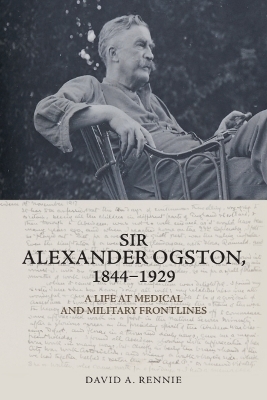
Sir Alexander Ogston, 1844-1929
A Life at Medical and Military Frontlines
Seiten
2023
Edinburgh University Press (Verlag)
978-1-3995-0131-6 (ISBN)
Edinburgh University Press (Verlag)
978-1-3995-0131-6 (ISBN)
Celebrates the life of a royal surgeon and one of Scotland’s most influential medical figures
Ogston’s career was of far-ranging, yet underacknowledged, excellence.
Inspired by the work of Joseph Lister and Robert Koch, Ogston determined to find the cause of post-operative infection. Working in his home laboratory, Ogston established the link between acute inflammation and suppuration and microorganisms, discovered (and named) staphylococcus (better known today in connection with MRSA), and correctly linked localised microorganism infections with blood poisoning.
Ogston served as a medical volunteer during the 1885 Soudan Campaign and, in 1892, became Surgeon in Ordinary to Queen Victoria. Although instrumental in founding the Royal Army Medical Corps in 1898, Ogston remained critical of the army medical services. These views were amply confirmed by the events of the Boer War, in which Ogston offered his medical services.
During the Great War, Ogston – in his early seventies and President of the British Medical Association – served as a surgeon with the British Red Cross at the Villa Trento hospital in north-east Italy – a site which served as an inspiration for the British hospital in Ernest Hemingway’s A Farewell to Arms.
Ogston’s career was of far-ranging, yet underacknowledged, excellence.
Inspired by the work of Joseph Lister and Robert Koch, Ogston determined to find the cause of post-operative infection. Working in his home laboratory, Ogston established the link between acute inflammation and suppuration and microorganisms, discovered (and named) staphylococcus (better known today in connection with MRSA), and correctly linked localised microorganism infections with blood poisoning.
Ogston served as a medical volunteer during the 1885 Soudan Campaign and, in 1892, became Surgeon in Ordinary to Queen Victoria. Although instrumental in founding the Royal Army Medical Corps in 1898, Ogston remained critical of the army medical services. These views were amply confirmed by the events of the Boer War, in which Ogston offered his medical services.
During the Great War, Ogston – in his early seventies and President of the British Medical Association – served as a surgeon with the British Red Cross at the Villa Trento hospital in north-east Italy – a site which served as an inspiration for the British hospital in Ernest Hemingway’s A Farewell to Arms.
Dr David Rennie is the author of American Writers and World War I and editor of Scottish Literature and World War I. His essays have appeared in The Hemingway Review, The F. Scott Fitzgerald Review, and the Cambridge History of American Literature and Culture in the Great War.
Acknowledgements
List of Images
Introduction
1 1844-1873
2 1874-1882
3 1883-1899
4 1899-1900
5 1901-1913
6 1914-1918
7 1919-1929
NotesFurther ReadingIndex
| Erscheinungsdatum | 08.12.2023 |
|---|---|
| Zusatzinfo | 13 black and white illustrations |
| Verlagsort | Edinburgh |
| Sprache | englisch |
| Maße | 156 x 234 mm |
| Themenwelt | Literatur ► Biografien / Erfahrungsberichte |
| Sachbuch/Ratgeber ► Geschichte / Politik | |
| Sachbuch/Ratgeber ► Natur / Technik | |
| Medizin / Pharmazie ► Medizinische Fachgebiete ► Chirurgie | |
| ISBN-10 | 1-3995-0131-3 / 1399501313 |
| ISBN-13 | 978-1-3995-0131-6 / 9781399501316 |
| Zustand | Neuware |
| Informationen gemäß Produktsicherheitsverordnung (GPSR) | |
| Haben Sie eine Frage zum Produkt? |
Mehr entdecken
aus dem Bereich



aus dem Bereich
Benennen - Erkennen - Instrumentieren
Buch | Softcover (2025)
Springer (Verlag)
CHF 55,95


