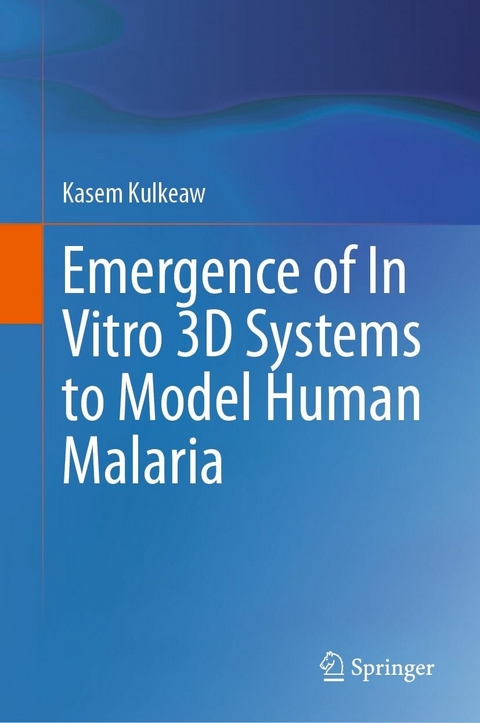
Emergence of In Vitro 3D Systems to Model Human Malaria (eBook)
94 Seiten
Springer Nature Singapore (Verlag)
978-981-99-0691-8 (ISBN)
This book illustrates the importance and advances of the disease model for malaria, a globally affected public health problem. This book provides comprehensive information on the malaria biology in a liver and all in vitro platforms for liver-stage malaria, including principles, protocols, applications for disease modeling and drug screening, and their limitations. The initial chapter describes the basis of stem cells in liver generation during development and in adults. The subsequent chapters highlight recent and emerging advances in liver organoid and liver-on-a-chip in modeling malaria. The book presents current protocols and methods to generate liver organoid and liver-on-a-chip together with their advantages and limitations. Toward the end, the book examines the humanized mouse model of liver-stage malaria using ectopic artificial livers regarding novel readout modalities. The recent advancement and challenges in combining liver-on-a-chip technology with biosensors are highlighted for assessing hepatocyte development viability and functions. The book elucidates the potential of these 3D models to understand the biological complexity of cellular and molecular mechanisms involved in Plasmodium development in the liver, toolboxes to investigate parasite deployment in the 3D models, and to implement in drug discovery. Finally, the book discusses the future directions and challenges in the applications of liver organoids and liver on-chip in the biology of live-stage malaria. This book is helpful for researchers and scientists in the field of parasitology, cell biology, tissue engineering, and pharmacology.
This book illustrates the importance and advances of the disease model for malaria, a globally affected public health problem. This book provides comprehensive information on the malaria biology in a liver and all in vitro platforms for liver-stage malaria, including principles, protocols, applications for disease modeling and drug screening, and their limitations. The initial chapter describes the basis of stem cells in liver generation during development and in adults. The subsequent chapters highlight recent and emerging advances in liver organoid and liver-on-a-chip in modeling malaria. The book presents current protocols and methods to generate liver organoid and liver-on-a-chip together with their advantages and limitations. Toward the end, the book examines the humanized mouse model of liver-stage malaria using ectopic artificial livers regarding novel readout modalities. The recent advancement and challenges in combining liver-on-a-chip technology with biosensors are highlighted for assessing hepatocyte development viability and functions. The book elucidates the potential of these 3D models to understand the biological complexity of cellular and molecular mechanisms involved in Plasmodium development in the liver, toolboxes to investigate parasite deployment in the 3D models, and to implement in drug discovery. Finally, the book discusses the future directions and challenges in the applications of liver organoids and liver on-chip in the biology of live-stage malaria. This book is helpful for researchers and scientists in the field of parasitology, cell biology, tissue engineering, and pharmacology.?
| Erscheint lt. Verlag | 29.5.2023 |
|---|---|
| Zusatzinfo | XI, 94 p. 1 illus. |
| Sprache | englisch |
| Themenwelt | Medizin / Pharmazie ► Medizinische Fachgebiete ► Mikrobiologie / Infektologie / Reisemedizin |
| Studium ► Querschnittsbereiche ► Infektiologie / Immunologie | |
| Naturwissenschaften ► Biologie ► Genetik / Molekularbiologie | |
| Naturwissenschaften ► Biologie ► Mikrobiologie / Immunologie | |
| Schlagworte | Liver-On-Chip • Liver Organoids • Liver stage • Malaria • Plasmodium |
| ISBN-10 | 981-99-0691-1 / 9819906911 |
| ISBN-13 | 978-981-99-0691-8 / 9789819906918 |
| Informationen gemäß Produktsicherheitsverordnung (GPSR) | |
| Haben Sie eine Frage zum Produkt? |
 PDF (Wasserzeichen)
DRM: Digitales Wasserzeichen
Dieses eBook enthält ein digitales Wasserzeichen und ist damit für Sie personalisiert. Bei einer missbräuchlichen Weitergabe des eBooks an Dritte ist eine Rückverfolgung an die Quelle möglich.
Dateiformat: PDF (Portable Document Format)
Mit einem festen Seitenlayout eignet sich die PDF besonders für Fachbücher mit Spalten, Tabellen und Abbildungen. Eine PDF kann auf fast allen Geräten angezeigt werden, ist aber für kleine Displays (Smartphone, eReader) nur eingeschränkt geeignet.
Systemvoraussetzungen:
PC/Mac: Mit einem PC oder Mac können Sie dieses eBook lesen. Sie benötigen dafür einen PDF-Viewer - z.B. den Adobe Reader oder Adobe Digital Editions.
eReader: Dieses eBook kann mit (fast) allen eBook-Readern gelesen werden. Mit dem amazon-Kindle ist es aber nicht kompatibel.
Smartphone/Tablet: Egal ob Apple oder Android, dieses eBook können Sie lesen. Sie benötigen dafür einen PDF-Viewer - z.B. die kostenlose Adobe Digital Editions-App.
Buying eBooks from abroad
For tax law reasons we can sell eBooks just within Germany and Switzerland. Regrettably we cannot fulfill eBook-orders from other countries.
aus dem Bereich