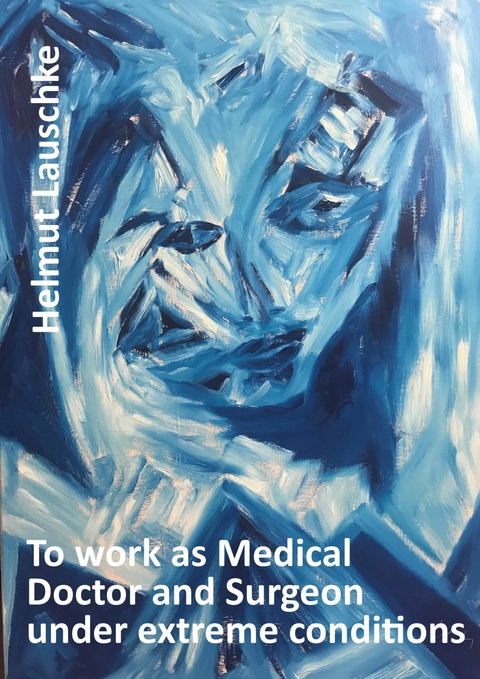
To work as Medical Doctor and Surgeon under extreme conditions (eBook)
341 Seiten
neobooks Self-Publishing (Verlag)
9783754995495 (ISBN)
•1985-1998 Arzt und Chirurg/Unfallchirurg am Hospital in Oshakati (im Norden Namibias nahe der angolanischen Grenze; innerhalb der Kampfzone bis zur Unabhängigkeit 1990) •entwickelte eine Operationsmethode, Kindern mit chronischer Schienbein-Osteomyelitis den langen Knochendefekt nach Sequesterentfernung mit vitalem Knochen aus dem Wadenbein zu schließen und so das Bein vor einer Amputation zu retten. (publiziert April 1994 im American 'The Journal of Bone and Joint Surgery')
•1985-1998 Arzt und Chirurg/Unfallchirurg am Hospital in Oshakati (im Norden Namibias nahe der angolanischen Grenze; innerhalb der Kampfzone bis zur Unabhängigkeit 1990) •entwickelte eine Operationsmethode, Kindern mit chronischer Schienbein-Osteomyelitis den langen Knochendefekt nach Sequesterentfernung mit vitalem Knochen aus dem Wadenbein zu schließen und so das Bein vor einer Amputation zu retten. (publiziert April 1994 im American "The Journal of Bone and Joint Surgery")
The bridge over the Cuvelai has been restored
Urgent needs in the most critical time
All bridges of the strategically important tar road in the north from west to east through the Ovamboland were guarded by the military. The situation was tense. The conflict came closer and the war was escalating. PLAN (People’s Liberation Army of Namibia), the military wing of Swapo, and its allies were fighting for an independent Namibia against the occupying South African colonial power and white apartheid regime of Pretoria which was supported by the majority of white people who fought for the white privileges in a status quo. The black population did sacrifice tremendously and the number of victims has become uncountable. People were brought to the hospital with lacerations, bloody wounds with bloodshot marks on the chest or back, on arms and legs after they were interrogated by the special forces of koevoet (Afrikaans for crowbar) on the field or in the villages or at the police station. Since koevoet had recruited black people, it often happened that black koevoet men beat and tortured their brothers and sisters, if the white captain was of the opinion that the person was a supporter of Swapo. It were most innocent people who became victims of the brutal stick treatment. The suspicion was enough to get beaten, tortured and deported. It was the spiral of force and violence which was cruel and awful. It was seen on the bodies of victims, who came to the hospital for treatment. If there was a suspicion of collaboration that for instance a PLAN-fighter was hiding in the kraal, the heavily armoured Casspir vehicles flattened the kraal down that the inhabitants with the old people and their children were literally left behind with nothing on the open field.
This civil war lasted for more than ten years and became more destructive the longer the war went on. The insecurity in the north and the military struggle in the close-to-border region to Angola escalated. The white perspective became increasingly critical what had consequences for the hospital as well. Dr Witthuhn as the civilian superintendent was removed from office and replaced by a tall man of the mid-thirties with the dashing uniform of a major. The new superintendent was a medical doctor, but this in second line of smaller importance. He spoke Afrikaans and English eloquently and juggled between the languages ‘ad libitum’ and made repetitions ‘ad infinitum’. He repeated a sentence in English five times and added the repetition of the same sentence in Afrikaans ten times. With each repetition the sentence got stretched longer up to a chewing gum hanging out of his mouth without any further meaning. The nouns were colourfully decorated with adjectives and the verbs were attached with numerous adverbs, thread-like appendages and other threadbare substitutes like empty shells that in the end the core was gone, and what was ‘invisible’ in the beginning were hidden in the end behind all these nonsense decorations.
The verbs about what had to be done what gave the noun the meaningful substance, had disappeared in the trapdoor. Subject and predicate were buried under a jumble of useless decorations and word rubbish. The sentences became irrational that one could not find out what was first and what not or what the superintendent in his dashing major uniform did try to say, not to mention what he was thinking under his word covers. It became clear that this man enjoyed to juggle in a erratic manner from one language to the other and back without speaking a short and meaningful sentence. His eloquence had the format of a barrel organ. People attending the morning meetings were confused and little later bored as well by the bilingual splits that he did not stop, and of the fact that they could not understand what he liked to say. So it became practice that the attendees looked at their watches, though the meeting was not far from the beginning or in the middle. The question was when would the superintendent stop his endless nonsense with the swinging empty shells and threadbare ingredients in a salad which was tasteless and meaningless. If somebody asked him a question, a torrent of words started again until the question had been crushed and chewed that nothing was left, but an answer did not come.
Meanwhile I had got a small flat allocated by the Bantu-administration. The flat had a small sitting room, a one-bed room, a very small kitchen with a semi-automatic washing machine, a veranda with a mosquito screen and a shower room with toilet. I did appreciate this improvement, especially that the sleeping room was spacious and not packed with cardboards from the bottom to the ceiling.
The first what the new superintendent in uniform of a major did, he let move the desk and swivel chair to the opposite site in the office. The old white painted asbestos board was hanged on the opposite wall where a telephone connection plug was put on as well. It was the side where the matrons and pharmacists took their seats when Dr Witthuhn was the civilian superintendent. That was the time when the lean white chief matron complained of the urine stench on the hospital square assisted by the short black matron who pulled the grimaces of disgust. It was also the time when the chief matron gave in one morning meeting an impressive speech regarding the team spirit by understanding each other and each other’s problem to work trustfully together in the very interest of the patients despite the many shortcomings under the poor hospital conditions in the critical circumstances of war. Her intention became a stillbirth by undermining and the false activities of Dr Hutman whom I soon recognized as the lieutenant of the devil.
Dr Witthuhn was moved down on the post of principal medical officer to the department of internal medicine. He took it cool without any effort of resistance, because he needed the regular income by the monthly salary. Above this, he was of the strong belief that the madness of the white arrogance and desperation would not last long. It also was no degradation salary-wise, since the white Bantu-administration had put him only as an acting superintendent on the previous chair and that for a short period of time. The military had mistrusted him as civilian superintendent because of his liberal, but ethically correct way of acting.
He made now the ward rounds as the other doctors did and was respected by the nursing staff as a friendly and understanding doctor with a human face, who made his notes with the big handwriting on the sheets in the patients’ files. Dr Witthuhn had a big heart and also big problems. It was part of his personality that he made big excursions when he was far away in his mind. He was a person, who was not simply to measure in the range of normal standard. He rejected the small-minded attitude of jealousy and malevolence, but was alert against people who were false and sly. He sat behind a small table in a small consulting room in ward 7 and examined the outpatients. A running ventilator stood on a chair opposite to him for some air circulation. It was a room of humbleness also in diagnostic terms as he sat back listening to the patient’s complaints and following the excursions in his mind. It was the case that he had to be touched for coming back to the world’s reality in this small consulting room with the smoothly running ventilator.
The health director sat in a flawless uniform of a colonel further and untouchable on the comfortable swivel chair behind his empty desk with the polished wooden plate in an air-conditioned office with the photo of the unyieldingly looking South African president in big format under glass on the wall. The director’s main concern were his teeth. His only work was to draw up decrees of what had to be done in the hospital and what not. So it was decreed and signed by this director that it was forbidden to treat Swapo-fighters and active Swapo-supporters. The Bantu-administration had no saying how the hospital had to be run. It was obvious that those white people remained indifferent about what was going on. They were not interested to look into the problems the hospital was confronted with.
It was the time when two officers of the SADF [South African Defence Force] occupied the chairs of the highest posts at the hospital administration. They controlled the medical work that had to be done under the most primitive conditions in using old and outdated facilities with the many missings. Nursing staff as patients and the population at large did not trust the military authority. The hospital got a strategic importance at the expense of being an open health institution for all the sick and injured people. Since the military had taken over the command in the hospital, the paramilitary koevoet patrolled the hospital ground in nightly raids with their armoured Casspirs searching with floodlight for hidden PLAN-fighters up into each angle and corner.
The replacement of the civilian superintendent by the young major has not brought any improvement. The Sekretaris had not kept his promise given one year ago to send a clerk to look into the critical matters and to list up the most urgent points for repair and replacement. The conditions remained miserable under which the huge workload had to be solved. The old central sterilization unit broke down from time to time what caused long delays in performing the operations. The outdated operating table...
| Erscheint lt. Verlag | 3.5.2023 |
|---|---|
| Verlagsort | Berlin |
| Sprache | deutsch |
| Themenwelt | Medizin / Pharmazie ► Allgemeines / Lexika |
| Schlagworte | humanity-in-mutual-respect • intellectual-and-psychological-education • life-in-maintaining-the-ethical-and-moral-values • passion-and-determination • Personal-humbleness-and-honesty • tolerance-and-dedication |
| ISBN-13 | 9783754995495 / 9783754995495 |
| Informationen gemäß Produktsicherheitsverordnung (GPSR) | |
| Haben Sie eine Frage zum Produkt? |
 EPUB (Wasserzeichen)
E-Book Endkundennutzungsbedinungen des Verlages
DRM: Digitales Wasserzeichen
Dieses eBook enthält ein digitales Wasserzeichen und ist damit für Sie personalisiert. Bei einer missbräuchlichen Weitergabe des eBooks an Dritte ist eine Rückverfolgung an die Quelle möglich.
Dateiformat: EPUB (Electronic Publication)
EPUB ist ein offener Standard für eBooks und eignet sich besonders zur Darstellung von Belletristik und Sachbüchern. Der Fließtext wird dynamisch an die Display- und Schriftgröße angepasst. Auch für mobile Lesegeräte ist EPUB daher gut geeignet.
Systemvoraussetzungen:
PC/Mac: Mit einem PC oder Mac können Sie dieses eBook lesen. Sie benötigen dafür die kostenlose Software Adobe Digital Editions.
eReader: Dieses eBook kann mit (fast) allen eBook-Readern gelesen werden. Mit dem amazon-Kindle ist es aber nicht kompatibel.
Smartphone/Tablet: Egal ob Apple oder Android, dieses eBook können Sie lesen. Sie benötigen dafür eine kostenlose App.
Geräteliste und zusätzliche Hinweise
Buying eBooks from abroad
For tax law reasons we can sell eBooks just within Germany and Switzerland. Regrettably we cannot fulfill eBook-orders from other countries.
aus dem Bereich