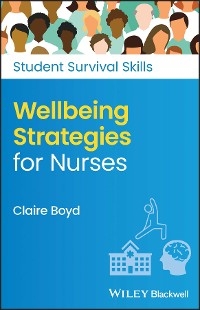
Wellbeing Strategies for Nurses (eBook)
John Wiley & Sons (Verlag)
978-1-119-89357-8 (ISBN)
Practical strategies for combating burnout and improving mental health while working as a nurse
Wellbeing Strategies for Nurses explores clear, straightforward, and practical techniques for cultivating resilience and positive mental health strategies in the face of a demanding clinical environment. This pocket-sized book is easy to carry during your clinical placement and offers tips, advice, and hard-won words of wisdom from student and qualified nurses to support you through a challenging, yet rewarding, career. You'll find stress-busting tools as well as exercises intended for long-term relief of stress incorporated throughout the book.
Readers will also find:
- A thorough introduction to self-care and wellbeing for nurses, as well as discussions of stress and guided meditation practice exercises
- Comprehensive explorations of breathing, humour, and nature therapy
- Practical discussions of muscle relaxation and the importance of healthy foods and hydration
- Treatments of the sense of smell, aromatherapy, guided meditation, mindfulness, and the five senses approach to wellbeing
Perfect for pre-registration adult nursing students in their first and second years of the programme, Wellbeing Strategies for Nurses will also benefit nursing associates, health care assistants, assistant practitioners, and professionals returning to the field after a period of absence.
Claire Boyd is a Practice Development Trainer in the Learning and Research Centre at North Bristol Healthcare Trust. She develops, designs, delivers, and evaluates learning programmes and organises the transition training programme for student nurses and support of these nurses in clinical areas. She has over 35 years' experience in the field of nursing.
Claire Boyd is a Practice Development Trainer in the Learning and Research Centre at North Bristol Healthcare Trust. She develops, designs, delivers, and evaluates learning programmes and organises the transition training programme for student nurses and support of these nurses in clinical areas. She has over 35 years' experience in the field of nursing.
Preface vii
Introduction ix
Acknowledgements xiii
Part 1 Occupational Ill-Health 1
1 Self-Care And Wellbeing 3
2 Stress 31
3 Sleep Well 49
Part 2 Strategies To Combat Stress 75
4 Breathing Therapy 77
5 Muscle Relaxation 91
6 Nature (Biophilia Theory) 101
7 Nutrition, Hydration, And Exercise 115
8 Colour Therapy 135
9 Aromatherapy 153
10 Sharing With Friends 167
11 Humour Therapy 179
12 Guided Meditation 193
13 Mindfulness 203
14 Visualisation (Guided Imagery) 213
15 Arts And Crafts 225
16 Stillness 247
Part 3 Guided Meditation For Groups And Individuals 255
17 Guided Meditations: Spring 257
Cool Waters 258
Rainbow 262
18 Guided Meditations: Summer 267
Tropical Paradise 268
Summer Meadows 273
19 Guided Meditations: Autumn 277
A Walk In The Forest 278
Moonlight 284
20 Guided Meditations: Winter 289
Candle Light 290
A Walk In The Snow 293
Answers To Activities 299
Appendix A: Effects Of Stress 303
Appendix B: Colouring A Rainbow 307
Appendix C: Glossary Of The Properties Of Essential Oils 309
Appendix D: Wellness Bingo 313
Index 315
Chapter 1
SELF‐CARE AND WELLBEING
LEARNING OUTCOMES
By the end of this chapter, you will have an understanding of the importance of self‐care and wellbeing in healthcare to help with compassion fatigue, burnout, and post‐traumatic stress disorder.
Different approaches to wellbeing techniques will be explored, including acupuncture, acupressure, yoga, Qigong, Tai Chi, and massage.
How are you feeling today? I ask this because we know the NHS is in a ‘jobs crisis’ with large numbers of healthcare professionals in the UK leaving the profession, citing as their reasons for leaving ‘pay, working conditions and feeling under huge pressure’. Those leaving the profession often are not replaced, and the shortfall of healthcare professionals is reaching record levels, which puts more pressure on those still hanging on and caring for the vulnerable.
But who is looking after you? We do need to look after ourselves, as laid out by the Nursing & Midwifery Council document ‘Future Nurse: Standards of Proficiency for Registered Nurses’ (2018). This document states that at the point of registration, the nurse will:
- 1.5 understand the demands of professional practice and demonstrate how to recognise signs of vulnerability in themselves or their colleagues and the action required to minimize risks to health
- 1.6 understand the professional responsibility to adopt a healthy lifestyle to maintain the level of personal fitness and wellbeing required to meet people's needs for mental and physical care.
In short, it is all about self‐care and wellbeing. We need to care for ourselves and our colleagues, which may be easier said than done in today's healthcare climate.
Self‐care
The actions we take for ourselves to remain fit and healthy and understand when we can look after ourselves and when we need to seek help from other healthcare professionals.
Wellbeing
Represents a broader bio‐psycho‐social construct that includes physical, mental, and social health.
The self‐care process can start by reflecting on what makes us happy. When we are going through trying times, it can be easy to focus on the negative aspects of our lives – causing us even more stress and anxiety. Before we go down a negative spiral, it is important to focus on the things that make us happy. Moving from the negative to the positive is an important aspect of the healing process. And note that we may need help with this process (counselling, general practitioners, etc.).
COMPASSION FATIGUE
Unique to the healthcare sector is the occupational stressor known as compassion fatigue, whereby the carer connects with a patient and feels how they are feeling. This opens them up to absorbing and experiencing the patient's trauma, suffering, and pain – known as vicarious traumatisation. This exposure stimulates our fight‐or‐flight response, which we then continually suppress, leading to consequences for our physical and mental health.
The symptoms of compassion fatigue can be seen in Table 1.1.
If we ignore the body's response to vicarious trauma, the physical symptoms will only get worse. This is when we need to take steps to care for ourselves before we experience burnout.
Table 1.1 Symptoms of compassion fatigue.
| Phase 1 | Anxiety | Vicarious trauma stimulates the nervous system into flight or fight, and you feel the effects of adrenaline on the body – raised heart and breathing rates, shaking, and muscle tension. It becomes harder to think clearly and concentrate and may be harder to sleep. It becomes more difficult to relax. |
| Phase 2 | Irritability | Chronic stress may induce headaches, fatigue, and multiple minor illnesses as the immune system becomes compromised. The tension may affect your musculoskeletal system, causing chronic neck and back pain. You may eat more (or less) than usual. |
| Phase 3 | Withdrawal | As you experience chronic fatigue and constant aches and pains, you may start to neglect your physical and emotional health. If you take time off from work, you do not feel any better on your return. |
| Phase 4 | Robot | These symptoms are very similar to those suffering from depression and also include headaches, generalised aches and pains, digestive problems, and a feeling of low‐level anxiety and very low mood. |
BURNOUT
Burnout is a syndrome resulting from chronic workplace stress that has not been successfully managed. It is characterised by three dimensions:
- Feelings of energy depletion or exhaustion
- Increased mental distance from one's job or feelings of negativism or cynicism related to one's job
- Reduced professional efficacy
Risk factors associated with increased susceptibility to developing Burnout Syndrome can be seen in Table 1.2.
Table 1.3 shows some of the actions we can take to prevent Burnout Syndrome in the workplace.
Table 1.2 Risk factors in developing Burnout Syndrome.
| Individual risk factors |
|
| Organisational risk factors |
|
| Risk factors for nurses |
|
Table 1.3 Action steps to prevent Burnout Syndrome.
| Manage | Understand that there are ways in which you can manage your work‐related stressors that put you at risk of Burnout Syndrome. |
| Engage | Engage in the support of management, co‐workers, friends, and family that may help you cope with stress – this is not a weakness. |
| Breaks | Take breaks at work and away from work. Go outside for a walk to get some fresh air during your breaks. |
| Enjoyment | Think about what you enjoy about your work, and focus your attention on your interests and passions. |
| Techniques | Gain techniques to be used at work when dealing with stressful work experiences and after work to relax and recharge. |
STRESS‐RELIEVING STRATEGIES
To effectively combat stress, we need to activate the body's natural relaxation response. We are all unique human beings, and stress‐relieving strategies are not a case of ‘one size fits all’. Each of us has preferred calming stress busters. The following bullet points show some of the strategies you may utilise to reach a state of calm and unwind after a stressful day or on a day off:
- Spending a day at a spa
- Eating chocolate
- Drinking a glass of wine at the end of the day
- Taking a walk in the country
- Going for a swim
- Going to the hairdresser/having your hair washed
- Going for a run
- Meditating
- Going somewhere for quiet time (stillness)
- Going to the gym
- Reading a book
- Undertaking some arts and crafts (hobbies)
- Watching a movie
- Listening to music
- Going to a café for a hot beverage (and a piece of cake) with friends
- Soaking in a warm bath
- Having a massage
- Gardening
- Playing with your pet animal
- Watching a football/rugby match (could be stressful if your team lose)
- Doing yoga
- Working on a jigsaw puzzle
- Modelling with LEGO bricks
I live in the West of England, and one of my favourite ways to destress is to go for a short walk in the Cotswold countryside and then stop in an Olde Worlde tea shop for a cup of tea and some cream scones (jam first, cream on top). Sometimes I forego the walk! (Several of my colleagues like to go to the gym after work – I can't think of anything worse!) My husband likes to snuggle up on the settee with a hot cup of tea, dunking his biscuits (yuk!) whilst watching a good movie on Netflix. In other words, it really is horses for courses. Also, everything in moderation: we should not become dependent on pouring alcohol down our gullets to ‘feel better’ as this could be a slippery slope.
The important thing is that we all need an outlet for our stress. Good health relies not just on the physical aspect but also the mental health aspect – a truly holistic...
| Erscheint lt. Verlag | 20.3.2023 |
|---|---|
| Reihe/Serie | Student Survival Skills |
| Student Survival Skills | Student Survival Skills |
| Sprache | englisch |
| Themenwelt | Medizin / Pharmazie ► Pflege |
| Schlagworte | Ausbildung u. Perspektiven i. d. Krankenpflege • covid burnout • Krankenpflege • Leitungstätigkeit u. Management i. d. Krankenpflege • nurse burnout • nurse depression • nurse wellbeing • nursing • nursing burnout • nursing covid burnout • Nursing Education & Professional Development • Nursing Management & Leadership • nursing mental health • nursing self-care • nursing stress • nursing stress reduction • nursing wellbeing • stress reduction for nurses • Wohlbefinden |
| ISBN-10 | 1-119-89357-7 / 1119893577 |
| ISBN-13 | 978-1-119-89357-8 / 9781119893578 |
| Informationen gemäß Produktsicherheitsverordnung (GPSR) | |
| Haben Sie eine Frage zum Produkt? |
 EPUB (Adobe DRM)
Kopierschutz: Adobe-DRM
Adobe-DRM ist ein Kopierschutz, der das eBook vor Mißbrauch schützen soll. Dabei wird das eBook bereits beim Download auf Ihre persönliche Adobe-ID autorisiert. Lesen können Sie das eBook dann nur auf den Geräten, welche ebenfalls auf Ihre Adobe-ID registriert sind.
Details zum Adobe-DRM
Dateiformat: EPUB (Electronic Publication)
EPUB ist ein offener Standard für eBooks und eignet sich besonders zur Darstellung von Belletristik und Sachbüchern. Der Fließtext wird dynamisch an die Display- und Schriftgröße angepasst. Auch für mobile Lesegeräte ist EPUB daher gut geeignet.
Systemvoraussetzungen:
PC/Mac: Mit einem PC oder Mac können Sie dieses eBook lesen. Sie benötigen eine
eReader: Dieses eBook kann mit (fast) allen eBook-Readern gelesen werden. Mit dem amazon-Kindle ist es aber nicht kompatibel.
Smartphone/Tablet: Egal ob Apple oder Android, dieses eBook können Sie lesen. Sie benötigen eine
Geräteliste und zusätzliche Hinweise
Buying eBooks from abroad
For tax law reasons we can sell eBooks just within Germany and Switzerland. Regrettably we cannot fulfill eBook-orders from other countries.
aus dem Bereich