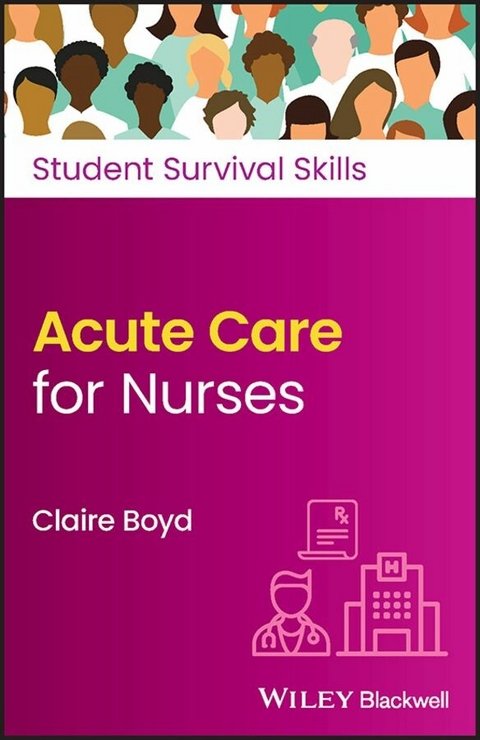
Acute Care for Nurses (eBook)
John Wiley & Sons (Verlag)
978-1-119-88247-3 (ISBN)
A practical handbook to boost your confidence with assessment techniques and key clinical skills when administering effective acute care
This helpful revision tool was developed to assist healthcare workers in the field of acute care, at a time when healthcare professionals have been under more pressure than ever before. In Acute Care for Nurses, readers will find:
- A revision of medicines management formulas, plus advanced formulas seen in a clinical setting, with chapters on sepsis and conflict resolution
- Assessment techniques and the individual components of the ABCDE assessment, covering vital signs, clinical observation at superficial and more in-depth levels, and clinical actions
- Higher skills, such as caring for the ventilated patient and fluid resuscitation in adults and children, and subcutaneous fluid hydration
- Critical care simulation and need-to-know medical abbreviations, plus three helpful appendices containing tool kits and charts
Acute Care for Nurses is a must-have resource for nursing students, including nursing associates, registered nurses and midwives, assistant practitioners and senior healthcare assistants, return to practice nurses, overseas nurses and anyone else requiring acute clinical skills and assessment techniques.
Claire Boyd is Practice Development Trainer in the Learning and Research Centre at North Bristol Healthcare Trust, Bristol, UK. She develops, designs, delivers and evaluates learning programmes, and organises the transition training programme for student nurses and support of these nurses in clinical areas.
Claire Boyd is Practice Development Trainer in the Learning and Research Centre at North Bristol Healthcare Trust, Bristol, UK. She develops, designs, delivers and evaluates learning programmes, and organises the transition training programme for student nurses and support of these nurses in clinical areas.
Preface
Introduction
Acknowledgements
Part 1
Chapter 1 Diagnostic tests and advanced formulae
Chapter 2 Sepsis
Chapter 3 Conflict Resolution
Chapter 4 Patient Assessment
Chapter 5 SBAR Communication
Part 2
Chapter 6 Airway
Chapter 7 Breathing
Chapter 8 Circulation
Chapter 9 Disability
Chapter 10 Exposure
Part 3
Chapter 11 Emergency fluid management in adults
Chapter 12 Treating Paediatric Dehydration
Chapter 13 Hypodermoclysis
Chapter 14 Central Lines
Chapter 15 Invasive and Non-Invasive Ventilation (CPAP/BIPAP)
Part 4
Chapter 16 Critical care simulation
Chapter 17 Medical Abbreviations
Chapter 18 Answers to activities questions
Appendix 1 NEWS II Observation Chart
Appendix 2 Sepsis tool kit
Appendix 3 Fluid prescription chart
Chapter 1
DIAGNOSTIC TESTS AND ADVANCED FORMULAE
LEARNING OUTCOMES
By the end of this chapter you will have an understanding of how to calculate mean arterial pressure (MAP), drug administration calculations, percentage strength of drugs, solution strength of drugs (e.g., mg/ml), infant feeding regimens, infant growth expectations, body surface area (BSA), and body mass index (BMI); how to measure cardiac output (CO); how to assess lung function and renal clearance; and how to determine energy requirements of the body.
Working in health care, we all need to have a good grasp of mathematics to perform our professional duties, such as keeping accurate fluid balance records (see Appendix 3), totting up the vital signs on the National Early Warning Score 2 observation chart (see Appendix 1), and administering medications, to name just three. As our careers progress, we may be involved in more complex mathematics. This may involve having an understanding of body organ and systems calculations. Even if you are not expected to undertake these calculations, it is still good to have the knowledge of how these readings are obtained and what they mean to the patient's health.
MEAN ARTERIAL PRESSURE
For instance, in Chapter 2 we will look at mean arterial pressure (MAP) of blood pressures (BPs) in relation to sepsis. This reading often pops up on automatic BP machines (electronic sphygmomanometers), but what exactly is it and how do we obtain this reading if using a manual sphygmomanometer (aneroid), as shown in Figure 1.1, with a stethoscope?
Figure 1.1 Aneroid sphygmomanometer.
Mean arterial pressure (MAP)
MAP is the average blood pressure of an individual during a single cardiac cycle and informs us whether the blood flow is adequately perfusing the tissues/organs. This is a vital calculation for patients in critical care and in cases of septic shock.
Working out the MAP from a BP recording is actually very simple:
- Step 1: Take BP recording.
- Step 2: Multiply the diastolic BP (DBP) by 2.
- Step 3: Add this value to the systolic BP (SBP) and divide by 3.
Example: BP: 120/80 mmHg
DBP: 80 × 2 = 160
160 + 120 (SBP) = 280
Divide by 3 = 93.3
Activity 1.1
- Work out the MAP of BP 135/85 mmHg.
- Work out the MAP of BP 120/70 mmHg.
DID YOU KNOW?
The normal MAP range is between 70 and 100 mmHg. The body needs at least 60 mmHg to provide enough blood to the coronary arteries, kidneys, and brain.
HEALTHCARE CALCULATIONS
Before we look at some more advanced body organ and systems calculations, we will first revise our more everyday or ‘bread and butter’ drug administration calculations.
Drug Dosages for Tablets/CapsulesA patient has been administered 0.25 mg of digoxin orally. Stock: 250‐microgram (μg) tablets. How many tablets do you administer?
First, change 250 μg to milligrams (mg): 250 μg/1000 = 0.25 mg.
- WYW: 0.25 mg
- WYG: 0.25 mg = 1 tablet
Question 1.1
- Prescription: 8 mg morphine
- Stock: 10 mg/2 ml
- How much do you administer?
Drug Dosages for Injections, Syrups, Elixirs, Among Others
A patient requires a subcutaneous injection of 22 units. 10 ml stock ampoules contain 100 units to every 1 ml. What volume do you draw up?
Question 1.2
A patient is prescribed 400 μg of Granisetron syrup orally. Stock solution = 1 mg/5 ml. How much do you draw up?
Infusion Pump Rates (in millilitres per hour)
A patient is to receive 4 l of 0.9% sodium chloride over eight hours. What is the infusion rate in millilitres per hour?
Question 1.3
350 ml of blood is to given to a patient over four hours. What is the infusion rate in millilitres per hour?
Drip Rates (in Drops per Minute)
The patient has been prescribed 1 l of 5% glucose to run over eight hours. What is the infusion rate in drops per minute, using a standard administration set delivering 20 drops/ml?
Question 1.4
Patient has been prescribed 0.5 l of fluid to run over five hours. What is the infusion rate in drops per minute, using a blood administration set delivering 15 drops/ml?
Duration of Infusions
600 ml of fluid is dripping at 20 drops/min. The intravenous (IV) set delivers 15 drops/ml. How long will the infusion take?
Question 1.5
An IV set delivers 15 drops/ml. A patient is to receive 1 l of Intralipid at 30 drops/min. How long will the infusion take?
TOP TIP
0.33 does not mean 0.33 minute. This is a decimal value and needs to be changed to minutes by doing the following conversion:
Drugs According to Body Weight
A patient with diabetic ketoacidosis needs to commence a fixed rate insulin infusion at 0.1 unit/kg/h as per trust policy. How much insulin should be prescribed to an 85 kg patient?
Question 1.6
A patient has a deep vein thrombosis and has been prescribed enoxaparin (low‐molecular‐weight heparin). The patient weighs 74 kg. The dose of enoxaparin is 1.5 mg/kg. How much do you administer?
DID YOU KNOW?
I think my calculator is broken. The only numbers that seem to work are 1, 3, 5, 7, and 9. It's very odd.
Calculating How Many Minutes Drug to Run Over
Furosemide should not exceed 4 mg of the run over one minute because of speed shock. A patient has been prescribed 20 mg. Over what time should this be administered?
Speed shock
A systemic reaction caused by the rapid injection of a medication into the circulation, resulting in toxic levels of medication in the plasma. Symptoms can include cardiac arrest, flushed face, headache, irregular pulse, shock fainting, and tightness in the chest.
Question 1.7
A patient has been prescribed 15 mg. Over what time should this be administered?
Percentage Strength of Drug
A patient is given 2 l of 0.45% sodium chloride. How many grams of sodium will the patient receive?
Question 1.8
How many grams of medication do you have in 20 g of 12% w/w ointment?
Solution Strength of Drug (mg/ml)
500 mg of amoxicillin powder has been reconstituted in 25 ml of water for injection. What is the concentration in milligrams per millilitre (mg/ml)?
Question 1.9
1 g of a drug has been reconstituted in 20 ml of water for injection. What is the strength in mg/ml.
Extra Questions
And now a couple of questions for you to do on your own – just for your own enjoyment!
Question 1.10
A patient is given 0.9% sodium chloride at a rate of 400 ml/h for five hours. How many litres will the patient receive?
Question 1.11
An infusion of dextrose 5% started at 10:00 and finished at 22:00. How many litres will the patient have received if the infusion is running at a rate of 100 ml/h?
Question 1.12
A patient has been prescribed ibuprofen 5 mg/kg/d in three divided doses. The patient weighs 60 kg. Calculate the daily dose and single dose.
DID YOU KNOW?
- OD = Once daily
- BD = Twice daily, or 12 hourly
- TDS = Three times daily, or 8 hourly
- QDS = Four times daily, or 6 hourly
Question 1.13
Stock ampoules of IV hydrocortisone = 100 mg in 2 ml. Patient requires 135 mg IV. How much would you administer?
Question 1.14
A patient is to have 2 l of clear fluid in 24 hours. He has received 1500 ml in 6 hours. How many drops per minute are required to correct the infusion?
TOP TIP
If you struggled with any of these calculations, perhaps you may wish to read the calculations book in this student survival series set of books.
Now let's look at some advanced body, organ, and systems calculations starting with infant feeding...
| Erscheint lt. Verlag | 9.2.2023 |
|---|---|
| Reihe/Serie | Student Survival Skills |
| Student Survival Skills | Student Survival Skills |
| Sprache | englisch |
| Themenwelt | Medizin / Pharmazie ► Pflege |
| Schlagworte | abcde assessment • Acute Care • Acute, Critical & Emergency Care • Akutmedizin • Akutpflege • Conflict Resolution • critical care stimulation • Einführungen in die Krankenpflege • Intensiv- u. Notfallpflege • Introductions to Nursing • Krankenpflege • Medicines management formulas • Notfallmedizin • Notfallpflege • nursing • nursing assessment techniques • nursing student • Nursing textbook • registered nurse • Sepsis • ventilated patient • vital signs clinical observation |
| ISBN-10 | 1-119-88247-8 / 1119882478 |
| ISBN-13 | 978-1-119-88247-3 / 9781119882473 |
| Informationen gemäß Produktsicherheitsverordnung (GPSR) | |
| Haben Sie eine Frage zum Produkt? |
 EPUB (Adobe DRM)
Kopierschutz: Adobe-DRM
Adobe-DRM ist ein Kopierschutz, der das eBook vor Mißbrauch schützen soll. Dabei wird das eBook bereits beim Download auf Ihre persönliche Adobe-ID autorisiert. Lesen können Sie das eBook dann nur auf den Geräten, welche ebenfalls auf Ihre Adobe-ID registriert sind.
Details zum Adobe-DRM
Dateiformat: EPUB (Electronic Publication)
EPUB ist ein offener Standard für eBooks und eignet sich besonders zur Darstellung von Belletristik und Sachbüchern. Der Fließtext wird dynamisch an die Display- und Schriftgröße angepasst. Auch für mobile Lesegeräte ist EPUB daher gut geeignet.
Systemvoraussetzungen:
PC/Mac: Mit einem PC oder Mac können Sie dieses eBook lesen. Sie benötigen eine
eReader: Dieses eBook kann mit (fast) allen eBook-Readern gelesen werden. Mit dem amazon-Kindle ist es aber nicht kompatibel.
Smartphone/Tablet: Egal ob Apple oder Android, dieses eBook können Sie lesen. Sie benötigen eine
Geräteliste und zusätzliche Hinweise
Buying eBooks from abroad
For tax law reasons we can sell eBooks just within Germany and Switzerland. Regrettably we cannot fulfill eBook-orders from other countries.
aus dem Bereich