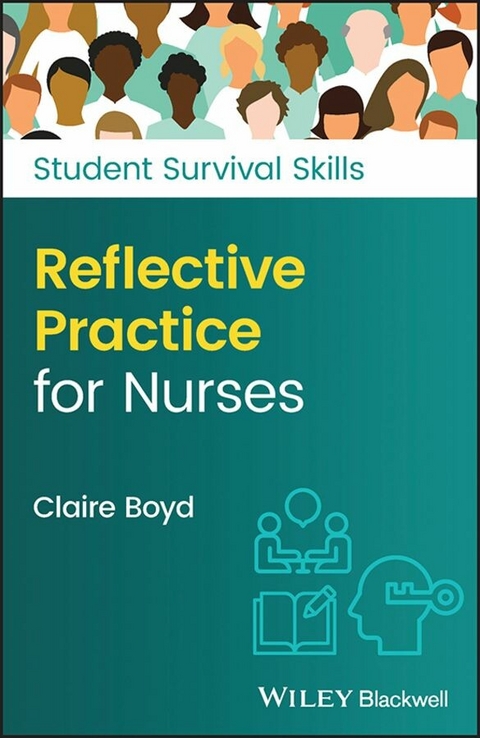
Reflective Practice for Nurses (eBook)
John Wiley & Sons (Verlag)
978-1-119-88250-3 (ISBN)
Become a reflective clinical practitioner and prepare for successful revalidation with this practical nursing guide
Reflective practice is increasingly being regarded as an essential tool for improving nursing practice, and since reflective practice is not always intuitive, there is an urgent need for an accessible guide for nurses wishing to incorporate best practices into their role.
Reflective Practice for Nurses meets this need and introduces the core concepts and principles of reflective practice. Designed for busy nursing professionals in want of a speedy overview and with jargon-free language, this is the easiest way to begin learning about reflective practice and how it can be used to support revalidation. It promises to become an indispensable tool for nursing students and professionals looking to turn the sometimes-fraught process of professional reflection into an asset to their practice.
Reflective Practice for Nurses readers will also find:
- An introduction to 14 different models of reflection
- Easy-to-read format for nurses in high-pressure professional situations
- Pocket-sized presentation for portability and use on-the-go
Reflective Practice for Nurses is essential for nursing students and practicing nurses looking to become more reflective and effective clinical practitioners.
Claire Boyd is Practice Development Trainer in the Learning and Research Centre at North Bristol Healthcare Trust. She develops, designs, delivers and evaluates learning programmes, and organises the transition training programme for student nurses and support of these nurses in clinical areas.
Reflective Practice for Nurses Become a reflective clinical practitioner and prepare for successful revalidation with this practical nursing guide Reflective practice is increasingly being regarded as an essential tool for improving nursing practice, and since reflective practice is not always intuitive, there is an urgent need for an accessible guide for nurses wishing to incorporate best practices into their role. Reflective Practice for Nurses meets this need and introduces the core concepts and principles of reflective practice. Designed for busy nursing professionals in want of a speedy overview and with jargon-free language, this is the easiest way to begin learning about reflective practice and how it can be used to support revalidation. It promises to become an indispensable tool for nursing students and professionals looking to turn the sometimes-fraught process of professional reflection into an asset to their practice. Reflective Practice for Nurses readers will also find: An introduction to 14 different models of reflection Easy-to-read format for nurses in high-pressure professional situations Pocket-sized presentation for portability and use on-the-go Reflective Practice for Nurses is essential for nursing students and practicing nurses looking to become more reflective and effective clinical practitioners.
Claire Boyd is Practice Development Trainer in the Learning and Research Centre at North Bristol Healthcare Trust. She develops, designs, delivers and evaluates learning programmes, and organises the transition training programme for student nurses and support of these nurses in clinical areas.
Preface vii
Introduction ix
Acknowledgements xiii
Section One Understanding
Reflection 1
1 What Is Reflection? 3
2 Human Factors 21
3 Models of Reflection 33
4 Reflection And NMC Revalidation 51
Section Two Learning Through
Reflection 65
5 Writing Reflectively 67
6 Improving Care Through Reflection 85
7 Critical Reflection 101
8 Reflective Assignments 113
Section Three Reflection In Practice 129
9 Case Study 1 - Newly Qualified Nurse 131
10 Case Study 2 - Nursing Associate 137
11 Case Study 3 - Mental Health Nurse 141
12 Case Study 4 - Qualified Nurse 145
13 Case Study 5 - Learning Disability Nurse 151
14 Case Study 6 - Midwife 155
15 Reflection In Practice - Reflective Journal Extract 159
Answers 163
Index 171
Chapter 1
WHAT IS REFLECTION?
LEARNING OUTCOMES
By the end of this chapter, you should have a working knowledge of the different types of reflection and how the process of reflection can enhance our nursing practice and learning.
Training in healthcare, you will find the skill of using reflection deeply embedded in the learning process of nurse education and practice.
When I began my nursing career (no, not alongside the pioneers of nursing, Mary Seacole and Florence Nightingale – cheeky!), the concept of ‘reflection’ as a learning aid was still considered quite new and in its infancy. I can remember some of my colleagues stating that reflection was ‘a flash in the pan’ and would be replaced by the ‘next new thing’: it was obvious that they had not yet fully understood the value and importance of reflection as an aid to enhance their learning and their nursing practice.
Reflection has been used in nursing and midwifery for many decades in many different guises – nurses with many years of experience under their belts all remember the SWOT (Strength, Weakness, Opportunities, Threats) analysis, still used today in many appraisals (we will look at a SWOT analysis and appraisals in Chapter 4). Reflection is also a process that we all engage in naturally to some extent; we may encounter a patient and wonder to ourselves, ‘Why did he respond that way to me?’
Today, reflection in nursing and many other professions (such as teaching) is recognised for its benefits in helping us to learn and in professional development.
DID YOU KNOW?
Reflection is not just to do with the subject matter of what we are thinking about or learning but how we think about it and how we learn.
As a student nurse/midwife, and even after we have qualified in the nursing profession, we may be asked to produce the following, all containing one or more elements of reflection:
DEFINITION OF REFLECTION
So what exactly is reflection? A definition of ‘reflection’ may mean different things to different people, but it can be said to describe learning from experience or even thinking with a purpose.
Today, nurses engaging in the revalidation process (which we will explore in Chapter 3) understand how the reflective practice can be an aid in learning and promoting good practice.
Research (Clarke 2014) tells us that there are 10 essential ingredients for successful reflection:
- Academic skills
- Knowledge
- Attitudinal qualities
- Self‐awareness
- Being person‐centred
- Being empathic
- Communication
- Mindfulness
- Being process‐orientated
- Being strategic
TYPES OF REFLECTION
Reflection may be said to be informal or formal.
Informal Reflection
This provides recognition that learning has taken place. It could take the form of spending a little time at the end of each day to write in a log and consider what you have learned, identifying further learning you want to undertake, or considering how you want to understand or think about how you may improve your practice. No one else ever needs to see this personal account unless you wish to share it with someone you trust to gain another perspective.
As informal learning may be unstructured, it may be a good idea to bring some structure to the process. This is often achieved by asking yourself
- What went well today?
- What did not go so well?
- What would you do differently next time?
Informal learning is a valuable learning aid even if it often results in superficial learning. More meaningful reflection and learning can be undertaken by the formal approach to reflection.
Formal Reflection
Formal reflection may be used during the capability process, perhaps after making a mistake in the workplace, to establish your learning from this mistake. Examples of these can be seen in Chapters 9–14.
Formal reflection is also the approach we need to undertake during revalidation (Chapter 4): as part of the revalidation process (every three years), it is mandatory that we produce five reflective accounts and demonstrate that we have learned from events. These reflections will be seen by and discussed with your confirmer so that we are able to develop our practice. The Nursing and Midwifery Council (NMC) reflective account must be based on one or more of the following:
- An instance of your continuing professional development (CPD)
- A piece of practice‐related feedback you have received
- An event or experience in your own professional practice and how this relates to the code
We will look at the process of revalidation more closely in Chapter 4, but it should be understood that revalidation only applies once you have qualified.
The five pieces of reflection can contain what is good about your practice. Following is a reflective piece used in my own revalidation some time ago; it concerns receiving feedback (praise) from a group of first‐year student nurses who attended a calculations master class I was delivering.
Reflective Account: Calculations Master Class (Evaluation Form Feedback)
- What was the nature of the CPD activity and/or practice‐related feedback and/or event or experience in your practice?
I delivered a Calculations Master Class to year 1 student nurses and am aware that mathematics is often a problem to participants with a ‘fear of maths’ for many individuals. I therefore try to add humour to diffuse the teaching sessions in order to relax them and aid their learning. - What did you learn from the CPD activity and/or feedback and/or event or experience in your practice?
Good to know that some of these nervous learners found my training event to be ‘useful’ and in some instances, even ‘enjoyable’. I will therefore continue to incorporate this technique to all my teaching sessions, where appropriate. I will however need to be mindful when using humour as humour is very subjective. - How did you change or improve your practice as a result?
I read articles, during my Certificate of Education course, about using humour in the learning environment, and how beneficial this can be, especially in topics not best liked by Participants i.e. calculations. - How is this relevant to the Code?
Practice effectively – 6, 7, 8, and 9Always practise in line with the best available evidence – 6Communicate clearly – 7Work co‐operatively – 8Share your skills, knowledge and experience for the benefit of people receiving care and your colleagues ‐ 9
To be quite honest, this was a poor attempt, as it was far too brief and needed more ‘meat on the bones' – in other words, it required much more information. Gibbs (1988) stated that ‘It is not sufficient to have an experience in order to learn. Without reflecting on this experience, it may quickly be forgotten, or its learning potential lost’. Very little learning has taken place in the previous example, so I discarded this account and wrote a more‐in‐depth piece – but you can see the beginnings of reflective writing.
GIVING PRAISE
Did you notice how the earlier reflection concerned ‘praise’? We will now look at a Nursing Associate's first attempt to use the reflective process without the structure of a nursing model:
I had a difficult shift and was very late going home. On my way down to the hospital lobby, I saw a newly qualified nurse I knew, and she was crying. When I went up to her to ask what the matter was, she told me that she had ‘had the shift from hell’. We went to a quiet corner, out of the way, and I listened to the nurse's account. I was able to steer the conversation to finding resolutions to the issues that she raised. I was careful not to give my opinions, but let her come to her own conclusions. By the end of the discussion, she had stopped crying and even laughed about the situation.Next shift, I received a ‘thank you’ card from this nurse, which made my day. It said how kind and empathetic I had been and what a lovely, caring nurse I am. I realised what receiving positive feedback means to individuals and how much difference this can make to people. Everyone loves praise, and I make sure I use positive praise in my daily working life and can see the impact of this on the morale of a team.
This is an excellent start in using the reflective process, but it would have been enhanced by using evidence to back up the claims that ‘everyone loves praise’. This Nursing Associate could have stated, ‘Research has shown that the power of praise creates a positive response that extends to enhancing the feeling of competence, improved motor skills performance, and increased motivation’ and then cited this piece of evidence.
DID YOU...
| Erscheint lt. Verlag | 5.1.2023 |
|---|---|
| Reihe/Serie | Student Survival Skills |
| Student Survival Skills | Student Survival Skills |
| Sprache | englisch |
| Themenwelt | Medizin / Pharmazie ► Pflege |
| Schlagworte | Ausbildung u. Perspektiven i. d. Krankenpflege • evidence-based practice • Evidenzbasierte Praxis • Krankenpflege • mental health nurse • midwife • modes of reflection • NMC registration • Nurse Practitioner • nurse revalidation • nurses • nursing • nursing associate • Nursing Education & Professional Development • nursing practice • nursing professional development • reflection • reflective discussion • registered nurse |
| ISBN-10 | 1-119-88250-8 / 1119882508 |
| ISBN-13 | 978-1-119-88250-3 / 9781119882503 |
| Informationen gemäß Produktsicherheitsverordnung (GPSR) | |
| Haben Sie eine Frage zum Produkt? |
 EPUB (Adobe DRM)
Kopierschutz: Adobe-DRM
Adobe-DRM ist ein Kopierschutz, der das eBook vor Mißbrauch schützen soll. Dabei wird das eBook bereits beim Download auf Ihre persönliche Adobe-ID autorisiert. Lesen können Sie das eBook dann nur auf den Geräten, welche ebenfalls auf Ihre Adobe-ID registriert sind.
Details zum Adobe-DRM
Dateiformat: EPUB (Electronic Publication)
EPUB ist ein offener Standard für eBooks und eignet sich besonders zur Darstellung von Belletristik und Sachbüchern. Der Fließtext wird dynamisch an die Display- und Schriftgröße angepasst. Auch für mobile Lesegeräte ist EPUB daher gut geeignet.
Systemvoraussetzungen:
PC/Mac: Mit einem PC oder Mac können Sie dieses eBook lesen. Sie benötigen eine
eReader: Dieses eBook kann mit (fast) allen eBook-Readern gelesen werden. Mit dem amazon-Kindle ist es aber nicht kompatibel.
Smartphone/Tablet: Egal ob Apple oder Android, dieses eBook können Sie lesen. Sie benötigen eine
Geräteliste und zusätzliche Hinweise
Buying eBooks from abroad
For tax law reasons we can sell eBooks just within Germany and Switzerland. Regrettably we cannot fulfill eBook-orders from other countries.
aus dem Bereich