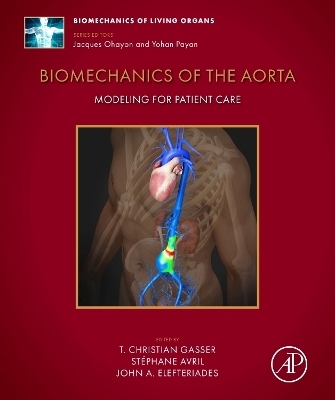
Biomechanics of the Aorta
Academic Press Inc (Verlag)
978-0-323-95484-6 (ISBN)
Divided into five parts, the book begins with an introduction to the fundamental aspects of the anatomy, biology, and physiopathology of the aorta, and then proceeds to present concepts of imaging and tissue/rheology characterization, tissue modeling and rupture, and flow modeling and algorithms. The final part dives into applications and case studies including transcatheter aortic valve implantation, aortic aneurysm rupture prediction, aortic dissections, and pharmacological treatments.
T. Christian Gasser is a professor of biomechanics at the KTH Royal Institute of Technology in Stockholm, Sweden, and an adjunct professor at the University of Southern Denmark in Odense, Denmark. Professor Gasser is the principal founder of VASCOPS GmbH, Graz, Austria, and ARTEC Vascular Diagnosis AB, Stockholm, Sweden. His scientific interest relates to vascular biomechanical problems, with particular emphasis on numerical techniques to solve clinically relevant questions. Constitutive models developed by Professor Gasser have been implemented in many major finite element simulation packages, and translational research led to diagnostic software that is used at many clinical centers. Professor Gasser is among the highest-cited researchers in vascular biomechanics. He has taught numerous courses at undergraduate and graduate levels, served as a supervisor for many engineering and clinical PhD students, is a frequent member of examination and grading committees, and is a reviewer of several science councils as well as the most relevant scientific journals in the field. Stéphane Avril is a distinguished Full Professor at Institut Mines Telecom affiliated at Mines Saint-Etienne in France. Stéphane received his PhD in mechanical and civil engineering in 2002 at Mines Saint-Etienne (France). After positions at Arts et Métiers ParisTech (France) and Loughborough University (UK), Stéphane returned to his alma mater in 2008 and extended his experience of inverse problems to soft tissue biomechanics, especially regarding aortic aneurisms in close collaboration with vascular surgeons. Stéphane was a visiting Professor at Yale University between 2014 and 2019 and is currently a guest professor at TU Vienna and TU Graz in Austria. Stéphane has received many awards and distinctions including an ERC (European Research Council) consolidator grant for the Biolochanics project on: Localization in biomechanics and mechanobiology of aneurysms: Towards personalized medicine. Most of Stéphane’s research is aimed at improving the treatment of cardiovascular diseases by assisting physicians and surgeons with biomechanical numerical simulations. In 2017, Stéphane co-founded Predisurge, a spin-off company of IMT at Mines Saint-Etienne. PrediSurge offers innovative software solutions for patient-specific numerical simulation of surgical procedures with first applications in endovascular aneurysm repair (EVAR). John A. Elefteriades is the William W.L. Glenn Professor of Surgery at Yale University and the Emeritus Director of the Aortic Institute at Yale New Haven Hospital. He is a past president of the Connecticut Chapter of the American College of Cardiology and a member of the national Board of Governors of the College. Dr. Elefteriades is also the past president of the International College of Angiology. He serves on the editorial board of the American Journal of Cardiology, the Journal of Cardiac Surgery, Cardiology, and the Journal of Thoracic and Cardiovascular Surgery, and he is the editor-in-chief of the journal AORTA. He has been a member of the Thoracic Surgery Director’s Association and has been named consistently in The Best Doctors in America. He is a frequently requested international lecturer, visiting professor, and guest surgeon. He has received the Walter Bleifeld Memorial Award for Distinguished Contribution in Clinical Research in Cardiology and the John B. Chang Research Achievement Award. In 2005, he was selected to lecture at the Leadership in Biomedicine Series at the Yale University School of Medicine. In 2006, he received the Socrates Award from the Thoracic Residents Association, the Thoracic Surgery Directors’ Association, and the Society of Thoracic Surgeons, recognizing exceptional achievement in teaching and mentoring residents. In 2017, Dr. Elefteriades was awarded an honorary PhD from the University of Liege (Belgium) in recognition of his work in the diagnosis and treatment of aortic diseases. In 2020, Dr. Elefteriades was recognized by Expertscape as the top aortic specialist in the world.
PART 1 Anatomy, biology, physiopathology
1. Physiopathology
2. Genetics of aortic disease
3. Mechanobiology of aortic cells and extracellular matrix
4. Clinical treatment options
PART 2 Imaging and tissue/rheology characterization
5. Novel experimental methods to characterize the mechanical properties of the aorta
6. Imaging aortic flows in 4D using MRI
7. Ultrasound imaging for aortic biomechanics
8. Functional imaging, focus on [18F]FDG positron emission tomography
9. Image processing: Deep learning for aorta model reconstruction
PART 3 Tissue modeling and rupture
10. On simulation of the biophysical behavior of the aortic heart valve interstitial cell
11. Abdominal Aortic Aneurysm and thrombus modeling
12. Computational modeling of aneurysm growth in mechanobiology
13. Analysis of aortic rupture: A computational biomechanics perspective
14. Multiscale modeling of aortic mechanics: Tissue, network, and protein
PART 4 Flow modeling and algorithm
15. Multiphysics flow modeling in the aorta
16. Novel Approaches for the numerical solution of fluid-structure interaction in the Aorta
17. Turbulence modeling of blood flow
18. Inverse problems in aortic flow modeling
19. Modeling of flow induced mechanosignaling
20. Reduced order modeling of cardiovascular hemodynamics
PART 5 Applications
21. Transcatheter aortic valve implantation (TAVI)
22. Abdominal Aortic Aneurysm rupture prediction
23. (T)EVAR simulation
24. Fluid Structure Interaction (FSI) in aortic dissections
25. Pharmacological treatments, mouse models, and the aorta
| Erscheinungsdatum | 22.08.2024 |
|---|---|
| Reihe/Serie | Biomechanics of Living Organs |
| Verlagsort | Oxford |
| Sprache | englisch |
| Maße | 191 x 235 mm |
| Gewicht | 1470 g |
| Themenwelt | Medizinische Fachgebiete ► Innere Medizin ► Kardiologie / Angiologie |
| Studium ► 1. Studienabschnitt (Vorklinik) ► Physiologie | |
| Naturwissenschaften ► Biologie | |
| ISBN-10 | 0-323-95484-7 / 0323954847 |
| ISBN-13 | 978-0-323-95484-6 / 9780323954846 |
| Zustand | Neuware |
| Informationen gemäß Produktsicherheitsverordnung (GPSR) | |
| Haben Sie eine Frage zum Produkt? |
aus dem Bereich