


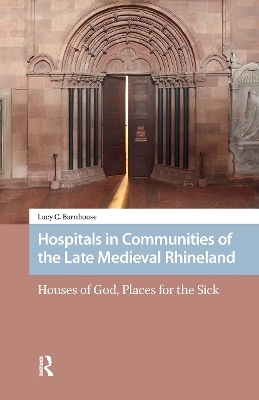
Hospitals in Communities of the Late Medieval Rhineland
Seiten
2023
Amsterdam University Press (Verlag)
978-94-6372-024-3 (ISBN)
Amsterdam University Press (Verlag)
978-94-6372-024-3 (ISBN)
From the mid-twelfth century onwards, the development of European hospitals was shaped by their claim to the legal status of religious institutions, with its attendant privileges and responsibilities. This book compares leper hospitals (leprosaria) to relgious multipurpose institutions in medieval times under canon law.
From the mid-twelfth century onwards, the development of European hospitals was shaped by their claim to the legal status of religious institutions, with its attendant privileges and responsibilities. The questions of whom hospitals should serve and why they should do so have recurred — and been invested with moral weight — in successive centuries, though similarities between medieval and modern debates on the subject have often been overlooked. Hospitals’ legal status as religious institutions could be tendentious and therefore had to be vigorously defended in order to protect hospitals’ resources. This status could also, however, be invoked to impose limits on who could serve in and be served by hospitals. As recent scholarship demonstrates, disputes over whom hospitals should serve, and how, find parallels in other periods of history and current debates.
From the mid-twelfth century onwards, the development of European hospitals was shaped by their claim to the legal status of religious institutions, with its attendant privileges and responsibilities. The questions of whom hospitals should serve and why they should do so have recurred — and been invested with moral weight — in successive centuries, though similarities between medieval and modern debates on the subject have often been overlooked. Hospitals’ legal status as religious institutions could be tendentious and therefore had to be vigorously defended in order to protect hospitals’ resources. This status could also, however, be invoked to impose limits on who could serve in and be served by hospitals. As recent scholarship demonstrates, disputes over whom hospitals should serve, and how, find parallels in other periods of history and current debates.
Lucy Barnhouse received her Ph.D. from Fordham University in 2017, and has been Assistant Professor of History at Arkansas State University since Fall 2020, having held visiting positions at the College of Wooster and Wartburg College. She has published on topics including medieval public health, leprosy, and religious women.
Acknowledgements, Introduction, Houses of God, Civic Hospitals in the City and Archdiocese of Mainz, Mainz's Hospital Sisters and the Rights of Religious Women, Leprosaria and the Leprous: Legal Status and Social Ties, For all miserable persons: Small and Extra-Urban Hospitals, Hospitals and their Networks: Recreating Relationships, Conclusion, Bibliography.
| Erscheinungsdatum | 21.07.2023 |
|---|---|
| Reihe/Serie | Premodern Health, Disease, and Disability |
| Verlagsort | Amsterdam |
| Sprache | englisch |
| Maße | 156 x 234 mm |
| Gewicht | 520 g |
| Themenwelt | Geisteswissenschaften ► Archäologie |
| Geschichte ► Allgemeine Geschichte ► Mittelalter | |
| Geschichte ► Allgemeine Geschichte ► Neuzeit (bis 1918) | |
| Studium ► Querschnittsbereiche ► Geschichte / Ethik der Medizin | |
| ISBN-10 | 94-6372-024-3 / 9463720243 |
| ISBN-13 | 978-94-6372-024-3 / 9789463720243 |
| Zustand | Neuware |
| Informationen gemäß Produktsicherheitsverordnung (GPSR) | |
| Haben Sie eine Frage zum Produkt? |
Mehr entdecken
aus dem Bereich



aus dem Bereich
Geschichte einer Augsburger Familie (1367-1650)
Buch | Softcover (2024)
Kohlhammer (Verlag)
CHF 47,60


