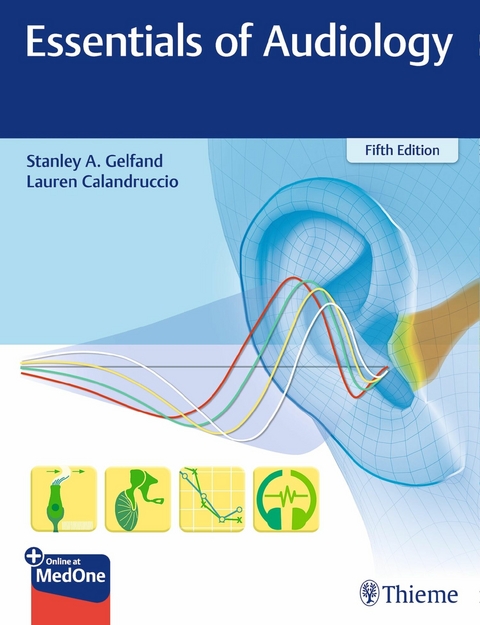
Essentials of Audiology (eBook)
590 Seiten
Georg Thieme Verlag KG
978-1-63853-106-7 (ISBN)
1Acoustics and Sound Measurement
We begin our study of audiology by reviewing the nature of sound because, after all, sound is what we hear. The science of sound is called acoustics, which is a branch of physics, and relies on several basic physical principles. Many useful sources are available for students wishing to pursue the areas covered in this chapter in greater detail (e.g., Peterson & Gross 1972; Hewitt 1974; Kinsler, Frey, Coppens, & Sanders 1982; Sears, Zemansky, & Young 1982; Beranek 1986; Gelfand 2018).
■ Physical Quantities
The basic physical quantities are mass, time, and length (or distance). All other physical quantities are derived by combining these three basic ones, as well as other derived quantities, in a variety of ways. The principal basic and derived quantities are summarized in Table 1.1. These basic quantities are expressed in terms of conventional units that are measurable and repeatable. The unit of mass (M) is the kilogram (kg) or the gram (g); the unit of length (L) is the meter (m) or the centimeter (cm); and the unit of time (t) is the second (s). Mass is not really synonymous with weight even though we express its magnitude in kilograms. The mass of a body is related to its density, but its weight is related to the force of gravity. If two objects are the same size, the one with greater density will weigh more. However, even though an object’s mass would be identical on the earth and the moon, it would weigh less on the moon, where there is less gravity.
Table 1.1 Principal physical quantities
| Quantity | Formula | MKS (SI) units | cgs units | Comments |
| Mass (M) | M | kilogram (kg) | gram (g) | 1 kg = 103 g |
| Time (t) | t | second (s) | s |
| Area (A) | A | m2 | cm2 | 1 m2 = 104 cm2 |
| Displacement (x) | x | meter (m) | centimeter (cm) | 1 m = 102 cm |
| Velocity (v) | v = x/t | m/s | cm/s | 1 m/s =102 cm/s |
| Acceleration (a) | a = v/t | m/s2 | cm/s2 | 1 m/s2 = 102 cm/s2 |
| Force (F) | F = Ma | kg · m/s2 | g · cm/s2 | 1 N = 105 dyne |
| = Mv/t | newton (N) | dyne |
| Pressure (p) | p = F/A | N/m2 Pascal (Pa) | dyne/cm2 microbar (μbar) | 2 × 10⁻⁵ N/m2 or 20 μPa (reference value) 2 × 10⁻⁴ dyne/cm2 or μbar (reference value) |
| Work (W) | W = Fx | N · m joule (J) | dyne · cm erg | 1 J = 107 erg |
| Power (P) | P = W/t | joule/s | erg/s | 1 W = 1 J/s |
| = Fx/t | watt (W) | watt (W) | 1 W = 107 erg/s |
| = Fv |
| Intensity (I) | I = P/A | W/m2 | W/cm2 | 10−12 W/m2 (reference value) 10−16 W/cm2 (reference value) |
When we express mass in kilograms and length in meters, we are using the meter-kilogram-second or MKS system. Expressing mass in grams and length in centimeters constitutes the centimeter-gram-second or cgs system. These two systems also have different derived quantities. For example, the units of force and work are called newtons and joules in the MKS system and dynes and ergs in the cgs system, respectively. We will emphasize the use of MKS units because this is the internationally accepted standard in the scientific community, known as the Système International d’Unites (SI). Equivalent cgs values will often be given as well because the audiology profession has traditionally worked in cgs units, and the death of old habits is slow and labored. These quantities are summarized with equivalent values in MKS and cgs units in Table 1.1. In addition, the correspondence between scientific notation and conventional numbers, and the meanings of prefixes used to describe the sizes of metric units are shown for convenience and ready reference in Table 1.2 and Table 1.3.
Table 1.2 Expressing numbers in standard notation and scientific notation
| Standard notation | Scientific notation |
| 0.000001 | 10−6 |
| 0.00001 | 10−5 |
| 0.0001 | 10−4 |
| 0.001 | 10–3 |
| 0.01 | 10–2 |
| 0.1 | 10–1 |
| 1 | 100 |
| 10 | 101 |
| 100 | 102 |
| 1000 | 103 |
| 10,000 | 104 |
| 100,000 | 105 |
| 1,000,000 | 106 |
| 3600 | 3.6 × 10³ |
| 0.036 | 3.6 × 10⁻² |
| 0.0002 | 2 × 10⁻⁴ |
| 0.00002 | 2 × 10⁻⁵ |
Table 1.3 Examples of prefixes used to express metric units
| Prefix | Symbol | Definition | Multiply by |
| Standard notation | Scientific notation |
| micro | μ | millionths | 1/1,000,000 or 0.000001 | 10−6 |
| milli | m | thousandths | 1/1000 or 0.001 | 10–3 |
| centi | c | hundredths | 1/100 or 0.01 | 10−2 |
| deci | d | tenths | 1/10 or 0.1 | 10–1 |
| deka | da | tens | 10 | 101 |
| hecto | h | hundreds | 100 | 102 |
| kilo | k | thousands | 1000 | 103 |
| mega | M | millions | 1,000,000 | 106 |
Quantities may be scalars or vectors. A scalar can be fully described by its magnitude (amount or size), but a vector has both direction and magnitude. For example, length is a scalar because an object that is one meter long is always one meter long. However, we are dealing with a vector when we measure the distance between two coins that are one meter apart because their relationship has both magnitude and direction (from point x 1 to point x 2). This quantity is called displacement (x). Derived quantities will be vectors if they have one or more components that are vectors; for example, velocity is a vector because it is derived from displacement, and acceleration is a vector because it involves velocity. We distinguish between scalars and vectors because they are handled differently when calculations are being made.
Velocity Everyone knows that “55 miles per hour” refers to the speed of a car that causes it to travel a distance of 55 miles in a one-hour period of time. This is an example of velocity (v), which is equal to the amount of displacement (x) that occurs over time (t):
Displacement is measured in meters and time is measured in seconds (s); thus,...
| Erscheint lt. Verlag | 9.11.2022 |
|---|---|
| Sprache | englisch |
| Themenwelt | Medizin / Pharmazie ► Gesundheitsfachberufe ► Logopädie |
| Medizin / Pharmazie ► Medizinische Fachgebiete ► HNO-Heilkunde | |
| Schlagworte | acoustic • acoustics • anatomy • Assessment • auditory disorders • clinical management • hearing impairments • Physiology • screening techniques |
| ISBN-10 | 1-63853-106-4 / 1638531064 |
| ISBN-13 | 978-1-63853-106-7 / 9781638531067 |
| Informationen gemäß Produktsicherheitsverordnung (GPSR) | |
| Haben Sie eine Frage zum Produkt? |
 EPUB (Wasserzeichen)
DRM: Digitales Wasserzeichen
Dieses eBook enthält ein digitales Wasserzeichen und ist damit für Sie personalisiert. Bei einer missbräuchlichen Weitergabe des eBooks an Dritte ist eine Rückverfolgung an die Quelle möglich.
Dateiformat: EPUB (Electronic Publication)
EPUB ist ein offener Standard für eBooks und eignet sich besonders zur Darstellung von Belletristik und Sachbüchern. Der Fließtext wird dynamisch an die Display- und Schriftgröße angepasst. Auch für mobile Lesegeräte ist EPUB daher gut geeignet.
Systemvoraussetzungen:
PC/Mac: Mit einem PC oder Mac können Sie dieses eBook lesen. Sie benötigen dafür die kostenlose Software Adobe Digital Editions.
eReader: Dieses eBook kann mit (fast) allen eBook-Readern gelesen werden. Mit dem amazon-Kindle ist es aber nicht kompatibel.
Smartphone/Tablet: Egal ob Apple oder Android, dieses eBook können Sie lesen. Sie benötigen dafür eine kostenlose App.
Geräteliste und zusätzliche Hinweise
Buying eBooks from abroad
For tax law reasons we can sell eBooks just within Germany and Switzerland. Regrettably we cannot fulfill eBook-orders from other countries.
aus dem Bereich