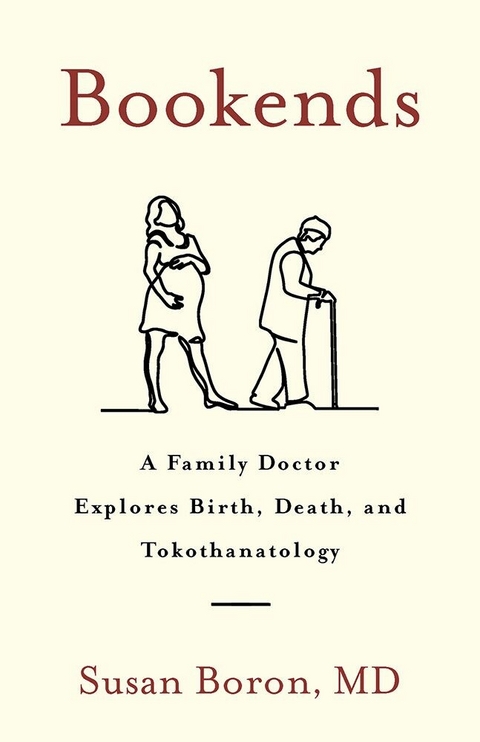
Bookends (eBook)
186 Seiten
Houndstooth Press (Verlag)
978-1-5445-3132-8 (ISBN)
Toko*thanat*ology (n): The theoretical study of the parallels between birth and death, especially in medical care. What do birth and death have in common? They both represent times of profound change, when patients and their families need emotional support and empathy from their caregivers-things they don't teach in medical school. The practical skills and knowledge required to provide care in obstetrics and palliative care are essential. But dealing with the deeper meaning, the human connection, is equally important. The very nature of these events encourages the caregiver to walk alongside the patient, to assist rather than control. In Bookends, Dr. Susan Boron explores the powerfully human aspects of caring for people at both ends of their lives. She shows how expertise in one area of care easily transfers to the other, increasing confidence and improving care and satisfaction for practitioner and patient alike.
Chapter 1
Why I Am the One to Write This Book
The two moments are much alike: birth and death are made of the same fabric.
—Isabel Allende
Tokothanatology: During my career in medicine, I learned that people facing terminal illness need many of the same things that women giving birth need.
My father is a delivery man.
Actually, he was an obstetrician, and a rather renowned one at that. But I heard him say “I’m off to do a delivery” many times, so I told my Grade 1 classmates that’s what he did.
Murray W. Enkin—MD FRCSC FACOG LLD (hon) D (hon) CM to the rest of the world, Daddy to me—was passionate about his work in maternal care. He talked about his love of women—pregnant women in particular. He said he made a commitment to himself very early on to do something about the way women in labour were treated. He vowed to change the status quo of the doctor being in charge and the woman having no involvement other than just being there. He was an early advocate of Dr. Grantly Dick-Read’s philosophy that a woman’s mental and emotional involvement in the delivery of her child improved the experience, and of Dr. Fernand Lamaze’s method for reducing pain in labour without medication by teaching exercises and breathing techniques.
Even before my father finished his internship in the late 1940s, he was teaching prenatal classes to his patients. His plan had been to become a general practitioner who did good obstetrics, but after a few years in rural Saskatchewan, he moved our family to New York to study and specialize in obstetrics and gynecology. Then we moved to Hamilton, Ontario, a city with a large immigrant population. Daddy saw the need for an Italian-speaking obstetrician in the city, so he hired a tutor, and he and Mommy learned Italian at our dining room table. My sister, Nomi, four or five at the time, became quite fluent in the language. Sitting near that table, I learned only two things in Italian. One was how to count to ten, “uno duo tre…” The other was how to say “spingi” (“push”). Hmm.
After my father attended an international conference in Paris in 1962, featuring Dr. Lamaze’s principles of psychoprophylaxis in obstetrics, he and my mother began teaching prenatal classes in our basement, promoting prepared childbirth as an alternative way of giving birth. I remember pregnant ladies streaming into our home with their husbands and their pillows for their weekly classes. I sometimes came home from school to find a pregnant couple in our living room. Daddy would invite his patients to our home for part of their labour—because we had a bathtub, and the hospital didn’t; and because my mother would give the women something to eat, and the hospital wouldn’t. It was a quick trip across the road when it was time to deliver.
Daddy was the first obstetrician in Canada to have fathers in the delivery room. On one occasion, he dressed a father up in scrubs, gown, mask, and shoe covers and had him watch the birth of his child silently. Only after the birth did Daddy reveal what he had done to the hospital administration.
My father was the first to deliver women in the labour room instead of moving to the sterile delivery suites. He challenged many of the standard procedures of obstetrical care of the time, such as episiotomies, shaving, and enemas. And later, as birth became even more medicalized, he questioned the routine use of technology such as fetal heart monitors for low-risk deliveries. Routine procedures, in his view, often became empty rituals, without good evidence to support their continued use.
He would sometimes sleep on the floor outside of his patient’s hospital room, to protect her from the “routines” done to women in labour. No wonder he missed so many family dinners!
He went on to do extensive teaching and writing, promoting family-centred maternity care and prepared childbirth. He worked closely with many of the leaders of childbirth education, such as Elisabeth Bing,2 Sheila Kitzinger,3 Suzanne Arms,4 Doris Haire,5 and others. Some of these women became his good friends and visited with our family. I remember staying with Elisabeth Bing in New York as a teenager one New Year’s Eve. Daddy must have been working with her, or maybe it was just a social visit. Her apartment was decorated with a huge collection of pre-Columbian figurines, mostly pregnant women, women giving birth, and fertility statues. After experiencing Times Square at midnight, we got to sleep in the room with her amazing sculptures.
My father wrote forewords to these women’s books, supporting the concepts they promoted. He was influential in organizations such as ASPO (the American Society for Psychoprophylaxis in Obstetrics) and ICEA (the International Childbirth Education Association), and he edited and wrote for journals related to their causes.
In collaboration with Marc Keirse and Iain Chalmers, and with my mother doing all the bibliographic work, my father did a thorough study of all of the literature on pregnancy and childbirth, reviewing it for the quality of research and the evidence on effectiveness. They classified practices by those that improved outcomes, those that caused more harm than good, and those that had no effect on outcomes. They wrote and edited Effectiveness and Satisfaction in Antenatal Care in 1982,6 and then Effective Care in Pregnancy and Childbirth (ECPC), which was published in 19897 and later morphed into the Cochrane Collaboration,8 now one of the most prestigious platforms for assessing and presenting all medical research and guidelines. There is a vast section on palliative care in the Cochrane now, as well.9
The group realized that the robust ECPC textbook was not accessible to the average birth attendant: the midwife in Africa, for example, or the family doctor in rural Saskatchewan. So they later wrote the bestselling Guide to Effective Care in Pregnancy and Childbirth,10 a small, inexpensive summary of the ECPC and all the results—positive, negative, and neutral.
My mother, Eleanor Enkin, was a birth photographer. Many couples hired her to take photographs of their labour, delivery, and family moments. Some of her photographs grace various books about pregnancy and were used in my father’s lectures and her own.
My father’s advocacy for pregnant women and for the best of all possible experiences in childbearing carried over into the rest of his life’s philosophy. Personal choice was always the most important principle of care for him. As he aged, he talked about the same principle at the end of life. He was fascinated by the palliative care work my husband, Doug, and I did. He embraced choice, education, and excellence in care for the dying. He was a strong advocate for the “death with dignity” concept, promoting the right of a person to die in the way and at the time of their choosing. Let’s just say that we had many heated discussions about this subject over the years. He coined the word tokothanatology to describe the study of birth and death and talked about it often. (I still claim the idea was mine.)
So I grew up in a home where pregnancy, deliveries, prenatal care, and patient choice were routine parts of the dinner conversation. Didn’t everyone?
My childhood answer to that universal question, “What are you going to be when you grow up?” was “a Mommy with eleven children—or a Mad Scientist.” Instead, I applied to medical school. Like most medical students, I wanted to go into each speciality as I did the rotation in that field. In particular, I loved obstetrics, geriatrics, and psychiatry. I remember, in a verbal exam during my OB rotation, being asked about the progress of a delivery and describing the whole thing, step by step, using my hands to demonstrate. I heard one of the examiners whisper to the other that I was a natural. And then I had a rotation in family medicine. I knew right away that was my fit—I wanted to be the doctor who could care for the whole person, to see them as a complex sum of all their parts, mind and body.
I did a family medicine residency, got married in the process, and then practiced in Hamilton for a couple of years before choosing a practice in the small town of Kincardine, on the shore of Lake Huron—mostly because the delivery room in their hospital had a big window facing out onto the lake, and I thought that was just wonderful.
I was well trained in the obstetrical practices of the time, so when I began delivering babies, I followed all the standard routines. But with my father’s ideas planted firmly in my head and the cockiness (or naivety) of youth, I pushed the limits and started to ignore a lot of the rules. At the time, there was a fairly rigid set of procedures for childbirth. At the onset of labour, the woman was admitted to hospital, examined and prepped (i.e., her pubic area was shaved and she was given an enema), and put to bed. Once labour was well established, the woman would be encouraged to get her epidural. Her husband might have been allowed in the labour room but was invited to leave for any examinations or procedures. When it was time to deliver, she was transferred...
| Erscheint lt. Verlag | 23.8.2022 |
|---|---|
| Sprache | englisch |
| Themenwelt | Medizin / Pharmazie |
| ISBN-10 | 1-5445-3132-X / 154453132X |
| ISBN-13 | 978-1-5445-3132-8 / 9781544531328 |
| Informationen gemäß Produktsicherheitsverordnung (GPSR) | |
| Haben Sie eine Frage zum Produkt? |
 EPUB (Ohne DRM)
Größe: 564 KB
Digital Rights Management: ohne DRM
Dieses eBook enthält kein DRM oder Kopierschutz. Eine Weitergabe an Dritte ist jedoch rechtlich nicht zulässig, weil Sie beim Kauf nur die Rechte an der persönlichen Nutzung erwerben.
Dateiformat: EPUB (Electronic Publication)
EPUB ist ein offener Standard für eBooks und eignet sich besonders zur Darstellung von Belletristik und Sachbüchern. Der Fließtext wird dynamisch an die Display- und Schriftgröße angepasst. Auch für mobile Lesegeräte ist EPUB daher gut geeignet.
Systemvoraussetzungen:
PC/Mac: Mit einem PC oder Mac können Sie dieses eBook lesen. Sie benötigen dafür die kostenlose Software Adobe Digital Editions.
eReader: Dieses eBook kann mit (fast) allen eBook-Readern gelesen werden. Mit dem amazon-Kindle ist es aber nicht kompatibel.
Smartphone/Tablet: Egal ob Apple oder Android, dieses eBook können Sie lesen. Sie benötigen dafür eine kostenlose App.
Geräteliste und zusätzliche Hinweise
Buying eBooks from abroad
For tax law reasons we can sell eBooks just within Germany and Switzerland. Regrettably we cannot fulfill eBook-orders from other countries.
aus dem Bereich