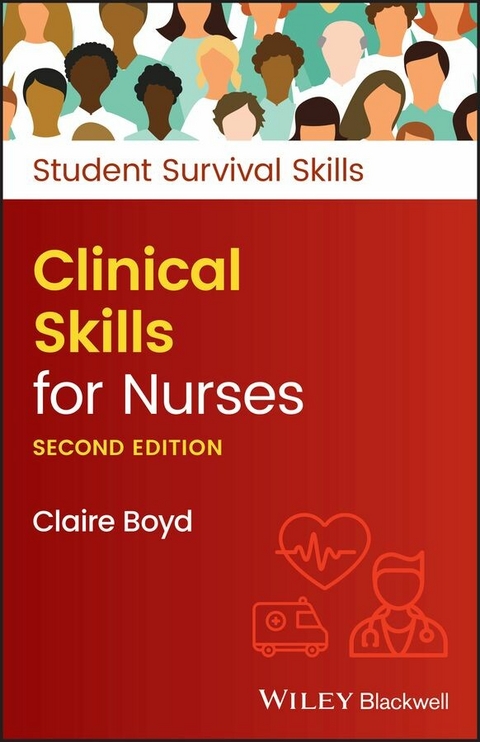
Clinical Skills for Nurses (eBook)
John Wiley & Sons (Verlag)
978-1-119-87156-9 (ISBN)
A handy introduction to the essential practical procedures that nurses need to know
Clinical Skills for Nurses is designed to help student nurses understand the practice of common clinical skills and procedures in various healthcare environments, from the acute hospital ward to the community setting. Written by a highly experienced nurse and Practice Development Trainer, this pocket-sized guide covers 16 clinical skills in an accessible, step-by-step format. Numerous activities and exercises build your confidence and competence, whilst end-of-chapter questions test your understanding of intravenous therapy, tracheotomy care, bowel care, early patient assessment and response, basic life support, and more.
Now in its second edition, Clinical Skills for Nurses provides new and updated material throughout, including information about the PUREWICK female external catheter, constipation, moisture lesions, Aseptic Non-Touch Technique (ANTT), and the National Early Warning Score (NEWS2). This edition also includes more 'Test Your Knowledge' questions, new links to internet resources, and coverage of four additional clinical skills: stoma care, continence care, anaphylaxis, and performing an electrocardiogram (ECG).
- Reflects the current NMC standards for pre-registration education and the Essential Skills Clusters
- Provides the underpinning knowledge of how each clinical skill should be performed
- Features valuable tips, hints, and advice from real-life student nurses
- Includes numerous examples drawn from a variety of real-world nursing and healthcare scenarios
- Contains a wealth of learning tools, including glossary boxes, key points, learning outcomes, illustrations, tables, and graphs
Developed by nursing students for nursing students, Clinical Skills for Nurses, Second Edition is a must-have guide for all student nurses as well as newly qualified or more experienced nurses looking to refresh their knowledge of clinical skills.
Claire Boyd was Practice Development Trainer in the Learning and Research Centre at North Bristol Healthcare Trust. She develops, designs, delivers and evaluates learning programmes, and organises the transition training program for student nurses and support of these nurses in clinical areas.
Claire Boyd was Practice Development Trainer in the Learning and Research Centre at North Bristol Healthcare Trust. She develops, designs, delivers and evaluates learning programmes, and organises the transition training program for student nurses and support of these nurses in clinical areas.
Preface vi
Introduction vii
Acknowledgements x
1 Aseptic Non-Touch Technique and Infection Prevention 1
2 Performing Observations 17
3 ABCDE Assessment 41
4 Continence Care 54
5 Male Urethral Catheterisation 71
6 Female Urethral Catheterisation 102
7 Bowel Care 112
8 Stoma Care 145
9 Tracheostomy Care 157
10 Point-of-Care Training 173
11 Venepuncture 193
12 Peripheral Cannulation 214
13 Intravenous Therapy 228
14 Blood Transfusion 256
15 Basic Life Support 275
16 Performing An Electrocardiogram 288
Answers 309
Appendix 1: News 2 Observation Chart 323
Index 325
Chapter 1
ASEPTIC NON‐TOUCH TECHNIQUE AND INFECTION PREVENTION
LEARNING OUTCOMES
By the end of this chapter you will have an understanding of the aseptic non‐touch technique (ANTT) and be able to define it. You will also be able to describe the ANTT framework, list the ANTT principles and be able to apply ANTT to your practice.
Performing any clinical skills we must first consider infection control principles to reduce incidences of healthcare acquired infections (HCAIs) and community acquired infections. We first need to refresh our understanding of some of these micro‐organisms. Table 1.1 shows just four of the micro‐organism culprits.
Healthcare acquired infection (HCAI)
Also known as healthcare associated infections. These are infections that people get while they are receiving healthcare for another condition. HCAIs are a significant cause of illness and death and they can have serious emotional, financial and medical consequences.
Table 1.1 Four types of micro‐organisms.
| Micro‐organism | Examples |
|---|
| Bacteria: Gram positive | Clostridium difficile, staphylococcus |
| Bacteria: Gram negative | Salmonella, gonorrhoeae |
| Mycobacteria | Tuberculosis, leprosy |
| Virus | Herpes zoster: chicken pox, shingles, norovirus, coronavirus |
| Fungi (superficial) | Thrush, ringworm |
| Protozoa | Plasmodium (cause of malaria) Cryptosporidium (can cause gastroenteritis) |
MICRO‐ORGANISMS
Bacteria, viruses, fungi or other less common pathogens can cause HCAIs. The most well‐known include those caused by methicillin‐resistant Staphylococcus aureus (MRSA) and Clostridium difficile (C‐diff).
Table 1.1 only shows the ‘bad’ micro‐organisms, known as pathogenic microbes. But not all bacteria are bad – the ‘good’ micro‐organisms, known as commensal microbes, actually live in or on the human body and help the body: vitamin K, which is necessary to regulate our blood clotting processes, is produced by some of these good bacteria.
DID YOU KNOW?
It has been estimated that 1 kg of an adult's total body weight is composed of bacteria, known as microflora, which are beneficial to the human body.
Just one of those good‐guy bacteria is known as Lactobacillus acidophilus. This bacterium helps us by:
- supporting digestive function
- supporting the health of the immune system
- supporting the health of the urinary tract
- improving vaginal microflora in women
- enhancing absorption of nutrients
- relieving abdominal cramps, gases, and diarrhoea.
Micro‐organisms already present in the body only cause problems when the body's defences are weakened (due to ill health) or breached by surgery or other medical procedures. Within the healthcare environment we are generally more concerned about pathogenic micro‐organisms.
MIASMA
Since 100 BCE, our ancestors were aware that disease could be spread by ‘imperceptible particles’ entering the body; In short that the air around us is not pure, and if you were unlucky, this bad air or ‘miasma’ could cause disease or death if breathed in. Later on, surgeons would have sulphur burnt where they would operate, to purify the air, creating a lovely aroma of rotten eggs! This rudimental understanding of microbes had not yet equated good health with good hand hygiene.
DID YOU KNOW?
The airborne germs we breathe in includes bacteria, fungi, moulds, viruses, and volatile organic compounds, which are chemicals that easily dissolve in water or vaporise into air.
How Are Micro‐organisms Spread?
Micro‐organisms are not solely spread through the air; The six potential routes are:
- Direct contact, for example kissing or sexual contact
- Indirect contact, for example contaminated hands touching surfaces or other people
- Airborne, for example sneezing or coughing or through disturbance of dust when cleaning
- Faecal–oral, for example not washing hands after going to the toilet and then preparing food and ingesting it
- Animal vector, for example mosquito bite inserting micro‐organisms into the body causing malaria
- Bloodborne, for example sharing dirty needles, used equipment or by infected blood products.
Five Moments of Hand Hygiene
As our knowledge about micro‐organisms increased, we also became much more aware of the importance in healthcare of correct hand washing. The World Health Organization (2009) developed the five moments of hand hygiene, suggesting when we should wash our hands:
- before patient contact
- before an aseptic task
- after body fluid exposure risk
- after patient contact
- after contact with patient surroundings.
It is all well and good knowing when to wash your hands, but it must be performed correctly.
Correct Hand Washing
A simple but effective means of protecting patients from nosocomial infection is hand washing, which is considered to be the most basic but vital infection control measure. Healthcare practitioners are taught the six‐point hand washing technique:
- Palm to palm.
- Right palm over left dorsum and left palm over right dorsum.
- Palm to palm fingers interlocked.
- Back of fingers to opposing palms with fingers interlocked.
- Rotational rubbing of right thumb clasped in left palm and vice versa.
- Rotational rubbing backwards and forwards with clasped fingers at right hand in left palm and vice versa.
The gold standard is to use liquid soap on wet hands and to dry the hands thoroughly.
The Chain of Infection
We now know how micro‐organisms are spread and how effective correct hand washing is, but we also need to be aware of the chain of infection. The chain of infection has six links; break one of the links and the spread of infection is prevented. The six links are:
- An infectious agent, such as MRSA or norovirus.
- A reservoir, such as people, food, water.
- A way out of the body, such as, faeces, urine, sneezing.
- A method of spread, such as contact by hand or equipment, droplets, airborne.
- A way into the body, such as breaks in the skin, mucous membrane, inhalation.
- A susceptible host such as elderly individuals or those with poor immune systems (cancer patients, newborn).
Today, healthcare workers are trained in infection control principles and our knowledge has somewhat increased since the miasma theory days! However, we still have much to learn as numbers of patients contracting infections in either the hospital or community setting are far too high. HCAIs pose a serious risk to patients, staff and visitors, and substantial costs to the NHS and care providers, and significant morbidity to those infected. Individuals have the right to expect that they are being safely cared for, with staff trained in infection control principles to minimise their chances of catching an infection.
POOR PRACTICE
As our knowledge in infection control principles have increased, our execution of this knowledge still needs to be addressed.
At the start of my nursing career as a student on placement, I once saw a registered midwife putting on sterile gloves to empty a new mother's urinary catheter bag. Clearly, this healthcare professional had not quite understood the basic principles of infection control, as non‐sterile gloves and apron would have sufficed. I have more recently seen a male patient having a urinary catheter inserted with the nurse wearing two pairs of sterile gloves (known as the ‘double gloving’ technique). We know today that the bottom pair of sterile gloves is not sterile because of the pores in the gloves. This practice should no longer be seen when conducting aseptic techniques.
Years ago, it was all very confusing, not least because we would use the term ‘sterile technique’ and ‘aseptic technique’ interchangeably. Sterile and aseptic are not the same thing.
DID YOU KNOW?
Double gloving is acceptable practice in surgery/operating theatres as it does provide an additional level of protection against penetration of the gloves by surgical instruments.
What Does It All Mean?
In the healthcare sector, we have known for many years the devastation that the harmful germs can inflict but the terminology we use to describe the technique we are using to reduce contamination has been less clear, if not downright confusing. For example, when performing any dressing change in the ward area, we would wait some time for the dust to settle after bed making and then refer to...
| Erscheint lt. Verlag | 24.6.2022 |
|---|---|
| Reihe/Serie | Student Survival Skills |
| Student Survival Skills | Student Survival Skills |
| Sprache | englisch |
| Themenwelt | Medizin / Pharmazie ► Pflege |
| Schlagworte | clinical handbook nursing • Clinical Skills • clinical skills for nursing students • Einführungen in die Krankenpflege • General Clinical Nursing • Introductions to Nursing • introduction to clinical nursing skills • Klinische Fertigkeiten • Klinische Krankenpflege • Krankenpflege • Medical Science • Medizin • nursing • nursing student clinical procedures guide • student nurse clinical guide • student nurse clinical skills • student nurse clinical skills handbook |
| ISBN-10 | 1-119-87156-5 / 1119871565 |
| ISBN-13 | 978-1-119-87156-9 / 9781119871569 |
| Informationen gemäß Produktsicherheitsverordnung (GPSR) | |
| Haben Sie eine Frage zum Produkt? |
 EPUB (Adobe DRM)
Kopierschutz: Adobe-DRM
Adobe-DRM ist ein Kopierschutz, der das eBook vor Mißbrauch schützen soll. Dabei wird das eBook bereits beim Download auf Ihre persönliche Adobe-ID autorisiert. Lesen können Sie das eBook dann nur auf den Geräten, welche ebenfalls auf Ihre Adobe-ID registriert sind.
Details zum Adobe-DRM
Dateiformat: EPUB (Electronic Publication)
EPUB ist ein offener Standard für eBooks und eignet sich besonders zur Darstellung von Belletristik und Sachbüchern. Der Fließtext wird dynamisch an die Display- und Schriftgröße angepasst. Auch für mobile Lesegeräte ist EPUB daher gut geeignet.
Systemvoraussetzungen:
PC/Mac: Mit einem PC oder Mac können Sie dieses eBook lesen. Sie benötigen eine
eReader: Dieses eBook kann mit (fast) allen eBook-Readern gelesen werden. Mit dem amazon-Kindle ist es aber nicht kompatibel.
Smartphone/Tablet: Egal ob Apple oder Android, dieses eBook können Sie lesen. Sie benötigen eine
Geräteliste und zusätzliche Hinweise
Buying eBooks from abroad
For tax law reasons we can sell eBooks just within Germany and Switzerland. Regrettably we cannot fulfill eBook-orders from other countries.
aus dem Bereich