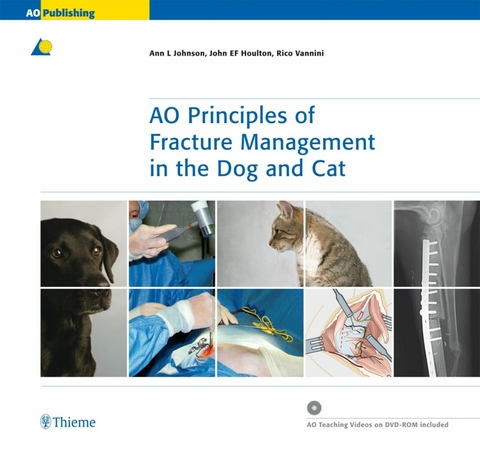
AO Principles of Fracture Management in the Dog and Cat (eBook)
552 Seiten
Georg Thieme Verlag KG
978-3-13-258184-5 (ISBN)
Ann L. Johnson, John E. F. Houlton/, Rico Vannini
Ann L. Johnson, John E. F. Houlton/, Rico Vannini
Introduction—AO philosophy and principles
1 AO philosophy
The philosophy of the AO group has remained consistent and clear, from its inception by a small group of friends and colleagues in 1958 to its current status as a worldwide surgical and scientific foundation. Seeing as its central concern all patients with skeletal injuries and related problems, the philosophy has been directed to providing for them a pattern of care designed to bring an early return to mobility and function. This philosophy has driven everything that has grown from the original aspirations and plans of the founding group, and remains the central inspiration of today's AO Foundation.
The key to its implementation has been effective and rational management of injured bones and soft tissues so as to foster rapid restoration of the patient's function. Management protocols have constantly been adapted to take account of the fresh understanding of the healing process gained from growing clinical expertise and expanding research.
2 Background
In the first half of the 20th century, fracture management was concentrated on the restoration of bony union, to the exclusion, largely, of other considerations seen today not only as relevant but essential.
The methods employed to manage fractures, mostly by immobilization in plaster or by traction, had the effect, too often, of inhibiting rather than promoting function throughout the healing period, which was itself frequently prolonged. The key concept of the AO was to give expression to its philosophy by safe and effective open reduction and internal fixation of fractures, intimately combined with early functional rehabilitation.
Long before the establishment of the AO, there had, of course, been keen championship and authoritative recognition of the value of open reduction and fixation of fractures. The innovative approaches and technical vision of early advocates of surgical fracture care are well documented. That their ideas were either not heard or failed to penetrate shows how arid was the ground on which these pioneering seeds first fell and, equally, what great technical and biological obstacles remainded to be overcome. The list is formidable: infection, dubious metallurgy, poor biological awareness, illconceived implants, and an underdeveloped understanding of the role of fixation were all added to peer group skepticism often amounting to real hostility.
Thus, such highlights as the visionary innovations of the Lambottes, the technical achievements of Küntscher with the intramedullary nail, and the conceptual advances of Lucas-Championnière and his protagonist Perkins in introducing early motion (albeit on traction), were dimmed by an apparent inability to reconcile within one pattern of care the two concepts of effective splintage of the fracture and controlled mobility of the joints.
3 The role of the AO
What was needed—and what the AO provided—was a coordinated approach to identify these obstacles, to study the difficulties they caused, and to set about overcoming them. The chosen path was to investigate and understand the relevant biology, to develop appropriate technology and techniques, to document the outcomes and react to the findings, and, through teaching and writing, to share whatever was discovered.
This enormous challenge had an apparently small beginning. In the 1940s and 1950s, questions were being asked, not least by the Swiss state and commercial insurance companies, as to why, if it took some fractures 6–12 weeks to heal, it often took 6–12 months for the patients to return to work.
The story of how an encounter with Robert Danis, first through his writings and later by a personal visit, provided the inspiration for Maurice Müller and the group he subsequently gathered about him to begin developing answers to questions, has been well documented.
The essence of Danis' observation was that if he used a compression device to impart absolute stability to a diaphyseal fracture, healing without callus would take place and, while it was happening, the adjacent joints and muscles could safely and painlessly be exercised.
Inspired by this concept and driven by a determination not only to apply it but also to establish how and why it worked, Müller and the AO group set in train a process of surgical innovation, technical development, basic research, and clinical documentation. This progressed as an integrated campaign to improve the results and minimize the problems of fracture care. They then set about propagating their message by writing and teaching. That work continues to this day, with involvement of many specialist groups working mostly, it should be said, in harmony to the common end of improving patient care worldwide, in greatly differing environments.
4 AO principles
Today, any statement of the key concepts— conventionally referred to as the AO “principles”— through which the AO philosophy was given expression, can be remarkably similar in wording to what appeared in the early AO publications from 1962 onwards. The essential feature, now as then, is the proper management of the fracture within the environment of the patient. The need was for a proper understanding of the “personalities” of the fracture and of the injury; from this all else would follow.
The original management objectives were restoration of anatomy, establishment of stability, while preserving blood supply, with early mobilization of limb and patient. These were at first presented as the fundamentals of good internal fixation. However, with increased understanding of how fractures heal, with acceptance of the supreme role of the soft tissues and with ever-expanding understanding of how implants and bones interact, they have undergone certain conceptual and technological changes while gaining their present status as the principles not just of internal fixation but also of fracture management overall.
Central to the effective application of the AO's concepts was the understanding that articular fractures and diaphyseal fractures have very different biological requirements. Allied to this was the increasingly clear recognition that the type and timing of surgical intervention must be guided by the degree of injury to the soft-tissue envelope and the physiological demands of the patient.
5 Progress and development
The AO principles relating to anatomy, stability, biology, and mobilization still stand as fundamentals. How they have been expressed, interpreted, and applied over the past 40 years has gradually changed in response to the knowledge and understanding emerging from scientific studies and clinical observation.
It is now accepted that the pursuit of absolute stability, originally proposed for almost all fractures, is mandatory only for joint and certain related fractures, and then only when it can be obtained without damage to blood supply and soft tissues. Within the diaphysis, there must always be respect for length, alignment, and rotation. When fixation is required, splintage by a nail is usually selected and this leads to union by callus. Even when the clinical situation favors the use of a plate, proper planning and the current techniques for minimal access and fixation have been designed to minimize any insult to the blood supply of the bony fragments and soft tissues.
It must be appreciated that simple diaphyseal fractures react differently to plating and to nailing, and if plating is employed, absolute stability must be achieved. In contrast, multifragmentary fractures can all be treated by splintage. Fractures of the forearm diaphyses, where long-bone morphology is combined with quasi-articular functions, need special consideration. Articular fractures demand anatomical reduction and absolute stability to enhance the healing of articular cartilage and make early motion possible, which is necessary for good ultimate function.
The imperatives of soft-tissue care, originally expressed in the principle of preserving blood supply to bone, must be addressed in every phase of fracture management, from initial planning to how, if at all, the bone is to be handled. A clear understanding of the roles of direct and indirect reduction, together with informed assessment of how the fracture pattern and soft-tissue injuries relate to each other, will lead to correct decisions on strategy and tactics being made and incorporated into the preoperative plan. From this will follow the...
| Erscheint lt. Verlag | 25.5.2005 |
|---|---|
| Verlagsort | Stuttgart |
| Sprache | englisch |
| Themenwelt | Medizin / Pharmazie ► Medizinische Fachgebiete ► Orthopädie |
| Schlagworte | Cat • Chirurgie • Dog • fracture treatment • Frakturbehandlung • Hund • Katze • Kleintierchirurgie • Small Animal Surgery • Surgery |
| ISBN-10 | 3-13-258184-4 / 3132581844 |
| ISBN-13 | 978-3-13-258184-5 / 9783132581845 |
| Informationen gemäß Produktsicherheitsverordnung (GPSR) | |
| Haben Sie eine Frage zum Produkt? |
 EPUB (Wasserzeichen)
DRM: Digitales Wasserzeichen
Dieses eBook enthält ein digitales Wasserzeichen und ist damit für Sie personalisiert. Bei einer missbräuchlichen Weitergabe des eBooks an Dritte ist eine Rückverfolgung an die Quelle möglich.
Dateiformat: EPUB (Electronic Publication)
EPUB ist ein offener Standard für eBooks und eignet sich besonders zur Darstellung von Belletristik und Sachbüchern. Der Fließtext wird dynamisch an die Display- und Schriftgröße angepasst. Auch für mobile Lesegeräte ist EPUB daher gut geeignet.
Systemvoraussetzungen:
PC/Mac: Mit einem PC oder Mac können Sie dieses eBook lesen. Sie benötigen dafür die kostenlose Software Adobe Digital Editions.
eReader: Dieses eBook kann mit (fast) allen eBook-Readern gelesen werden. Mit dem amazon-Kindle ist es aber nicht kompatibel.
Smartphone/Tablet: Egal ob Apple oder Android, dieses eBook können Sie lesen. Sie benötigen dafür eine kostenlose App.
Geräteliste und zusätzliche Hinweise
Buying eBooks from abroad
For tax law reasons we can sell eBooks just within Germany and Switzerland. Regrettably we cannot fulfill eBook-orders from other countries.
aus dem Bereich