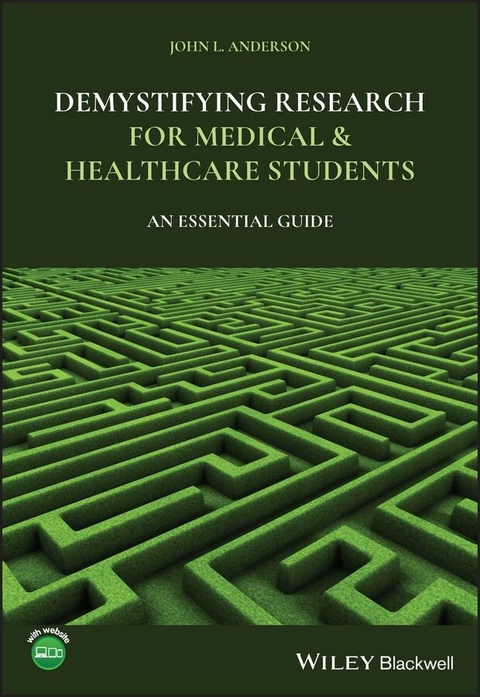
Demystifying Research for Medical and Healthcare Students (eBook)
John Wiley & Sons (Verlag)
978-1-119-70138-5 (ISBN)
DEMYSTIFYING RESEARCH FOR MEDICAL & HEALTHCARE STUDENTS
All healthcare students need to understand research methods to be able to understand research articles and to actively engage in research where necessary. Most clinical programs include research training within their courses, and many students are required to undertake an assessed research project-both at undergraduate and postgraduate levels. Breaking down the jargon barriers of research methods, and designed for those new to the world of research, Demystifying Research is a straightforward and highly accessible guide to fundamental research methods, approaches, and skills.
This student-friendly resource describes quantitative and qualitative research approaches, mixed research methods, research ethics and governance, research skills and more. Step-by-step, students learn to appraise research in scholarly articles, design a project, and conduct research in the lab, in clinical practice, and other real-life situations. Technical jargon and classic research are explained in plain English, while relevant theory is illustrated through relatable examples of research in practice. Designed to make learning about research easy, this valuable guide:
- Explains basic research methods in a direct and engaging style
- Breaks research methods down into manageable, easy-to-digest pieces
- Defines what research is, and provides an overview of its methods and methodologies
- Covers all key areas of research, including observational and experimental approaches, and clinical trials
- Includes real-life examples of successful student research projects
- Features a companion website containing lecture slides available to download in PowerPoint
Demystifying Research is a must-have for undergraduate and postgraduate medical, nursing, other healthcare and social sciences students, as well as professionals looking to refresh their knowledge.
John L. Anderson, Principal Lecturer, Department of Medical Education, Brighton and Sussex Medical School, UK.
DEMYSTIFYING RESEARCH FOR MEDICAL & HEALTHCARE STUDENTS All healthcare students need to understand research methods to be able to understand research articles and to actively engage in research where necessary. Most clinical programs include research training within their courses, and many students are required to undertake an assessed research project both at undergraduate and postgraduate levels. Breaking down the jargon barriers of research methods, and designed for those new to the world of research, Demystifying Research is a straightforward and highly accessible guide to fundamental research methods, approaches, and skills. This student-friendly resource describes quantitative and qualitative research approaches, mixed research methods, research ethics and governance, research skills and more. Step-by-step, students learn to appraise research in scholarly articles, design a project, and conduct research in the lab, in clinical practice, and other real-life situations. Technical jargon and classic research are explained in plain English, while relevant theory is illustrated through relatable examples of research in practice. Designed to make learning about research easy, this valuable guide: Explains basic research methods in a direct and engaging style Breaks research methods down into manageable, easy-to-digest pieces Defines what research is, and provides an overview of its methods and methodologies Covers all key areas of research, including observational and experimental approaches, and clinical trials Includes real-life examples of successful student research projects Features a companion website containing lecture slides available to download in PowerPoint Demystifying Research is a must-have for undergraduate and postgraduate medical, nursing, other healthcare and social sciences students, as well as professionals looking to refresh their knowledge.
John L. Anderson, Principal Lecturer, Department of Medical Education, Brighton and Sussex Medical School, UK.
Preface vi
About the Companion Website viii
1 Introduction: What is 'Research'? 1
2 Experimental Quantitative Approaches: Laboratory Experiments 14
3 Experimental Quantitative Approaches: Real- Life (Field) Experiments 27
4 Experimental Quantitative Approaches: Non- randomised Clinical Trials 39
5 Experimental Quantitative Approaches: Randomised Control Trials 48
6 Observational Quantitative Approaches: Cohort Studies 66
7 Observational Quantitative Approaches: Case- Control Studies 80
8 Observational Quantitative Approaches: Cross- Sectional Studies (Surveys) 87
9 Observational Quantitative Approaches: Cross- Sectional Studies - Other Types of Study 100
10 Qualitative Ethnographic Approaches: Using Participant Observation 108
11 Qualitative Ethnographic Approaches: Using Interviews and Focus Groups 124
12 Qualitative Ethnographic Approaches: Autoethnography 144
13 Qualitative Approaches: Phenomenology 157
14 Qualitative Approaches: Grounded Theory 175
15 Mixed Methods: Case Study Methods 186
16 Mixed Methods: Policy Analysis 200
17 Mixed Methods: Multi- Stage Studies 216
18 Research Ethics and Governance: The Need for Regulation 223
19 Research Ethics and Governance: Regulations, Approvals, and Permissions 237
Appendices 258
Appendix A: Research Skills Obtaining Informed Consent 258
Appendix B: Research Skills Searching the Literature 268
Appendix C: Research Skills Laboratory Safety 276
Appendix D: Research Skills Interviewing 281
Appendix E: Research Skills Focus Groups 294
Appendix F: Research Skills Analysing Qualitative Data 303
Appendix G: Research Skills Writing Research Reports 314
Postscript 320
Index 321
CHAPTER 1
Introduction: What is ‘Research’?
The Aims of this Book
I have been teaching research methods to medical, nursing, and social sciences students, and in postgraduate medicine, for over 40 years. In that time, I have realised that the prospect of learning about doing research, or doing ‘science’, terrifies a lot of people. Many have a ‘mental block’ at the thought of it. ‘Research is what scientists do and I'm not a scientist!’ So, this is where I give my first, and possibly, most important piece of advice:
‘Don't Panic!’
Can you think of the source? These words were written by Douglas Adams in 1979 … That's right! They are from his book, The Hitch Hiker's Guide to the Galaxy, and on the back of the Guide are found these immortal words. Remember them. You don't need to panic when you are learning about research. You can do it.
My goal is to de‐mystify research. I aim to help you understand research, to be able to appraise research in scholarly articles, to be able to design a research project, and to believe that you could do research yourself. This book is not intended to impress my colleagues and bewilder students. I hope that, by explaining research in a straightforward and simple manner, I can make the process of learning about and understanding research easier. I shall try to explain jargon terms wherever possible and I shall use examples of classic research as well as some of my own and that of my students. (Over the past 10 years, I have supervised over 70 masters students' dissertations to completion.) I aim to illustrate the theoretical with examples of research in practice.
The other aspect of research which frightens the heck out of learners is … that's right – the ‘S’ word – statistics. Well, I guess I have to touch on the subject, but I shall leave it to those more able than myself to cover that subject in depth. I have included some parts on data analysis, but I shall try to make these as pain‐free and understandable as possible.
What is ‘Research’?
If I were to ask you to come up with a definition of ‘research’, I guess that most people would aim for something which included words like ‘rigorous’, ‘bias‐free’, ‘academic’, ‘random’, ‘systematic’, ‘generalisable’, and so on. They would probably be right … ‐ish. But I do not try to give a flowery, posh definition. The answer to the question is much simpler:
Research is about getting answers to questions.
And it is something which we all engage in every day of our lives. Let's consider what ‘research’ we do in our everyday lives. Think about it. What sort of things do you come up with?
- Planning your journey to work?
- Which car to buy?
- What house to buy?
- What to cook for dinner?
- Where to go on holiday?
- Etc., etc.
All of these involve us in some ‘research’. Let's see … What are the options in travel to work? Walk, bicycle, bus/train, car, etc. So, we calculate how long each mode of transport might take – that is relatively easy. It has an answer in numbers. It is quantifiable – so it is what we call quantitative (sorry! There's an early bit of jargon!) data. So we know how much time each type of journey should take. Next, we work out the cost of each. Again, this is straightforward – we get a number in pounds and pence, and it is easy to say which costs more than another.
Now we are faced with a different form of question – which is the most convenient, and which is the most reliable? The answers to these are based upon personal choice and preferences – they have more to do with the quality of the experience and we can't measure these in numbers, so we are dealing with qualitative (sorry!) data and different types of information will guide our decisions.
The same sets of information can guide us when we buy a TV, a car, a house, or decide upon a meal. If you reflect on the last time you bought something, you may be aware of the sorts of ‘research’ you got involved in and how you found the information which informed your decision. Good old Google! Search engines have helped to make us all much more able to search for answers to questions – to do research.
So, research is something we do every day. But how did we learn to be researchers?
How Early Do we Start ‘Researching’?
We start researching the moment we are born. Some scholars might insist that we explore our environment and learn whilst we are still in the womb. Maybe so. I know that as soon as we are born we start to explore out environment to learn more about it and to get answers to important questions such as ‘What is food?’ What is the first thing a newborn baby does? S/he will search for food. Can I eat this, or this, or that? It puts things in its mouth and lets the universe know it is looking for food by crying out. This early, trial and error learning (literally – suck it and see) experimentation is a fundamental type of research. The results will inform the baby's future actions. That's how we learn. We are continually testing our environment (the world around us). So, when we give an infant a clock to play with and it ends up in pieces on the floor, be proud, not angry! That infant is trying to make sense of the thing we call ‘clock’ and is trying to answer the excellent research question ‘how does this work?’ Sometimes we are aware of it. Sometimes we are not. We do it in our physical world and in our social and psychological worlds. If we are lucky and don't stick our finger in a live electric socket, we live and learn and are all the wiser from it.
But What Makes our Research a Science?
We are all doing research every day, and we are all learning from it, but we are not all ‘scientists’. For it to be scientific, we have to select a specific area (or field) to research and then we have to be systematic and rigorous in getting our answers to very specific questions. We may search a lot around a subject to find out what has already been researched, and we might, think about where the unanswered questions are and begin to plan our own study. Then we call it ‘research’, we write lots of scientific articles and become famous – I wish!
There are different types and levels of scientific research. I remember being interviewed for a job to do some research in learning difficulties and was surprised to hear the Chair of the interview panel say to me ‘We want real, meaningful research. We are not setting out to count angels on pinheads!’ What did he mean by that? Then I realised that his stereotype of researchers was of ‘academics’ who engaged in what is termed ‘blue skies research’. That is, research which may advance our knowledge, but is of no practical benefit to people on an everyday level. Some people differentiate between ‘applied research’ and ‘blue skies research’. To my mind there is no difference really. At some point and in some way, all research has an application and to try to differentiate which is which is like … trying to count angels on a pinhead!
OK – So we all Do ‘Research’ but I Am Not Good Enough to Do Meaningful Research
Many people are put off doing research because they don't think they can achieve the ‘perfection’ needed for good research. Don't panic! That is a myth. There are very few research projects which might be described as ‘perfect’. Many are weak in some regard. But most are ‘good enough’ – good enough to provide us with answers which can advance our knowledge – at least by signposting us to other questions which still remain unanswered.
My dear friend Mick Bloor and I ran a brief research course together once in the Highlands of Scotland for senior service managers. They were all terrified of the prospect of learning about research, let alone doing it. So, in this course Mick described research thus:
Research is the art of the possible.
I always think that this is a very liberating and empowering statement. What he meant was that it is OK to do research that is as good as we can do – that is, it is good enough. Very few studies have the massive funding that is required in, for example, the testing of a potential new drug to treat cancer. We do what we can within the resources available to us. And we should do it with pride. We say what we have done, we alert people to the limitations of what we have done, and we do it. Do not be put off by thinking that ‘my study is not as good as one I have read about’. Go ahead. Do it. Be thorough and systematic and you will likely succeed. The fact that you have picked up this book shows that you are trying to be systematic.
Always remember:
You are already a natural researcher.
By being thorough and systematic you will be a ‘scientific’ researcher.
‘Research is the art of the possible.’
Overview of Research Methods
Introduction
As we have...
| Erscheint lt. Verlag | 1.6.2022 |
|---|---|
| Sprache | englisch |
| Themenwelt | Mathematik / Informatik ► Mathematik ► Statistik |
| Mathematik / Informatik ► Mathematik ► Wahrscheinlichkeit / Kombinatorik | |
| Medizin / Pharmazie ► Allgemeines / Lexika | |
| Medizin / Pharmazie ► Studium | |
| Naturwissenschaften | |
| Schlagworte | basic research skills </p> • Forschung • Forschung im Gesundheitswesen • Gesundheits- u. Sozialwesen • Health & Social Care • health care research • Krankenpflege • Krankenpflegeforschung • <p>Research methods • Medical Statistics & Epidemiology • Medizinische Statistik u. Epidemiologie • nursing • Nursing Research • research basics • research guide healthcare students • research guide medical students • research guide nursing students • Research Methodologies • research methods introduction • research methods overview • Statistics • Statistik |
| ISBN-10 | 1-119-70138-4 / 1119701384 |
| ISBN-13 | 978-1-119-70138-5 / 9781119701385 |
| Informationen gemäß Produktsicherheitsverordnung (GPSR) | |
| Haben Sie eine Frage zum Produkt? |
 EPUB (Adobe DRM)
Kopierschutz: Adobe-DRM
Adobe-DRM ist ein Kopierschutz, der das eBook vor Mißbrauch schützen soll. Dabei wird das eBook bereits beim Download auf Ihre persönliche Adobe-ID autorisiert. Lesen können Sie das eBook dann nur auf den Geräten, welche ebenfalls auf Ihre Adobe-ID registriert sind.
Details zum Adobe-DRM
Dateiformat: EPUB (Electronic Publication)
EPUB ist ein offener Standard für eBooks und eignet sich besonders zur Darstellung von Belletristik und Sachbüchern. Der Fließtext wird dynamisch an die Display- und Schriftgröße angepasst. Auch für mobile Lesegeräte ist EPUB daher gut geeignet.
Systemvoraussetzungen:
PC/Mac: Mit einem PC oder Mac können Sie dieses eBook lesen. Sie benötigen eine
eReader: Dieses eBook kann mit (fast) allen eBook-Readern gelesen werden. Mit dem amazon-Kindle ist es aber nicht kompatibel.
Smartphone/Tablet: Egal ob Apple oder Android, dieses eBook können Sie lesen. Sie benötigen eine
Geräteliste und zusätzliche Hinweise
Buying eBooks from abroad
For tax law reasons we can sell eBooks just within Germany and Switzerland. Regrettably we cannot fulfill eBook-orders from other countries.
aus dem Bereich