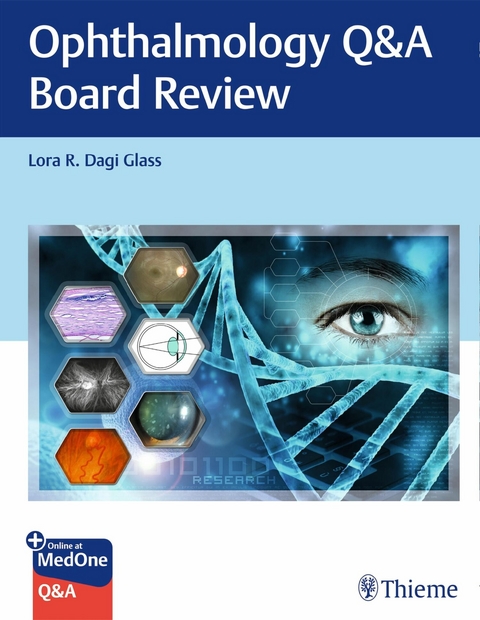
Ophthalmology Q&A Board Review (eBook)
356 Seiten
Georg Thieme Verlag KG
978-1-63853-645-1 (ISBN)
Chapter 1
Cornea, External Disease, and Anterior Segment
Carolina Adams, Danielle Trief
1.1 Questions
| Easy | Medium | Hard |
1. A 67-year-old female presents to the outpatient clinic with a history of recurrent nodules of the right upper eyelid for the past 5 years that were treated with multiple intralesional injections of triamcinolone. On exam, you notice two right upper lid nodules associated with madarosis and lid margin thickening. The left eyelids are unremarkable. What condition are you concerned about?
A. Recurrent chalazion
B. Sebaceous gland carcinoma
C. Basal cell carcinoma
D. Squamous cell carcinoma
2. A 47-year-old female presents with a history of chronic foreign body sensation and tearing associated with inferior punctate epithelial erosions. You decide to evaluate tear production without topical anesthetic. What is the name of this test?
A. Basic secretion test
B. Schirmer I test
C. Schirmer II test
D. Schirmer IV test
3. Which of the following is a quantitative test of tear production?
A. Lactoferrin
B. Immunoglobulin G
C. Schirmer testing
D. Meibography
4. A 45-year-old female with a history of seborrheic dermatitis complains of foreign body sensation and tearing. On exam, there is a rapid tear breakup time and foam in the tear meniscus. What would be the most likely cause of this patient’s dry eye?
A. Sjogren’s syndrome
B. Age-related dry eye
C. Trachoma
D. Meibomian gland dysfunction
5. A 19-year-old Caucasian female presents with a history of meibomian gland dysfunction for the past 2 years. On slit lamp exam, she has lid margin telangiectasias and anterior blepharitis in both eyes and corneal neovascularization of the right eye as shown in figure. What is the most likely underlying etiology of this patient’s findings?
A. Rosacea
B. Staphylococcal blepharitis
C. Keratoconjunctivitis sicca
D. Chalazion
6. A 45-year-old female presents to your office due to persistent left eye foreign body sensation and pain. She visited the emergency room 5 months ago due to sudden left facial weakness including the forehead. On exam, she is noted to have interpalpebral fluorescein uptake. Which of the following findings on clinical exam would you expect to find?
A. Reduced sensation of the cornea on the affected side
B. History of ptosis surgery on the affected side
C. Failure to close the eye completely on the affected side
D. Uncontrolled high blood pressure
7. Which one of the following is not a cause of neurotrophic keratopathy?
A. Herpes simplex virus (HSV)
B. Riley–Day syndrome
C. Hansen’s disease
D. Human immunodeficiency virus (HIV)
8. A 34-year-old obese male with obstructive sleep apnea presents to the cornea clinic due to progressive decline in visual acuity in the right eye. He visited a community optical shop and was told he had irregular astigmatism in the right eye. Clinical findings revealed laxity of the bilateral upper eyelid with severe tarsal papillary reaction. What is the most likely diagnosis?
A. Floppy eyelid syndrome
B. Superior limbic keratoconjunctivitis
C. Dermatochalasis
D. Ocular rosacea
9. A 57-year-old woman presents with a history of chronic ocular surface disease since a bilateral upper lid blepharoplasty 3 years ago. Clinical findings include a fine papillary reaction on the superior tarsal conjunctiva associated with hypertrophy of the superior limbus and fine punctate epithelial erosions in the superior one-third of the cornea. What would be the most likely diagnosis?
A. Floppy eyelid syndrome
B. Exposure keratopathy
C. Foreign body under superior eyelid
D. Superior limbic keratoconjunctivitis
10. A 25-year-old healthy female presents with a history of multiple episodes of sudden left eye pain upon awakening associated with photophobia and tearing. She has a remote history of a left eye corneal abrasion due to a fingernail trauma 3 years ago. Which of the following is not a potential therapy for this patient?
A. Lubricating ointment at night
B. Sodium chloride hypertonic ointment
C. Phototherapeutic keratectomy (PTK)
D. Laser-assisted in situ keratomileusis (LASIK)
11. A 29-year-old medical resident presents with a worsening corneal infiltrate and edema despite topical antibiotics. The resident had a corneal abrasion and was treated initially in the emergency department. Clinical exam findings include keratic precipitates, a necrotic ring opacity, and ciliary flush. The patient reports compliance and denies the use of contact lenses or history of trauma. Which of the following diagnoses should be considered?
A. Topical anesthetic abuse
B. Acanthamoeba keratitis
C. Fungal keratitis
D. Herpetic keratitis
12. A 12-year-old female with a history of a bone marrow transplant 2 months ago presents with dry eye not responding to standard lubrication management. On exam, she is noted to have a loss of the palisades of Vogt in two-thirds of the limbus and early corneal neovascularization. What would be the most likely diagnosis?
A. Toxic keratoconjunctivitis
B. Stem cell deficiency
C. Keratoconjunctivitis sicca
D. Rosacea
13. A 3-year-old boy is referred by his pediatrician due to progressive right eye corneal clouding since birth. On exam, he is noted to have opacification resembling sclera limited to the corneal periphery and 10 D of hyperopia in each eye. Which of the following corneal anomalies is most likely to be present?
A. Microcornea
B. Megalocornea
C. Cornea plana
D. Posterior embryotoxon
14. An 8-year-old boy with multiple craniofacial and dental abnormalities presents for follow-up. On anterior slit lamp examination, as shown in the figure, you notice one of the following. What is the most likely diagnosis?
A. Peters anomaly
B. Keratoconus
C. Axenfeld–Rieger syndrome (ARS)
D. Sclerocornea
15. A 1-day-old premature male born at 30 weeks of gestation presents with multiple cardiac malformations, cleft lip, and skeletal abnormalities. On exam, bilateral corneal opacities are noted. You suspect a condition characterized by the findings on the provided figure. What is the most likely diagnosis?
A. Corneal ulcer
B. Peters anomaly
C. Trauma
D. Dermoid
16. An 8-year-old male presents to clinic due to bilateral eye pain and redness. He has a history of premature delivery overseas. While interviewing the patient you note that the patient has a hearing deficit and dental abnormalities. On examination, as seen in the given figure, he is noted to have microcystic edema, intense stromal vascularization, and ghost vessels. Which of the following treatment would have prevented this corneal pathology?
A. IV penicillin
B. IV ceftazidime
C. IV acyclovir
D. IV voriconazole
17. A 5-day-old...
| Erscheint lt. Verlag | 5.2.2020 |
|---|---|
| Verlagsort | Stuttgart |
| Sprache | englisch |
| Themenwelt | Medizin / Pharmazie ► Medizinische Fachgebiete ► Augenheilkunde |
| Medizin / Pharmazie ► Studium | |
| Schlagworte | ABO exam • OKAP exam • Ophthalmology board review • Q&A • Questions and answers • Written Qualifying Examination |
| ISBN-10 | 1-63853-645-7 / 1638536457 |
| ISBN-13 | 978-1-63853-645-1 / 9781638536451 |
| Informationen gemäß Produktsicherheitsverordnung (GPSR) | |
| Haben Sie eine Frage zum Produkt? |
 EPUB (Wasserzeichen)
DRM: Digitales Wasserzeichen
Dieses eBook enthält ein digitales Wasserzeichen und ist damit für Sie personalisiert. Bei einer missbräuchlichen Weitergabe des eBooks an Dritte ist eine Rückverfolgung an die Quelle möglich.
Dateiformat: EPUB (Electronic Publication)
EPUB ist ein offener Standard für eBooks und eignet sich besonders zur Darstellung von Belletristik und Sachbüchern. Der Fließtext wird dynamisch an die Display- und Schriftgröße angepasst. Auch für mobile Lesegeräte ist EPUB daher gut geeignet.
Systemvoraussetzungen:
PC/Mac: Mit einem PC oder Mac können Sie dieses eBook lesen. Sie benötigen dafür die kostenlose Software Adobe Digital Editions.
eReader: Dieses eBook kann mit (fast) allen eBook-Readern gelesen werden. Mit dem amazon-Kindle ist es aber nicht kompatibel.
Smartphone/Tablet: Egal ob Apple oder Android, dieses eBook können Sie lesen. Sie benötigen dafür eine kostenlose App.
Geräteliste und zusätzliche Hinweise
Buying eBooks from abroad
For tax law reasons we can sell eBooks just within Germany and Switzerland. Regrettably we cannot fulfill eBook-orders from other countries.
aus dem Bereich