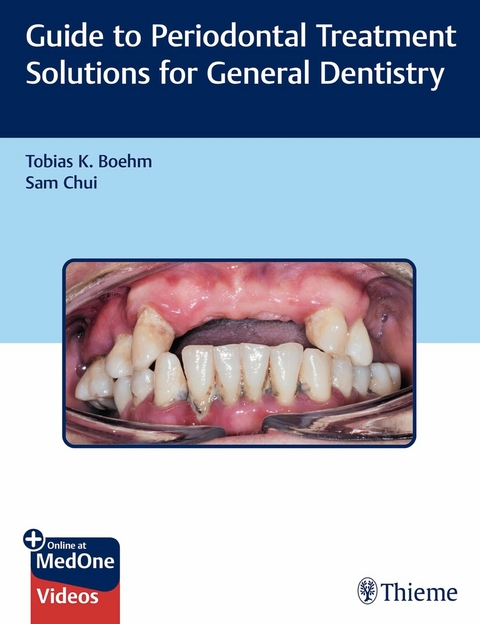
Guide to Periodontal Treatment Solutions for General Dentistry (eBook)
255 Seiten
Georg Thieme Verlag KG
978-1-63853-530-0 (ISBN)
1 Background: Periodontal Disease Mechanisms and Wound Healinga
Abstract
Periodontal diseases are one of the most common diseases in adults. Signs of mild periodontal inflammation are usually present in adults, and 10 to 60% of middle-aged adults have severe enough periodontal disease that requires treatment.
For diagnosis, it is helpful to understand the appearance of healthy periodontal tissues. This chapter begins with a description of periodontal health and reviews the contribution of microbes and immune system to the cellular changes that lead to the signs and symptoms of periodontal diseases. This is followed by reviews of periodontal wound healing and tooth development, and their influences on periodontal disease and treatment.
Keywords: structure, microbes, cells, development
1.1 Learning Objectives
•Recognize normal anatomy of healthy periodontal tissue.
•Describe the contribution of microbes to the periodontal disease process.
•Describe cellular and molecular events that lead to clinical signs and symptoms of periodontal disease.
•Describe how periodontal tissue recovers from injury caused by bacteria or tissue trauma.
•Describe how tooth development influences periodontal disease and treatment.
1.2 Case
A 25-year old healthy female dental student is seen for a peri-odontal exam as part of a clinical peer-to-peer exercise. See ►Fig. 1.1 for clinical presentation and ►Fig. 1.2 for radiographic presentation. She is currently satisfied with her dental condition, but had minor restorative treatment in the past and receives routine preventive dental care. She brushes and flosses regularly at least twice a day. These are the findings:
•Soft tissue exam: No pathology other than the presence of small lingual tori.
•Tooth condition: Small occlusal and interproximal amalgam restorations, and a slightly chipped maxillary incisor.
•Periodontal measurements: Probing depths less than 5 mm, no bleeding on probing, no clinical attachment loss, furca-tion involvement, tooth mobility, and gingival recession. The gingiva is coral pink with patches of light pink on the maxilla, firmly attached to underlying hard tissue and stippled. The gingival margin follows the contours of the teeth in a scalloped fashion, and no plaque or calculus is present.
Fig. 1.1 Clinical presentation for case.
Fig. 1.2 Radiographic series for case.
What can be learned from this case?
This dental student displays a good example of periodontal health. The description of the gingiva matches characteristics of periodontal health. Periodontal health is most commonly seen in young, healthy adults who receive frequent preventive care and practice effective oral hygiene.
1.3 Periodontal Health
1.3.1 Characteristics of Healthy versus Diseased Periodontal Tissues
As seen in the previous case, periodontal health means absence of signs and symptoms of periodontal disease. No signs of inflammation are present in any area of the gingiva (see ►Fig. 1.1), and all gingival landmarks are easily visible and in normal proportion to each other. Landmarks and areas of gingiva and mucosa are named as shown in ►Fig. 1.3.
The case illustrates what periodontal health looks like, and clinical data matches many elements of periodontal health as shown in ►Table 1.1.
Most patients' periodontal disease experience will fall somewhere on a spectrum of periodontal disease between perfect periodontal health and severe disease, matching all characteristics listed in ►Table 1.1. The challenge for a clinician is to decide whether a patient has sufficient signs and symptoms of the disease to warrant treatment.
1.3.2 Healthy, but Reduced Periodontium
The case described in this chapter demonstrates a healthy peri-odontium in an individual who likely never experienced severe periodontal disease, as the tissues are intact with no evidence of gingival recession, attachment loss, and bone loss. It is possible to achieve periodontal health after periodontal therapy, but here the tissues may show signs of past disease activity. This state is called “healthy, but reduced periodontium,” and has the following characteristics:
Fig. 1.3 (a) Oblique facial view of gingiva in patient seen in the preceding case with the different gingival landmarks and areas labeled. (b) Diagram of gingival landmarks. Healthy gingiva usually contains patches of stippling in the attached gingiva zone. (c) Diagram of a cross-section of healthy gingiva and periodontium attaching up to the cemento-enamel junction (CEJ). E = epithelium, CT = connective tissue. (d) Atraumatic extraction of a periodontally involved tooth reveals a depression in the interdental papilla called a “col,” which forms around wide interproximal contact points. Periodontal disease also produced the rough, pebbly epithelial surface that lined the extracted tooth. This is the sulcular epithelium that normally adapts tightly to the tooth surface inside the periodontal sulcus.
•Low probing depths.
•Little (< 10% of sites) or no bleeding on probing.
•Clinical attachment levels greater than zero/presence of radiographic bone loss.
•Gingival recession may be present.
•Tooth mobility may be present.
•Often, has a history of past periodontal treatment.
•Likely needs continued periodontal preventive care to prevent disease recurrence.
“Periodontal health” can also be achieved in edentulous areas of the jaw as there is no tooth-soft tissue interface where peri-odontal disease can develop. Here, the residual gingiva, away from any teeth, will appear healthy and there is no disease activity other than slow ridge resorption from lack of use.
1.4 Anatomy, Histology, and Clinical Relevance
The anatomy and histology of periodontal tissues are important for diagnosis and disease development as shown here.
1.4.1 Relationship between Clinical Landmarks and Tissue Histology
Gingival landmarks are related to unique histologic features of each gingival area (see ►Fig. 1.3):
•Marginal gingiva or free gingiva consists of keratinized stratified squamous epithelium resting on a small area of connective tissue apical to it. There is no fiber attachment to the underlying tooth. This makes the free gingiva flexible, and allows the insertion of a periodontal probe. Since this area is closest to the tooth surface, this area will display the earliest signs of periodontal inflammation. In healthy tissues, the marginal groove usually corresponds to the level of the periodontal sulcus.
•Attached gingiva consists of a thick layer of stratified squamous keratinized epithelium that usually lack residual cell nuclei in the most superficial layer (orthokeratinized). On the hard palate, and occasionally in gingiva, the superficial layer may retain greatly reduced cell nuclei (parakeratinized). The epithelium is firmly attached to underlying dense connective tissue with interlocking tissue fingers (rete pegs), and the underlying dense connective tissue is firmly attached to the periosteum of alveolar bone and teeth through gingival fibers. In a thin biotype, the gingiva is thin, translucent, relatively smooth, and has long and thin, friable dental papillae. In a thick biotype, the gingiva is very thick and heavily stippled with a dense, fibrous connective tissue core, and has short, stubby interdental papillae.
•Palatal gingiva is similar to the attached gingiva found on facial surfaces, but may also contain minor salivary glands and islands of adipose tissue, loose connective tissue, nerves and blood vessels, in addition to dense connective tissue. The epithelium and dense connective tissue of the hard palate also tend to be thicker and denser than their facial gingiva counterpart, which makes the palatal gingiva lighter in color than facial gingiva, and makes it more difficult to reflect palatal gingiva during surgery.
•Mucosa is a soft, flexible tissue that covers most of the oral cavity and allows jaw, lip, and tongue movement. It consists of a relatively thin nonkeratinized squamous stratified epithelium that has shallow rete pegs and rests on a deep bed of loose connective tissue. Clinically, since the epithelium is thinner and so it is more transparent. This tissue appears darker than gingiva and contains numerous small surface blood vessels that are clearly visible.
•Interdental papilla consists of smooth, keratinized-stratified squamous epithelium, and dense connective tissue near the interproximal alveolar bone. For anterior teeth, the interdental papilla usually is pyramid-shaped, whereas, for posterior teeth, it is saddle-shaped around the contact point. The depression around the contact point is called a col (see ►Fig. 1.4). Periodontal disease usually starts interproximally, and this tissue usually suffers the worst destruction during periodontal disease.
•Sulcular...
| Erscheint lt. Verlag | 7.10.2020 |
|---|---|
| Verlagsort | Stuttgart |
| Sprache | englisch |
| Themenwelt | Medizin / Pharmazie ► Gesundheitsfachberufe |
| Medizin / Pharmazie ► Studium | |
| Medizin / Pharmazie ► Zahnmedizin | |
| Schlagworte | dentistry • Furcation • gingival inflammation • Gingival Recession • Gingivitis • gum pockets • Periodontal • Periodontal Disease • Periodontics • Periodontitis • tooth longevity • Tooth mobility • Treatment |
| ISBN-10 | 1-63853-530-2 / 1638535302 |
| ISBN-13 | 978-1-63853-530-0 / 9781638535300 |
| Informationen gemäß Produktsicherheitsverordnung (GPSR) | |
| Haben Sie eine Frage zum Produkt? |
 EPUB (Wasserzeichen)
DRM: Digitales Wasserzeichen
Dieses eBook enthält ein digitales Wasserzeichen und ist damit für Sie personalisiert. Bei einer missbräuchlichen Weitergabe des eBooks an Dritte ist eine Rückverfolgung an die Quelle möglich.
Dateiformat: EPUB (Electronic Publication)
EPUB ist ein offener Standard für eBooks und eignet sich besonders zur Darstellung von Belletristik und Sachbüchern. Der Fließtext wird dynamisch an die Display- und Schriftgröße angepasst. Auch für mobile Lesegeräte ist EPUB daher gut geeignet.
Systemvoraussetzungen:
PC/Mac: Mit einem PC oder Mac können Sie dieses eBook lesen. Sie benötigen dafür die kostenlose Software Adobe Digital Editions.
eReader: Dieses eBook kann mit (fast) allen eBook-Readern gelesen werden. Mit dem amazon-Kindle ist es aber nicht kompatibel.
Smartphone/Tablet: Egal ob Apple oder Android, dieses eBook können Sie lesen. Sie benötigen dafür eine kostenlose App.
Geräteliste und zusätzliche Hinweise
Buying eBooks from abroad
For tax law reasons we can sell eBooks just within Germany and Switzerland. Regrettably we cannot fulfill eBook-orders from other countries.
aus dem Bereich