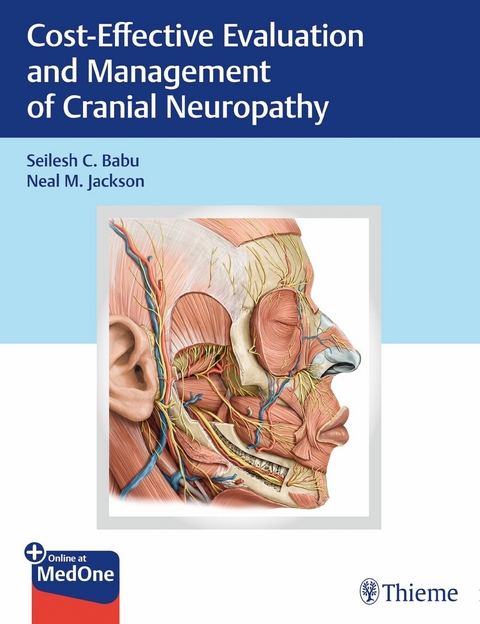
Cost-Effective Evaluation and Management of Cranial Neuropathy (eBook)
142 Seiten
Georg Thieme Verlag KG
978-1-63853-628-4 (ISBN)
2 Cranial Nerve I: Olfactory Nerve Disorders
Brendan Smith, Peter Svider, Robert Wayne Jr., and Adam Folbe
Abstract
Smell loss is a common presenting symptom seen in clinics. There are a number of potential etiologies for olfactory dysfunction, but upper respiratory tract infections, sinonasal disease, and head trauma cause the majority of cases. A careful history and physical examination including nasal endoscopy are able to differentiate between the most common causes of olfactory dysfunction, thereby minimizing the need for costly and potentially unhelpful diagnostic tools such as imaging. Inexpensive smell tests can help confirm the diagnosis of olfactory dysfunction and allow monitoring of response to treatment. There is limited data on treatment options for olfactory dysfunction, and the treatment tends to depend on the etiology. Smell training has also showed promise for treating olfactory dysfunction due to multiple etiologies and may be the most effective treatment for patients who have anosmia and hyposmia that do not respond to initial treatments. This chapter will cover the epidemiology, anatomy, diagnosis, and management of anosmia and hyposmia, with a focus on delivering cost-effective health care.
Keywords: anosmia, olfactory dysfunction, nasal polyps, skull base tumors, smell and taste disorders
2.1 Introduction
A properly functioning sense of smell is an important part of the human experience. Smell plays a role in the enjoyment of food, perception of memories, and avoidance of potential dangers (e.g., smoke from fire, spoiled food that should not be eaten, etc.). Therefore, disorders of olfaction (anosmia and hyposmia) impact patients in multiple areas of life. Anosmia is defined as a total loss of smell, while hyposmia is defined as a reduced ability to detect smells and odors. The relationship between anosmia and decreased quality of life has been illustrated throughout the literature, as a loss of smell and the consequent inability to taste can have significant impact on one’s well-being, including an association with mental illness and depression.1,2
2.2 Epidemiology
The prevalence of smell disturbances in the overall U.S. population has not been well studied. In recent years, the National Health and Nutrition Examination Survey (NHANES) added questions encompassing chemosensory disturbances (including anosmia/hyposmia).3 Subsequent cross-sectional studies on results of this analysis provide some of the best available data on the prevalence of anosmia/hyposmia in the adult U.S. population; importantly, 23.3% of adults older than 40 years self-reported a history of smell disturbance at any point in their life.4 The severity of dysfunction has also been studied, and between 12.4 and 13.5% have olfactory disturbance, defined as correctly identifying less than six of eight NHANES pocket smell test items, while 3.2% had anosmia/severe hyposmia (less than three odors correctly identified).3,5
While the causes of anosmia/hyposmia are diverse, certain risk factors such as older age and male sex may predispose to development. For example, the incidence of olfactory dysfunction increases with age, and has a prevalence of 4.2% in people aged 40 to 49 years, 12.7% in people aged 50 to 59 years, and 39.4% in those aged 80 years and older.3 Additionally, males appear to be at increased risk as compared to females. Of the 3.2% of people who had anosmia/severe hyposmia in the NHANES database, 74% were males.3 Further complicating this task is the fact that the length and severity of olfactory dysfunction varies by etiology.
The most common causes of olfactory dysfunction are post upper respiratory tract infection (URI), sinonasal disease including chronic rhinosinusitis (CRS) or obstructing lesions, and a history of head trauma.2,6 Collectively, these three entities account for approximately 75% of cases of olfactory dysfunction.2,6 Less common causes include sinonasal surgery, congenital anosmia, xerostomia, toxin exposure (e.g., smoking), certain medications (e.g., angiotensin-converting enzyme [ACE] inhibitors, calcium channel blockers, etc.), intracranial tumors, chronic diseases including hepatic or renal failure, endocrine disorders, autoimmune disorders, nutritional deficiencies, and neurologic dysfunction such as stroke or Parkinson’s disease.2,6,7,8 Around 18% of cases have no immediately identifiable cause.2,6 A differential diagnosis is detailed in ▶Table 2.1.
The primary impact of olfactory dysfunction on patients is a decrease in quality of life. Of patients experiencing taste or smell disturbance within the prior year, 5.8% felt it affected their quality of life.9 In a separate study, patients with olfactory dysfunction reported a 20% decrease in quality of life on a survey measuring effects on daily functioning and dissatisfaction.2 Overall, the high prevalence of olfactory disorders as well as the psychosocial impact these have makes this an important condition for clinicians to understand and manage.
Table 2.1 Etiologies of olfactory dysfunction
| Sinonasal disease | Chronic rhinosinusitis, allergic rhinitis, nasoseptal deviation, nasal polyposis |
| Postviral | Upper respiratory tract infections |
| Head trauma |
|
| Neurodegenerative diseases | Parkinson’s disease, Alzheimer’s disease, multiple sclerosis |
| Toxins | Cigarette smoke, volatile chemicals, radiation/chemotherapy |
| Medications | Many including ACE inhibitors, calcium channel blockers, and diuretics |
| Cerebrovascular disease | Ischemic stroke, subarachnoid hemorrhage, intracerebral hemorrhage |
| Tumors | Sinonasal tumors, olfactory meningiomas |
| Congenital syndromes | Kallmann’s syndrome |
| Malnutrition | Vitamin B12 and B6, zinc |
| Chronic medical conditions | Renal disease, hepatic disease, endocrinopathies (hypothyroidism, diabetes, Addison’s disease, Cushing’s syndrome), autoimmune disorders |
| Abbreviation: ACE, angiotensin-converting enzyme. Source: Malaty and Malaty 2013.7 |
2.3 Anatomy and Physiology of Olfaction
Signaling for the olfactory system begins with the nasal mucosa, and the nasal passages represent the first component. One function of the nasal passages is to transport air to the cribriform plate, superior septum, and superior and middle turbinates, where odor molecules dissolve in mucus. Once solubilized, odorants can then be sampled by chemoreceptors buried within the mucosa at these sites. Olfactory neurons express 1 of up to 350 different individual chemoreceptor proteins expressed by humans.10 When chemoreceptors on an olfactory neuron bind its specific substrate, the neurons are depolarized, and signals travel up the branches of the olfactory nerve in the mucosal epithelium through perforations in the cribriform plate to reach the olfactory nerve (cranial nerve I). The olfactory nerve then projects to the olfactory cortex, which has multiple functional areas (▶Fig. 2.1). These include the piriform cortex, amygdala, and entorhinal cortex, which function in concert to provide odor discrimination.
In addition to smell discrimination, the olfactory system is critical for the function of taste experience as well. During chewing of food, retrograde air movement from the pharynx to the olfactory epithelium in the superior nasal cavity allows food odors to be appreciated, which allows for a depth of taste not possible from taste buds alone. While humans are able to taste five broad categories (sweet, salty, bitter, sour, or savory), the ability to identify up to 350 separate odors helps explain the variety of taste experiences possible.10
Odor discrimination is essential to overall olfactory function. Because air movement is required to bring odorant molecules in proximity with chemoreceptors in the superior nasal cavity, any airflow obstruction (e.g., sinonasal masses or nasal congestion) can cause olfactory dysfunction. Trauma, mass effect, or demyelinating disorders that affect the olfactory nerve can also result in olfactory dysfunction. Due to their location in the nasal mucosa, olfactory nerve endings are readily exposed to toxic inhalants (e.g., tobacco smoke), which can affect odor discrimination. Finally, because an intact sense of smell is important to food taste, patients may initially report loss of taste (ageusia/hypogeusia) even though the primary issue is olfactory dysfunction.7 Since each of these etiologies present similarly, a thorough history and physical examination is critical to identifying the causative pathology.
2.4 Diagnostic Evaluation
2.4.1 History of Present Illness
A thorough patient history is low cost and essential for an accurate diagnosis for patients with olfactory dysfunction. The severity, duration, and abruptness of symptom onset should be ascertained.7,8,11,12 A...
| Erscheint lt. Verlag | 5.2.2020 |
|---|---|
| Verlagsort | Stuttgart |
| Sprache | englisch |
| Themenwelt | Medizin / Pharmazie ► Medizinische Fachgebiete ► Chirurgie |
| Medizinische Fachgebiete ► Innere Medizin ► Pneumologie | |
| Schlagworte | Audio vestibular Disorders • cranial nerve • dysphagia • Facial Nerve • Olfactory Disorders • Trigeminal Nerve |
| ISBN-10 | 1-63853-628-7 / 1638536287 |
| ISBN-13 | 978-1-63853-628-4 / 9781638536284 |
| Informationen gemäß Produktsicherheitsverordnung (GPSR) | |
| Haben Sie eine Frage zum Produkt? |
 EPUB (Wasserzeichen)
DRM: Digitales Wasserzeichen
Dieses eBook enthält ein digitales Wasserzeichen und ist damit für Sie personalisiert. Bei einer missbräuchlichen Weitergabe des eBooks an Dritte ist eine Rückverfolgung an die Quelle möglich.
Dateiformat: EPUB (Electronic Publication)
EPUB ist ein offener Standard für eBooks und eignet sich besonders zur Darstellung von Belletristik und Sachbüchern. Der Fließtext wird dynamisch an die Display- und Schriftgröße angepasst. Auch für mobile Lesegeräte ist EPUB daher gut geeignet.
Systemvoraussetzungen:
PC/Mac: Mit einem PC oder Mac können Sie dieses eBook lesen. Sie benötigen dafür die kostenlose Software Adobe Digital Editions.
eReader: Dieses eBook kann mit (fast) allen eBook-Readern gelesen werden. Mit dem amazon-Kindle ist es aber nicht kompatibel.
Smartphone/Tablet: Egal ob Apple oder Android, dieses eBook können Sie lesen. Sie benötigen dafür eine kostenlose App.
Geräteliste und zusätzliche Hinweise
Buying eBooks from abroad
For tax law reasons we can sell eBooks just within Germany and Switzerland. Regrettably we cannot fulfill eBook-orders from other countries.
aus dem Bereich