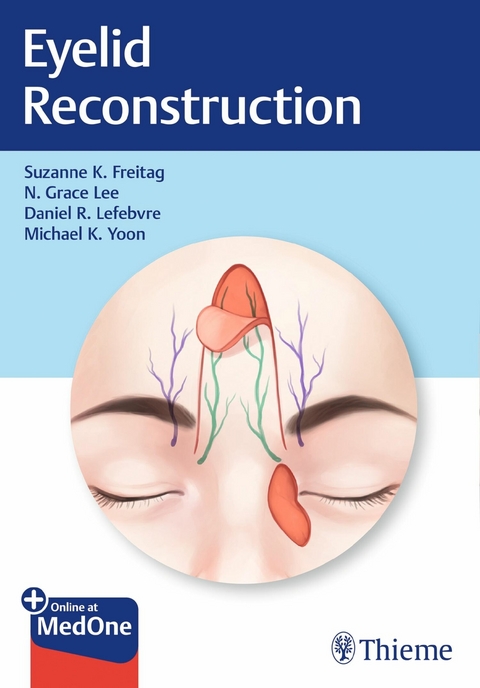
Eyelid Reconstruction (eBook)
130 Seiten
Georg Thieme Verlag KG
978-1-63853-536-2 (ISBN)
1 Periocular Anatomy
Juan C. Jiménez-Pérez
Summary
A thorough understanding of eyelid and periocular anatomy is crucial for functional and aesthetic success in eyelid reconstruction after trauma, tumor excision, or any procedure that changes the normal eyelid architecture. Proficiency in restoring the eyelids takes experience as well as a fundamental knowledge of the anatomy that is presented in this chapter.
Keywords: eyelid anatomy, eyelid circulation, eyelid innervation, eyelid musculature
1.1 Eyelids
The main function of the eyelid is to protect the eye. The eyelids attach to orbital bones via the medial canthal tendon (MCT) and lateral canthal tendon (LCT) forming two opposite arches. The lateral canthus is usually approximately 2 mm higher than the medial canthus. The horizontal length of the eyelid is about 30 mm and the vertical aperture height (palpebral fissure) is about 10 mm. The adult upper eyelid rests about 1.5 mm below the superior limbus of the cornea, while the lower eyelid rests at the level of the inferior limbus. The peak of the upper eyelid is at the medial border of the pupil, and the lowest point of the lower eyelid margin is the lateral aspect of the pupil. The eyelid margin can be conceptually divided into anterior (skin and orbicularis muscle) and posterior (tarsus and conjunctiva) lamellae for the purposes of eyelid reconstruction.1,2
1.2 Eyelid Layers
The layers of the upper eyelid from anterior (superficial) to posterior (deep) are skin, orbicularis oculi muscle, orbital septum, preaponeurotic fat, levator palpebrae superioris muscle, Müller muscle, tarsus, and conjunctiva (▶Fig. 1.1). It is important to understand that the different layers of the eyelid are not always present in all eyelid sections and vary by vertical height within the eyelid.
1.2.1 Skin
The eyelid skin is the thinnest in the body. It is composed of keratinized stratified squamous epi thelium and has no subcutaneous fat. With aging, skin loses elasticity and becomes thinner due to breakdown of collagen. The upper eyelid crease is formed from levator aponeurosis attachments to the skin and pretarsal orbicularis oculi muscle. The crease is usually higher in women and Caucasians compared to men and Asians. The crease is approximately at the same height as the superior tarsal border in Caucasians. In Asians, it is about 4 mm above the eyelid margin due to a lower fusion of the orbital septum with the levator muscle, allowing the preaponeurotic fat to fall more anteriorly and inferiorly in the upper eyelid.1,2
1.2.2 Orbicularis Oculi Muscle
The orbicularis oculi muscle is the protractor of the eyelid. It extends from the upper and lower eyelid margin in a circumferential fashion to the superior and inferior orbital rims, respectively. It is anatomically divided into the palpebral (pretarsal and preseptal) and orbital portions (▶Fig. 1.2). Innervation by the zygomatic and temporal branches of facial nerve (seventh cranial nerve) allows the muscle to contract and close the eyelids. The involuntary closure or blinking is mediated by the palpebral portion, whereas the voluntary closure is mediated by the orbital portion of the muscle. A portion of the orbicularis, the muscle of Riolan, is visualized along the middle of the eyelid margin, forming the gray line.1,2
1.2.3 Orbital Septum
The orbital septum is a thin, multilayered, inelastic, fibrinous tissue that demarcates the anterior extent of the orbital soft tissues. The orbital septum arises from the arcus marginalis, a dense periosteal fusion of orbital septum, periorbita, and pericranium that circumferentially lines the orbital rim (▶Fig. 1.3). It inserts onto the upper and lower eyelid retractors and provides support. Aging causes septum attenuation allowing the orbital fat to move forward via pseudoherniation. The orbital septum is an important anatomical landmark that divides the superficial skin and orbicularis muscle from the deeper structures of the orbit and functions as a barrier to infections and spread of tumors.1,2
Fig. 1.1 Cross-section of the upper and lower eyelid anatomy. (From Chen WP, Oculoplastic Surgery: The Essentials. New York: Thieme Medical Publishers; 2001.)
1.2.4 Preaponeurotic Fat
The preaponeurotic fat is a relatively avascular collection of adipose tissue situated between the orbital septum anteriorly and levator palpebrae superioris muscle posteriorly. In the upper eyelid there are two fat pads: the medial and the central. They are each enclosed in a thin fibrous sheath. The medial fat pad is usually paler in color and smaller compared to the distinctly yellow central fat pad.3 The lacrimal gland fills the analogous space in the lateral upper eyelid. The lower eyelid contains three fat pads: the medial, central, and lateral (▶Fig. 1.4). When fat is visible through a traumatic eyelid laceration, it indicates that the injury has extended to a depth beyond the orbital septum. In such instances, after proper wound cleaning, exploration, and repositioning of fat, the septum must not be sutured so as to avoid cicatricial eyelid retraction.4
1.2.5 Retractor Muscles
Upper Eyelid Retractors
Opening of the upper eyelid is mediated by two muscles: the levator palpebrae superioris and Müller muscles. The levator muscle is responsible for the voluntary elevation of the upper eyelid and is the primary retractor muscle. It originates in the orbital apex from the periorbita of the lesser wing of the sphenoid bone just above the superior rectus muscle origin in the annulus of Zinn. The muscular portion measures 40 mm in length, while the aponeurosis is 14 to 20 mm in length. The muscle traverses in the superior orbit from the apex in an anterior direction until it interfaces with Whitnall ligament, where it changes to an inferior direction. The aponeurosis inserts onto the anterior tarsal surface with additional loose attachments to the skin creating the lid crease. As the aponeurosis travels inferiorly, it spreads out creating medial and lateral horns. The medial horn of the levator aponeurosis is thinner and more delicate than the lateral horn. The lateral horn divides the lacrimal gland into palpebral and orbital lobes (▶Fig. 1.5). The muscle is innervated by the superior division of the oculomotor nerve (third cranial nerve).1,2,5
Fig. 1.2 The eyelid protractors. (From Watanabe K, Shoja MM, Loukas M, Tubbs RS. Anatomy for Plastic Surgery of the Face, Head, and Neck. New York: Thieme Medical Publishers; 2016.)
Fig. 1.3 The orbital septum. (From Wobig JL, Dailey RA. Oculofacial Plastic Surgery: Face, Lacrimal System, and Orbit. New York: Thieme Medical Publishers; 2004.)
Fig. 1.4 The preaponeurotic fat. (From Chen WP, Oculoplastic Surgery: The Essentials. New York: Thieme Medical Publishers; 2001.)
Müller muscle (superior tarsal muscle) is a smooth muscle innervated by sympathetic nerve fibers contributing approximately 2 mm of upper eyelid involuntary elevation. It originates from the deep surface of the levator aponeurosis at the level of Whitnall ligament and inserts at the superior tarsal border (▶Fig. 1.5). The conjunctiva is deep to Müller muscle, and the peripheral vascular arcade is located superficial to the muscle above the superior tarsal border.1,2
Lower Eyelid Retractors
The lower eyelid retractors are analogous to the upper eyelid retractors, but less well defined. The equivalent of the levator aponeurosis is the capsulopalpebral fascia, which originates from the inferior rectus muscle fibers and then divides to encircle the inferior oblique muscle. Lockwood suspensory ligament forms anterior to the inferior oblique muscle and is somewhat analogous to Whitnall ligament in the upper eyelid (▶Fig. 1.5). Terminal capsulopalpebral fascia fibers insert into both the inferior conjunctival fornix and the lower eyelid tarsus.1,2,6 The lower eyelid analogue of Müller muscle is the inferior tarsal muscle, which originates from Lockwood ligament, travels between the capsulopalpebral fascia and conjunctiva, and inserts on the lower eyelid tarsus.1,2,6
Fig. 1.5 The upper and lower eyelid retractors. (From Watanabe K, Shoja MM, Loukas M, Tubbs RS. Anatomy for Plastic Surgery of the Face, Head, and Neck. New York: Thieme Medical Publishers; 2016.)
1.2.6 Tarsus
The upper and lower eyelid tarsal plates are composed of dense fibrous tissue and provide structural rigidity to the eyelids. They attach firmly to the periosteum via the MCT and LCT. They measure about 1 mm in thickness and a maximum of 8 to 10 mm in vertical height in the central portion of the upper eyelid and about 4 mm in the lower lid, and taper medially and laterally as they attach to the canthal tendons (▶Fig. 1.6). The Meibomian glands spiral vertically within the tarsal plates.1,2
1.2.7 Conjunctiva
The conjunctiva is a nonkeratinized squamous epithelium that covers the surface of the globe and the posterior surface of the eyelids. This mucous membrane is divided by location into palpebral, forniceal, and...
| Erscheint lt. Verlag | 4.3.2020 |
|---|---|
| Verlagsort | Stuttgart |
| Sprache | englisch |
| Themenwelt | Medizin / Pharmazie ► Medizinische Fachgebiete ► Augenheilkunde |
| Medizinische Fachgebiete ► Chirurgie ► Ästhetische und Plastische Chirurgie | |
| Medizin / Pharmazie ► Medizinische Fachgebiete ► Dermatologie | |
| Medizin / Pharmazie ► Medizinische Fachgebiete ► HNO-Heilkunde | |
| Medizinische Fachgebiete ► Innere Medizin ► Pneumologie | |
| Schlagworte | eyelid surgery • eyelid trauma repair • mohs surgery • oculoplastic surgery • ophthalmic plastic surgery • Ophthalmic Surgery • periocular surgery |
| ISBN-10 | 1-63853-536-1 / 1638535361 |
| ISBN-13 | 978-1-63853-536-2 / 9781638535362 |
| Informationen gemäß Produktsicherheitsverordnung (GPSR) | |
| Haben Sie eine Frage zum Produkt? |
 EPUB (Wasserzeichen)
DRM: Digitales Wasserzeichen
Dieses eBook enthält ein digitales Wasserzeichen und ist damit für Sie personalisiert. Bei einer missbräuchlichen Weitergabe des eBooks an Dritte ist eine Rückverfolgung an die Quelle möglich.
Dateiformat: EPUB (Electronic Publication)
EPUB ist ein offener Standard für eBooks und eignet sich besonders zur Darstellung von Belletristik und Sachbüchern. Der Fließtext wird dynamisch an die Display- und Schriftgröße angepasst. Auch für mobile Lesegeräte ist EPUB daher gut geeignet.
Systemvoraussetzungen:
PC/Mac: Mit einem PC oder Mac können Sie dieses eBook lesen. Sie benötigen dafür die kostenlose Software Adobe Digital Editions.
eReader: Dieses eBook kann mit (fast) allen eBook-Readern gelesen werden. Mit dem amazon-Kindle ist es aber nicht kompatibel.
Smartphone/Tablet: Egal ob Apple oder Android, dieses eBook können Sie lesen. Sie benötigen dafür eine kostenlose App.
Geräteliste und zusätzliche Hinweise
Buying eBooks from abroad
For tax law reasons we can sell eBooks just within Germany and Switzerland. Regrettably we cannot fulfill eBook-orders from other countries.
aus dem Bereich