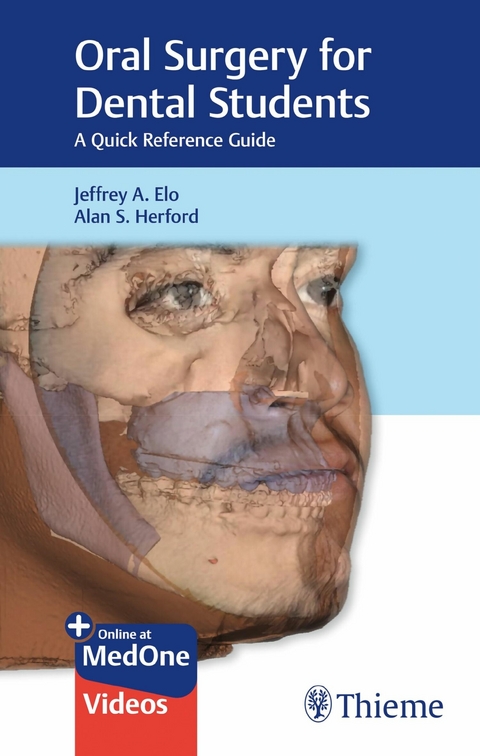
Oral Surgery for Dental Students (eBook)
264 Seiten
Thieme Medical Publishers (Verlag)
978-1-63853-577-5 (ISBN)
Portable, user-friendly reference covers the most essential oral surgery information!Oral Surgery for Dental Students: A Quick Reference Guide by nationally recognized oral and maxillofacial surgeons and educators Jeffrey A. Elo and Alan S. Herford focuses on essential oral surgery-related topics and management of patients in general dental practice. Well-rounded perspectives are reflected in contributions from dental students, an oral and maxillofacial surgery resident, an oral and maxillofacial radiologist, an oral and maxillofacial pathologist, and an author/anatomist.Key Features:Step-by-step chapters with clinical images and online videos detail instrumentation, posture/ergonomics, and proper techniques of dental extractionIn-depth chapters on radiographic analysis and interpretation, common oral pathologies/lesions, medical emergencies, and co-occurring patient health issues, including protocols and case studiesSample note writing and new patient scripts provide unique tutorials for dental students, residents, and new dentistsThis quintessential clinical learning tool also provides a quick procedural review prior to treating dental/surgical patients.
1 New Patient Visit
Jeffrey A. Elo, Alan S. Herford, Ho-Hyun Sun, Christopher H. Yi
Consultation Visit—New Patient Script
One of the greatest sources of anxiety and confusion for preclinical and new-to-clinic dental students is What should I say to the patient? Learning what to say and how to say it to patients is an important skill worthy of development. Of course, it takes time to get the words, rhythm, and the delivery correct, but doing so may help the practitioner appear friendly, amicable, and thorough while instilling confidence in the listening patient. But importantly, this must occur within a short period of time.
Over the years, many generations of students and young practitioners have found it immensely helpful to have some scripts—well-practiced guidelines—as far as what to say, how to say, and what level of depth to delve into when first interacting with patients. Good practitioners work at fine-tuning their delivery when it comes to greeting a new patient, discussing their findings/diagnoses, presenting the treatment plan, and then closing out the visit.
This is meant to be a starting point for new practitioners or those with high anxiety about the first few times when they have a patient in their chair.
Example: The following might be a sample consultation script to use as a guideline when meeting a new patient “Ms. Jones” who has a painful, nonrestorable mandibular molar that requires removal.
“Good morning, Ms. Jones, my name is (student) Doctor______. Tell me what brings you in today. I understand that you have a broken molar causing you pain, and that you would like to have it removed. Is that correct? We are more than happy to get that taken care of for you. First, let me ask you a couple of questions. Do you have any medical conditions or concerns that you are currently being treated for, such as diabetes or asthma? Do you have any problems with your heart or with high blood pressure? Do you get pains in your chest or lose your breath when walking or doing any form of activity, or even from just sitting? Have you had any issues with bleeding in the past? Are you currently taking any prescription or nonprescription medications? Do you have any allergies to any medications—penicillin, codeine, or dental numbing medicine? Do you smoke? If so, how much and for how many years? Do you drink alcohol? Do you use any other recreational drugs—marijuana, cocaine, or heroin? It is important for us to know these things because some of our medications or treatments might interact with certain drugs or chemicals. Have you had any surgeries in the past? Have you ever had any problems with anesthesia that you know of or were told about? Have you ever had any problems with local anesthesia in a dental office? What we will do right now is take a look at your radiograph(s), talk about what we see and what we can offer you, and then we’ll leave any decision-making up to you. Okay?”
When reviewing diagnostic material such as a panoramic radiograph, a thorough, verbal description in terms understandable to the patient is helpful. You can say something like the following (while using your hands or a pointer to describe as you speak).
“In the radiograph(s), these teeth up here (indicating with a pointer) are your top teeth; these are your bottom teeth. This is your right side; this is your left side. Let us zoom in on the bad molar causing your pain. This tooth is missing tooth structure and has a deep cavity, or a hole, that we can see in this dark area of the tooth. Notice how it appears very different in color from the other surrounding teeth.
Because of how much tooth structure is missing, we are not able to fix that with our dental techniques. The only treatment we can offer you is removal or extraction. Most patients do well with these procedures with local anesthesia—where we give you some numbing medicine in the area so you do not feel any pain. You will feel pressure as I am working, but there will be no discomfort or pain. You might even hear some funny noises as we are working, but that is normal, as well. We might have to make a small incision in the gums. If we do, it will only be as long as the tooth from front to back, so it will not be very big. But that will allow us better access to the entire tooth so we can work more quickly and get you back on your way. Once we get the tooth out, we will put in some dissolvable stitches to close the gums. This also helps with the healing process. The procedure will take about 10 to 20 minutes once you are numb and comfortable. And after we are done you will be ready to go home.
Then comes your recovery phase. It is normal and expected for some swelling to occur. It takes about 3 days for this swelling to reach its peak before it starts to get better. There also is a possibility of bruising in the area. Bruising typically lasts longer than swelling, but it will go away. There are no diet restrictions or activity restrictions. You can eat and drink whatever is comfortable for you, but perhaps it will be wise to stay away from sharper-edged foods, such as chips, for a few days. And lastly, we will be giving you two or three medication prescriptions to take during your recovery. One is a pain medication such as acetaminophen (Tylenol®). Take it if you need it. One is a medicated mouthwash. It is like a topical antibiotic and helps the gum tissue and the socket heal more quickly. And the last one is something like Motrin®or Advil®that helps minimize your swelling and contributes to pain relief.
Let me discuss with you the risks of the procedure. The main risks of any tooth removal procedure are some minor discomfort, swelling, and bleeding or oozing following surgery. These are all normal and expected. There is a low risk of infection, but these are rare. There is also a small possibility that additional surgery may be needed if the site fails to heal properly. It is unlikely, but adjacent teeth or nerve structures can be bruised, bumped, or nicked during the process of completing our work. We will make every effort to avoid this, but it is possible. There is also a chance that we may decide to leave a small piece of the tooth or root behind if attempting to remove it places important structures, such as nerves, at risk of injury or damage. We will discuss this, if needed, during the procedure so you are fully aware of what is happening and why.
The benefits of this treatment include removing the bad tooth that is the source of your pain. After a brief healing period of a couple days, you should be feeling a lot better.
The only alternative treatment option is to not remove the tooth and leave it in, as is. However, leaving that tooth in will continue to cause you pain and put you at risk for continued or worsening infection. Root canal therapy is not an option because there is too much tooth destruction from the large cavity.
Do you have any questions?
I am going to go ahead and enter a treatment plan, which is just a list of the procedure(s) we talked about. One of our staff members will go over the treatment plan, have you sign the plan if you are in agreement, and take you to the scheduler who can get you scheduled for an appointment. There is also a procedure consent form we will need to have you sign.
We will take very good care of you, okay.”
Typically, the above conversation and guided questioning can be done in about 10 minutes. The script is direct and focused, and guides the young practitioner to stay efficient and on topic with their time. By maintaining direction and focus in the consultation, the practitioner can maximize each patient’s chair time. Practicing this as a student doctor will enable the graduate to be highly skilled in the art of patient communication by the time he/she is ready to see many more patients in private practice.
Consultation Talking Points
Efficiency is most easily achieved through repetition. Below is a list of talking points that should be mentioned during a consultation. Practice implementing this list into a personalized script. This is merely a suggested order and all providers should make their own list. However, delivery should be made in the same sequence each time so that key elements are not omitted.
1. Introduce yourself and establish patient rapport.
2. Review patients’ chief complaint and what brings them in.
3. Review medical history, past surgeries, and conditions.
4. Review list of medications and allergies.
5. Note past anesthesia issues.
6. Review radiographs.
7. Explain procedure: include specific preop instructions if needed, time frame, as well as postop expectations.
8. Answer questions, if any.
9. Review treatment plan, consent, and next step(s).
Charts and Charting
• Most attorneys say that if something is not written in the chart, it did not happen.
• Document every encounter with patients.
• If you call a patient, document it in the chart.
• If you see a patient, document the progress notes in the chart.
• If you are scheduled to see a patient, and he/she fails to show, document it.
Comprehensive Oral Evaluation—History and Physical...
| Erscheint lt. Verlag | 7.8.2019 |
|---|---|
| Verlagsort | Stuttgart |
| Sprache | englisch |
| Themenwelt | Medizin / Pharmazie ► Gesundheitsfachberufe |
| Medizin / Pharmazie ► Medizinische Fachgebiete ► Chirurgie | |
| Medizin / Pharmazie ► Zahnmedizin ► Chirurgie | |
| Schlagworte | Dental • dental consultation • dental management of medical emergencies • dental management of pregnant patient • dental prescription writing • dental radiographic analysis • dentistry • dentoalveolar surgery • Infection control • odontogenic infection • Oral lesions • Oral surgery • pharmacology for dental practitioner • pocket book |
| ISBN-10 | 1-63853-577-9 / 1638535779 |
| ISBN-13 | 978-1-63853-577-5 / 9781638535775 |
| Informationen gemäß Produktsicherheitsverordnung (GPSR) | |
| Haben Sie eine Frage zum Produkt? |
 EPUB (Wasserzeichen)
DRM: Digitales Wasserzeichen
Dieses eBook enthält ein digitales Wasserzeichen und ist damit für Sie personalisiert. Bei einer missbräuchlichen Weitergabe des eBooks an Dritte ist eine Rückverfolgung an die Quelle möglich.
Dateiformat: EPUB (Electronic Publication)
EPUB ist ein offener Standard für eBooks und eignet sich besonders zur Darstellung von Belletristik und Sachbüchern. Der Fließtext wird dynamisch an die Display- und Schriftgröße angepasst. Auch für mobile Lesegeräte ist EPUB daher gut geeignet.
Systemvoraussetzungen:
PC/Mac: Mit einem PC oder Mac können Sie dieses eBook lesen. Sie benötigen dafür die kostenlose Software Adobe Digital Editions.
eReader: Dieses eBook kann mit (fast) allen eBook-Readern gelesen werden. Mit dem amazon-Kindle ist es aber nicht kompatibel.
Smartphone/Tablet: Egal ob Apple oder Android, dieses eBook können Sie lesen. Sie benötigen dafür eine kostenlose App.
Geräteliste und zusätzliche Hinweise
Buying eBooks from abroad
For tax law reasons we can sell eBooks just within Germany and Switzerland. Regrettably we cannot fulfill eBook-orders from other countries.
aus dem Bereich