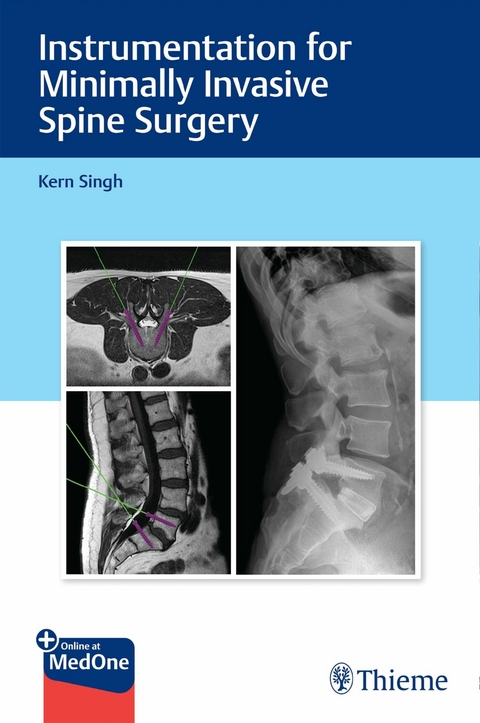
Instrumentation for Minimally Invasive Spine Surgery (eBook)
242 Seiten
Georg Thieme Verlag KG
978-1-63853-148-7 (ISBN)
2 Introduction to MIS Posterior Approach
Benjamin Khechen, Brittany E. Haws, Ankur Narain, Fady Hijji, Jordan A. Guntin, Kaitlyn L. Cardinal, and Kern Singh
2.1 Introduction
The minimally invasive spine (MIS) posterior approach for decompression and fusion of the lumbar spine utilizes the Harms modification of the original Wiltse approach, described in 1968.1,2 The posterior parasagittal technique was designed to reduce the morbidity associated with the traditional open midline approach.3 This approach minimizes muscular trauma by dissecting the natural plane of two separate muscle groups and allowed for the preservation of midline structures.3 The MIS posterior approach can be utilized for the treatment of a variety of pathologies of the thoracic and lumbar spine.4,5 These treatment options can include decompression, diskectomy, posterior instrumentation, and interbody fusion.4,6 This approach allows for the direct decompression of neural elements and direct access to the disk space.4,6,7,8
2.2 Surgical Anatomy
The lumbar spinous processes and iliac crests are easily palpable for orientation prior to performing the MIS posterior approach. This approach utilizes the internervous plane between the paraspinal muscles, minimizing any requirement for muscle dissection. However, multiple structures of the posterior vertebrae are encountered with this approach. The lamina and facet joints are directly involved with this approach, and their removal will lead to exposure of the traversing nerve root and underlying dura mater.
Due to the posterior orientation of this approach, some structures are at risk for injury.4 Primarily, the traversing and exiting nerve roots can be iatrogenically injured as it passes the surgical corridor. Additionally, the dura is within the proximity of the approach and may be inadvertently disrupted while decompressing the overlying structures.
2.3 Surgical Technique
2.3.1 Positioning
Patients undergoing a posterior MIS approach are placed in the prone position on a radiolucent table following anesthesia induction (▶ Fig. 2.1). Pads are placed under the manubrium and anterior superior iliac spine to maintain lumbar lordosis. The patient’s legs are left extended, while the arms are placed in 90 degrees of shoulder and elbow flexion. A foam pad is placed underneath the flexed arms to reduce the risk of ulnar nerve compression. Prior to surgical preparation and draping, fluoroscopic images are obtained of the lumbar spine to confirm visibility of the pedicles and other spinal anatomy.
2.3.2 Approach (Exposure) for MIS Transforaminal Lumbar Interbody Fusion
A 22-gauge needle is oriented toward the facet joint at the disk level of interest and inserted. A fluoroscopic image is then obtained to confirm the correct surgical level. The side of the operation to be performed is determined by the location of neurologic symptoms. Following confirmation, an incision is made paramedially, 4 to 5 cm lateral to the midline. The incision is made to be approximately 2.0 cm in length in order to fit the final tubular retractor. Bovie cautery is used to incise the underlying fascia. The smallest tubular dilator is inserted through the muscle down to the level of the facet joint or lamina in a lateral to medial direction. Once appropriate positioning of the initial dilator is determined using fluoroscopy, serial dilators are inserted, gradually increasing the size of the surgical corridor. Finally, the tubular retractor is then placed over the last dilator and the dilators are subsequently removed (▶ Fig. 2.2). The tubular retractor is then fixed to the table after being docked over the area of interest. Fluoroscopy is then utilized to confirm adequate positioning and orientation of the retractor.
Fig. 2.1 Demonstration of prone surgical positioning. (Reproduced, with permission, from Singh K, Vaccaro A, eds. Pocket Atlas of Spine Surgery. 2nd ed. New York, NY: Thieme; 2018.)
The following aspects of the procedure are performed under illumination with loupe magnification or with the use of an operating microscope. Residual soft tissue overlying the lamina and facet is removed with electrocautery followed by pituitary instruments. Following laminar exposure, a high-speed drill is used to perform a complete bilateral laminectomy. Bone removed from the laminectomy can be used as graft material within the interbody cage. Once the ligamentum flavum is identified, the laminectomy is extended cranially until the flavum insertion is visualized; however, the flavum is left intact to protect underlying neural structures. Following complete laminectomy, a facetectomy is performed. To facilitate the facetectomy, the inferior articular process and pars interarticularis are removed first. Caution must be taken to avoid drilling into the pedicle. Once the facet joint is removed, the ligamentum is removed to expose the underlying nerve roots. The working zone for MIS transforaminal lumbar interbody fusion (TLIF) is defined medially by the traversing nerve root and laterally by the exiting nerve root (▶ Fig. 2.3). The venous plexus surrounding the epidural space can cause significant bleeding; therefore, adequate hemostasis using bipolar electrocautery is crucial to maintain appropriate visualization of the disk space.
2.3.3 Disk Space Preparation
A complete diskectomy is performed through the tubular retractor. Pituitaries and curettes can be utilized to perform the annulotomy and remove disk material. Once all disk material is removed, the intervertebral space is distracted with paddle distractors and the endplates are prepared utilizing end plate shavers.
Fig. 2.2 Initial exposure of the working portal with the corresponding structures. (Reproduced, with permission, from Singh K, Vaccaro A, eds. Pocket Atlas of Spine Surgery. 2nd ed. New York, NY: Thieme; 2018.)
2.3.4 Interbody Cage Placement
Trial sizers are placed into the disk space under fluoroscopic guidance to determine the appropriate size for the implant. A bone funnel containing the previously morcellized bone fragments is placed through the disk space. The interbody cage is then impacted into the disk space toward the midline (▶ Fig. 2.4). Care should be taken to protect the nearby nerve root. In select cases, osteobiologic products such as recombinant human bone morphogenetic protein-2 can be utilized with the interbody cage. Bilateral cages can also be inserted using a bilateral approach.
2.3.5 Supplemental Fixation
Percutaneous pedicle screws are placed into the adjacent vertebrae of the MIS TLIF to provide supplemental fixation. The steps leading to the insertion of the guidewires are performed prior to retractor placement for the MIS TLIF. The pedicle screws themselves are placed after the completion of the MIS TLIF.
A Jamshidi trocar is inserted onto the center of the pedicle using fluoroscopic guidance. A guidewire is placed through the trocar and advanced until it reaches the medial pedicle wall, as identified by anteroposterior (AP) fluoroscopic images (▶ Fig. 2.5). These steps are repeated for the adjacent level. It is necessary to ensure that the spinous processes are centered in the AP view in order to adequately assess screw placement. Once all guide wires have been placed, a lateral fluoroscopic image is taken to ensure that the guide wires have been advanced past the posterior vertebral body wall. Once correct guide wire placement is confirmed, pedicle screws are inserted using the guide wires. The guide wires are then removed and a rod is inserted, connecting the tulips of the inserted pedicle screws.
Fig. 2.3 Exposure following removal of the ligamentum flavum. (Reproduced, with permission, from Singh K, Vaccaro A, eds. Pocket Atlas of Spine Surgery. 2nd ed. New York, NY: Thieme; 2018.)
Fig. 2.4 Lateral fluoroscopic image of the interbody cage being impacted into place. (Reproduced, with permission, from Singh K, Vaccaro A, eds. Pocket Atlas of Spine Surgery. 2nd ed. New York, NY: Thieme; 2018.)
Fig. 2.5 Fluoroscopic image of cannulated pedicle screws upon insertion. (Reproduced, with permission, from Singh K, Vaccaro A, eds. Pocket Atlas of Spine Surgery. 2nd ed. New York, NY: Thieme; 2018.)
2.3.6 Closure and Postoperative Care
Final fluoroscopic images are obtained to confirm accurate placement of all implants and instrumentation. The wound is then irrigated and the fascia and skin are subsequently closed in layers. Following the procedure, attempts should be made to mobilize the patient early to maximize functionality postoperatively.
2.3.7 Complications
While MIS techniques may exhibit some advantages over traditional techniques, including reduced blood loss, rate of transfusion, postoperative pain, and length of stay, the complications of MIS and open posterior approaches remain similar.4,9,10,11,12 Primary complications associated with MIS TLIF are dural tear, cerebrospinal fluid leak, neurologic injury/deficits, hemorrhage, pedicle screw malposition, and cage migration.13 The overall complication rate following MIS TLIF ranges from 0 to 33.3%.13 Due to the narrow surgical corridor, particular concern has arisen for an increased risk for...
| Erscheint lt. Verlag | 24.2.2021 |
|---|---|
| Sprache | englisch |
| Themenwelt | Medizinische Fachgebiete ► Chirurgie ► Neurochirurgie |
| Medizinische Fachgebiete ► Chirurgie ► Unfallchirurgie / Orthopädie | |
| Medizin / Pharmazie ► Medizinische Fachgebiete ► Orthopädie | |
| Schlagworte | cortical screw systems • facet screw systems • fixation systems • percutaneous pedicle • retractors • Spinal instrumentation |
| ISBN-10 | 1-63853-148-X / 163853148X |
| ISBN-13 | 978-1-63853-148-7 / 9781638531487 |
| Informationen gemäß Produktsicherheitsverordnung (GPSR) | |
| Haben Sie eine Frage zum Produkt? |
 EPUB (Wasserzeichen)
DRM: Digitales Wasserzeichen
Dieses eBook enthält ein digitales Wasserzeichen und ist damit für Sie personalisiert. Bei einer missbräuchlichen Weitergabe des eBooks an Dritte ist eine Rückverfolgung an die Quelle möglich.
Dateiformat: EPUB (Electronic Publication)
EPUB ist ein offener Standard für eBooks und eignet sich besonders zur Darstellung von Belletristik und Sachbüchern. Der Fließtext wird dynamisch an die Display- und Schriftgröße angepasst. Auch für mobile Lesegeräte ist EPUB daher gut geeignet.
Systemvoraussetzungen:
PC/Mac: Mit einem PC oder Mac können Sie dieses eBook lesen. Sie benötigen dafür die kostenlose Software Adobe Digital Editions.
eReader: Dieses eBook kann mit (fast) allen eBook-Readern gelesen werden. Mit dem amazon-Kindle ist es aber nicht kompatibel.
Smartphone/Tablet: Egal ob Apple oder Android, dieses eBook können Sie lesen. Sie benötigen dafür eine kostenlose App.
Geräteliste und zusätzliche Hinweise
Buying eBooks from abroad
For tax law reasons we can sell eBooks just within Germany and Switzerland. Regrettably we cannot fulfill eBook-orders from other countries.
aus dem Bereich