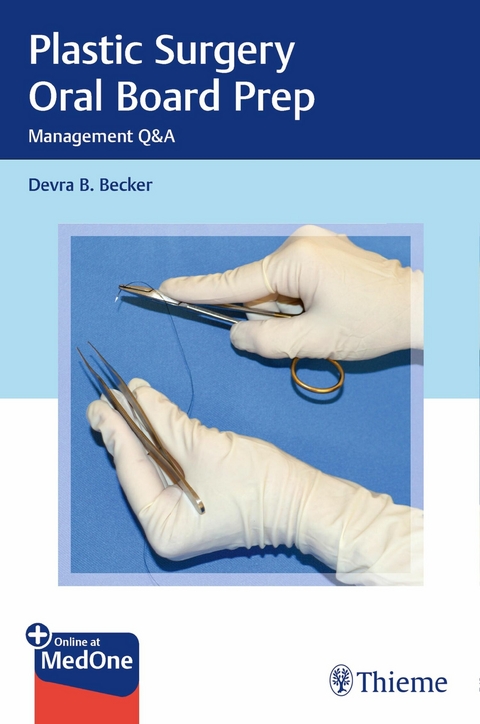
Plastic Surgery Oral Board Prep (eBook)
160 Seiten
Georg Thieme Verlag KG
978-1-63853-400-6 (ISBN)
2 Preoperative Assessment and Perioperative Management
Abstract
This chapter will provide an overview of preoperative assessment as it relates to plastic surgery. It will include medication management and will review perioperative antibiotic management. The reader will be able to prepare management plans for different scenarios.
Keywords: preoperative assessment, perioperative management, DVT, antibiotic prophylaxis, SCIP
Six Key Points
• The Surgical Care Improvement Project (SCIP) defines postoperative events and makes recommendations on perioperative management.
• Superficial plastic surgery cases are low risk.
• Patients with cardiac stents should remain on anticoagulation.
• Smoking increases complications fivefold.
• Patients should stop smoking 8 weeks prior to elective surgery.
• Assess the risk of obstructive sleep apnea.
Overview
While the preoperative workup can be tailored to a specific problem, there are general principles of perioperative management that are useful for any case. The Surgical Care Improvement Project (SCIP) was created in 2003 as an initiative of the Centers for Disease Control and Prevention (CDC) and Centers for Medicare & Medicaid Services (CMS), and has a defined goal to reduce surgical morbidity and vmortality. It has defined postoperative events and makes recommendations on perioperative management.
Questions
Case 1
Preoperative Assessment
1. What is considered low-risk surgery?
Superficial plastic surgery cases and general breast surgery are considered low-risk surgeries. Low-risk surgery can become moderate risk surgery if general anesthesia is required.
2. What are the revised cardiac risk indicators?
Invasive surgery, ischemic heart disease, heart failure, cerebrovascular accident (CVA), creatinine greater than 2.0, and diabetes mellitus requiring insulin.
3. Your patient was found to have a cardiac condition and had stents placed. Under what conditions do you proceed with surgical intervention?
If a patient has had a previous balloon angioplasty over 14 days ago, one can proceed with surgery if the patient continues aspirin. If the patient has a bare-metal stent, and it has been more than 6 weeks (ideally 3 months), the patient can be taken to surgery with aspirin. If the patient has had a drug-eluting stent, nonurgent surgery should be postponed until after a year, and then surgery can proceed if the patient continues aspirin.
Medication Management
1. Your patient wants to know which medications he can take before surgery (Table 2.1). What do you tell him?
Some medications can be taken up to and including the day of surgery, some should be taken until surgery but not taken on the day of surgery, and some should be stopped prior to surgery. These are summarized in Table 2.1.
Pulmonary
1. Your patient is a smoker. What sorts of perioperative pulmonary risks are associated with smoking?
All complications (major and minor) related to smoking are increased almost fivefold when compared with never smokers. Past smokers are also at increased risk.1
2. How long should a patient have quit smoking prior to surgery?
Ideally, a patient should have quit smoking for at least 8 weeks prior to elective surgery.2
3. How do you verify the patient has quit smoking prior to surgery?
One always has discussion with patients regarding smoking prior to surgery. Identification and verification of smoking cessation is a two-pronged approach: direct discussion with the patient and a serum cotinine test.
RATIONALE: A serum cotinine test can be ordered either qualitatively or quantitatively. The quantitative test will help distinguish between an active tobacco user and one who has recently quit; it takes approximately 2 weeks for serum cotinine to return to normal.
Active smokers have serum cotinine greater than 14 ng/mL, recent smokers have levels of 0.5 to 13.9 ng/mL, and unexposed people have serum cotinine levels less than 0.05 ng/mL.3
4. How do you assess the risk of obstructive sleep apnea (OSA) in a patient?
I assess the risk of OSA with the STOP-Bang score.
RATIONALE: The STOP-Bang score, published in 2008 and 2012,4,5 is used to assess risk of OSA. It assigns 1 point for each answer of yes to the following screening questions:
• Do you Snore?
• Are you Tired during the day?
• Witnessed Obstruction when asleep?
• High blood Pressure?
• BMI greater than 35 kg/m2?
• Age older than 50 years?
• Neck size greater than 17 inches in males and greater than 16 inches in females?
• And male Gender?
A score of 0 to 2 is low risk, 3 to 4 is intermediate risk, and greater than 5 is high risk. A score of 6 or higher is most predictive. The STOP-Bang questionnaire has been validated in obese and morbidly obese patients.6
Case 2
Perioperative Management
1. When do you start and stop perioperative antibiotics?
Antibiotics are given within one hour of surgery and are discontinued within 48 hours after surgery.
RATIONALE: The SCIP measures include postoperative infection as a surgical complication. The recommendations are to receive IV antibiotics within 1 hour of incision, and antibiotics given more than 2 hours before incision or after incision are both associated with greater rates of wound infection.7 The criteria for antibiotic prophylaxis are that the antibiotic should be safe, cost-effective, and broad spectrum. Prophylactic antibiotics should be discontinued within 48 hours of surgical end time.
There is some controversy regarding postoperative use of antibiotics. The American Society of Plastic Surgeons notes that there are no good recommendations regarding antibiotics with the use of drains. Some studies have shown that when postoperative antibiotics are continued longer than recommended, antibiotic resistance is more prevalent when infection does occur.
2. What is your intraoperative and postoperative deep vein thrombosis (DVT) prophylaxis protocol?
DVT prophylaxis b egins with assessment of risk, which is performed by calculating the Caprini score (Fig. 2.1).
RATIONALE: The Caprini score is a point system in which patient-specific factors such as obesity, age, history, and type and length of surgery are considered and assigned points. A score of 0 to 1 is low risk (2% incidence of DVT), 2 is moderate risk (10–20% incidence), 3 to 4 is high risk (20–40% incidence), and 5 is highest risk (40–80%). Treatment for each score is presented in Table 2.2.
Early ambulation is a mainstay of prevention for all plastic surgery patients and is undertaken as soon as it is safe to do so surgically. In addition, for body contouring patients, enoxaparin is given for a 7- to 10-day postoperative course.
Fig. 2.1 Caprini score. The Caprini score is a validated method of predicting deep vein thrombosis/pulmonary embolism risk, and proposes intervention based on measured risk. (Adapted from Caprini JA. Risk assessment as a guide to thrombosis prophylaxis. Curr Opin Pulm Med 2010;16(5):448–452.)
Table 2.2 Caprini score risk stratification and recommendations
| Caprini score | Risk | Prophylaxis |
| 0–1 | Low (2%) | Early ambulation |
| 2 | Moderate (10–20%) | Mechanical prophylaxis (sequential compression device) OR chemoprophylaxis (heparin 5,000 units SQ twice daily) |
| 3–4 | High (20–40%) | Chemoprophylaxis (heparin or enoxaparin weight-based and renally based dosing) ± mechanical prophylaxis |
| ≥ 5 | Highest (40–80%) | Chemoprophylaxis (Lovenox is preferred, heparin preferred with epidurals) AND mechanical prophylaxis |
Abbreviation: SQ, subcutaneous.
References
1. Bluman LG, Mosca L, Newman N, Simon DG. Preoperative smoking habits and postoperative pulmonary complications. Chest 1998;113(4):883–889
2. Smetana GW. Preoperative pulmonary evaluation. N Engl J Med 1999;340(12):937–944
3. Benowitz NL, Schultz KE, Haller CA, Wu AH, Dains KM, Jacob P III. Prevalence of smoking assessed biochemically in an urban public hospital: a rationale for routine cotinine screening. Am J Epidemiol 2009;170(7):885–891
4. Chung F, Yegneswaran B, Liao P, et al. STOP questionnaire: a tool to screen patients for obstructive sleep apnea. Anesthesiology 2008;108(5):...
| Erscheint lt. Verlag | 10.4.2019 |
|---|---|
| Verlagsort | Stuttgart |
| Sprache | englisch |
| Themenwelt | Medizinische Fachgebiete ► Chirurgie ► Ästhetische und Plastische Chirurgie |
| Medizin / Pharmazie ► Studium | |
| Schlagworte | Becker • Board • board examinations • Board Exams • boards study • in-service exams • Oral Boards • Plastic • plastic surgery boards • Surgery |
| ISBN-10 | 1-63853-400-4 / 1638534004 |
| ISBN-13 | 978-1-63853-400-6 / 9781638534006 |
| Informationen gemäß Produktsicherheitsverordnung (GPSR) | |
| Haben Sie eine Frage zum Produkt? |
 EPUB (Wasserzeichen)
DRM: Digitales Wasserzeichen
Dieses eBook enthält ein digitales Wasserzeichen und ist damit für Sie personalisiert. Bei einer missbräuchlichen Weitergabe des eBooks an Dritte ist eine Rückverfolgung an die Quelle möglich.
Dateiformat: EPUB (Electronic Publication)
EPUB ist ein offener Standard für eBooks und eignet sich besonders zur Darstellung von Belletristik und Sachbüchern. Der Fließtext wird dynamisch an die Display- und Schriftgröße angepasst. Auch für mobile Lesegeräte ist EPUB daher gut geeignet.
Systemvoraussetzungen:
PC/Mac: Mit einem PC oder Mac können Sie dieses eBook lesen. Sie benötigen dafür die kostenlose Software Adobe Digital Editions.
eReader: Dieses eBook kann mit (fast) allen eBook-Readern gelesen werden. Mit dem amazon-Kindle ist es aber nicht kompatibel.
Smartphone/Tablet: Egal ob Apple oder Android, dieses eBook können Sie lesen. Sie benötigen dafür eine kostenlose App.
Geräteliste und zusätzliche Hinweise
Buying eBooks from abroad
For tax law reasons we can sell eBooks just within Germany and Switzerland. Regrettably we cannot fulfill eBook-orders from other countries.
aus dem Bereich