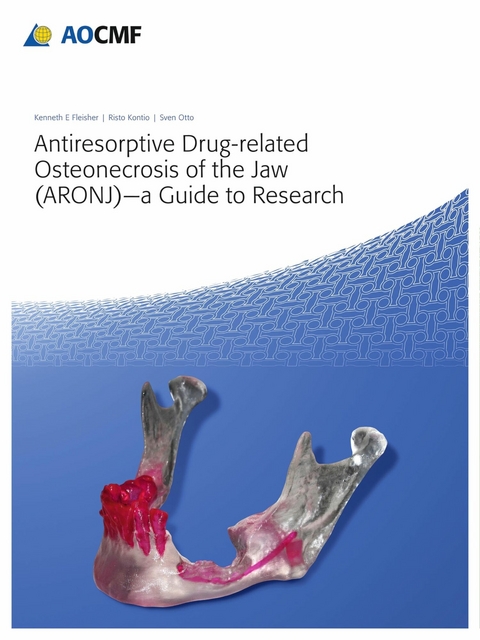
Antiresorptive Drug-Related Osteonecrosis of the Jaw (ARONJ) - A Guide to Research (eBook)
72 Seiten
Thieme (Verlag)
978-3-13-258228-6 (ISBN)
1 Definition, nomenclature, and classification of antiresorptive drug-related osteonecrosis of the jaw (ARONJ)
Tae-Geon Kwon
1 Introductory questions
In this opening chapter, the following questions are raised and discussed:
- When was bone necrosis first reported and how is it defined?
- What definitions for antiresorptive drug-related osteonecrosis of the jaw (ARONJ) exist?
- Why are different terms used and why are there so many?
- How is ARONJ classified?
2 Definition
According to a review article by Nixon in 1983 [1], bony necrosis was first described by a Professor James Russell in 1794, and the possibility of osteonecrosis due to an aseptic condition was first proposed in the early 20th century. Until recently, osteonecrosis had been considered synonymous with avascular necrosis or aseptic necrosis, which is frequently encountered in femoral head necrosis or radiation-induced necrosis of the jaw. Therefore, osteonecrosis had usually been regarded as a necrosis of bone caused by obstruction of the blood supply.
The initial reports of osteonecrosis of the jaw (ONJ) after bisphosphonate (BP) administration designated this condition as “avascular necrosis of the jaw” [2] or “avascular bone necrosis” [3] due to the similarities of the clinical manifestation of ONJ caused by radiation therapy and exposure to BPs, including the presence of nonvital and exposed bone with loss of the overlying mucosa. Consequently, the definition of ONJ after radiation therapy (osteoradionecrosis) had been similarly applied to ONJ after BP administration. Osteoradionecrosis is defined as exposed irradiated bone that fails to recover within 3 months in the absence of a residual or recurrent tumor [4]. A period of 3 months was considered because simple radionecrosis can spontaneously heal within a short period of time. Several authors have suggested that the period of bone exposure required to meet the definition of osteoradionecrosis should be at least 2 months [5, 6] or longer than 6 months [7].
The working definition of ONJ after BP treatment was first proposed by an Australian consensus guideline as “an area of exposed bone that persists for more than 6 weeks” [8. 9]. A 2007 position paper from the American Association of Oral and Maxillofacial Surgeons (AAOMS) defined bisphosphonate-related osteonecrosis of the jaw (BRONJ) [10]. The diagnosis of BRONJ is made if all three of the following characteristics are present: 1) Current or previous treatment with a BP; 2) Exposed necrotic bone in the maxillofacial region that had persisted for more than 8 weeks; 3) No history of radiation therapy to the jaws. There is no scientific explanation as to why the duration of bone exposure should be more than 8 weeks, however, it was assumed that an 8-week healing period would be sufficient for most infectious and inflammatory jaw lesions to heal normally even though postoperative infection or systemic disease was present [11]. A Canadian consensus guideline emphasized the 8-week period of clinical observation because exposed bone should be followed-up to confirm whether the soft tissues would heal spontaneously [12]. In its 2009 position paper, the AAOMS removed the term “necrotic” from the definition of BRONJ and established “stage 0” (early stage) for this disease. Aside from this change, the definition of BRONJ given by the 2009 AAOMS guideline was nearly the same as that given in 2007 [13].
The recent definition from the 2014 AAOMS position paper included significant modifications compared to the 2009 position paper [14]. Under the 2014 definition, the following characteristics were defined: 1) Current or previous treatment with antiresorptive or antiangiogenic agents; 2) Exposed bone or bone that can be probed through an intraoral or extraoral fistula(e) in the maxillofacial region that has persisted for more than 8 weeks; 3) No history of radiation therapy to the jaws or obvious metastatic disease of the jaws. The previous description of ONJ as “exposed necrotic bone” was changed to “exposed bone or bone that can be probed through an intraoral or extraoral fistula”. This is an important change to the definition of ONJ. However, there are limitations in these definitions because ONJ is not a histologically proven term and relies on only one clinical finding and two types of anamnestic information. A list of the changes to the definition of ONJ after BP administration is shown in Table 1-1.
3 Nomenclature
Osteoradionecrosis has also been frequently referred to as “osteomyelitis of irradiated bone”, “osteonecrosis”, “radioosteomyelitis”, or “septic osteoradionecrosis”. Like osteoradionecrosis, BRONJ has also been defined using a variety of terms, including “bisphosphonate-induced osteonecrosis of the jaw (BIONJ)” [15, 16] and “bisphosphonate-associated osteonecrosis of the jaw (BAONJ)” [12, 17, 18]. Some authors have emphasized the infectious cause of ONJ and used the term “bisphosphonate-associated osteomyelitis of the jaw (BAOMJ)” [19] or “bisphosphonate-related osteomyelitis of the jaw (BROMJ)” [20].
The term “associated” implies that a specific factor is assumed to be the cause of the disease whereas “related” implies that a specific factor was confirmed to be the cause of the disease [21]. The term “induced” implies a more direct cause-effect relationship; it is variously used based on the clinician's perception of the degree of proof that the BP is the cause of the jaw necrosis.
The terms for BRONJ, BAONJ, BIONJ, DIONJ, and MRONJ have recently been consolidated by the term antiresorptive drug-related osteonecrosis of the jaw (ARONJ) because of clinical reports of osteonecrosis of the jaw related to non BP antiresorptive medications such as denosumab or cathepsin K inhibitors [22]. However, there is some argument regarding this terminology due to the fundamental differences in the pharmacodynamics and accumulative toxicity of BPs and denosumab. Therefore, those authors argued that these two disease entities cannot be categorized as a single ONJ [23]. Another article used the term “denosumab-related osteonecrosis of the jaw, DRONJ” to differentiate the disease condition of BRONJ [24, 25]. To additionally include the antiangiogenic agents such as sunitinib or bevacizumab (vascular endothelial growth factor (VEGF) pathway inhibitor) to antiresorptive drugs, “drug-related osteonecrosis of the jaw, DRONJ” had been suggested [26]. In 2014, the AAOMS position paper also changed the term from BRONJ to medication-related osteonecrosis of the jaw (MRONJ), reflecting the potential risk of osteonecrosis associated with antiresorptive (denosumab) and antiangiogenic therapies [14]. In 2015, the International Task Force on Osteonecrosis of the Jaw also defined BP and denosumab as antiresorptive agents [27]. In this chapter, and throughout this publication, we use the term “antiresorptive drug-related osteonecrosis of the jaw (ARONJ)” based on the confirmed relationship between antiresorptive drugs and ONJ.
Only a limited number of cases of ONJ after administration of denosumab or antiangiogenic agents have been described, and the terminology of the disease may still be changed or modified if the pathophysiological mechanism is more clearly understood in the future.
| Year | Definition | Endorsed by |
| 2006 | Position paper [8] Bisphosphonate and osteonecrosis of the jaw (ONJ) Working definition of ONJ: an area of exposed bone that persists for more than 6 weeks | Australian and New Zealand Bone and Mineral Society, Osteoporosis Australia, Medical Oncology Group of Australia, and the Australian Dental Association |
| 2007 | 2007 AAOMS position paper [10] Bisphosphonate-related osteonecrosis of the jaw (BRONJ), if each of the following three characteristics are present:
| American Association of Oral and Maxillofacial Surgeons |
| 2007 | Report of the Task Force of the ASBMR [18] Bisphosphonate-associated osteonecrosis of the jaw (ONJ)
| American Society for Bone... |
| Erscheint lt. Verlag | 21.9.2016 |
|---|---|
| Verlagsort | Stuttgart |
| Sprache | englisch |
| Themenwelt | Medizin / Pharmazie ► Medizinische Fachgebiete ► Orthopädie |
| Medizin / Pharmazie ► Zahnmedizin | |
| Technik | |
| Schlagworte | animals in modelling • Antiresorptive • ARONJ • Jaw • Osteonecrosis |
| ISBN-10 | 3-13-258228-X / 313258228X |
| ISBN-13 | 978-3-13-258228-6 / 9783132582286 |
| Informationen gemäß Produktsicherheitsverordnung (GPSR) | |
| Haben Sie eine Frage zum Produkt? |
 EPUB (Wasserzeichen)
DRM: Digitales Wasserzeichen
Dieses eBook enthält ein digitales Wasserzeichen und ist damit für Sie personalisiert. Bei einer missbräuchlichen Weitergabe des eBooks an Dritte ist eine Rückverfolgung an die Quelle möglich.
Dateiformat: EPUB (Electronic Publication)
EPUB ist ein offener Standard für eBooks und eignet sich besonders zur Darstellung von Belletristik und Sachbüchern. Der Fließtext wird dynamisch an die Display- und Schriftgröße angepasst. Auch für mobile Lesegeräte ist EPUB daher gut geeignet.
Systemvoraussetzungen:
PC/Mac: Mit einem PC oder Mac können Sie dieses eBook lesen. Sie benötigen dafür die kostenlose Software Adobe Digital Editions.
eReader: Dieses eBook kann mit (fast) allen eBook-Readern gelesen werden. Mit dem amazon-Kindle ist es aber nicht kompatibel.
Smartphone/Tablet: Egal ob Apple oder Android, dieses eBook können Sie lesen. Sie benötigen dafür eine kostenlose App.
Geräteliste und zusätzliche Hinweise
Buying eBooks from abroad
For tax law reasons we can sell eBooks just within Germany and Switzerland. Regrettably we cannot fulfill eBook-orders from other countries.
aus dem Bereich