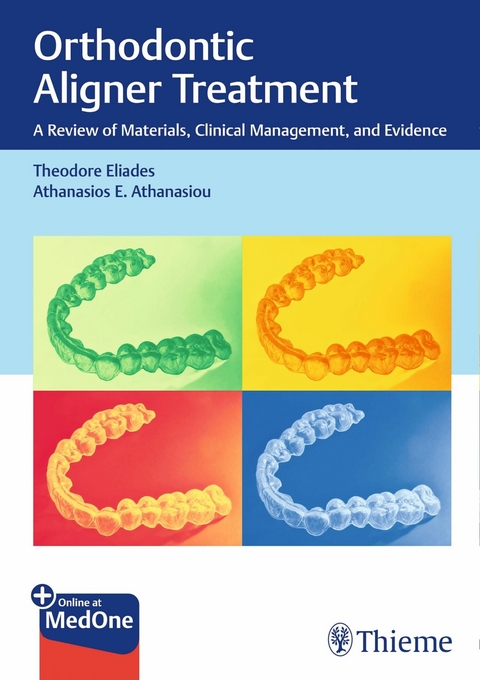
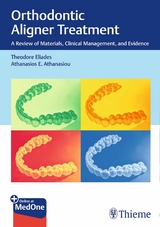
Orthodontic Aligner Treatment (eBook)
200 Seiten
Thieme (Verlag)
978-3-13-258227-9 (ISBN)
1 Aligner Treatment: An Overview*
Lauren Teske†, T. Gerard Bradley, and Sarandeep S. Huja
Summary
For almost 20 years, clear aligners have been used with growing popularity in addressing with success patients’ demands for esthetic orthodontic treatment. Many companies all over the world have developed methods of fabricating custom-made clear aligners designed to gradually and sequentially move teeth to their desired positions. Treatment efficacy with clear aligners has been reported to be good but further investigation of the various aspects of this kind of orthodontic treatment modality is needed for scientific evidence and further clinical improvement. This chapter presents an overview of the patients’ esthetic treatment demands, which led to the popularity of this modality of orthodontic therapy, as well as important aspects of the clear aligner method, the orthodontic tooth movement with clear aligners, and the material properties of clear aligners. Clear aligner material efficiency and effectiveness should continue to be studied, as a better understanding of the material properties and treatment outcomes could lead to better sequencing of tooth movement and more efficient treatment.
Keywords: orthodontic aligners, orthodontic treatment, malocclusion, patients’ esthetic treatment demands, orthodontic tooth movement, clear aligners material properties
1.1 Introduction
Patients’ demands for esthetic orthodontic treatments have grown to include esthetic appliances, such as ceramic brackets, lingual orthodontics, and clear aligner therapy.1,2,3 If patients’ orthodontic treatment motivations are esthetically driven, they may prefer a more attractive appliance as well. More Invisalign patients reported seeking treatment to improve their appearance (85 vs. 67% for fixed appliance patients), whereas more fixed appliance patients reported seeking treatment because their dentist referred them (26 vs. 3% for Invisalign patients).4
Companies including Align Technology (Santa Clara, California, United States), Allesee Orthodontic Appliances (Sturtevant, Wisconsin, United States), and Smile Direct (Nashville, Tennessee, United States) have developed a method of fabricating custom-made clear aligners designed to gradually and sequentially move teeth to their desired positions.5 The short-term chemical and physical changes, as well as the structural conformation and leaching before and after use, have been previously studied on Invisalign (Align Technology).6,7,8 Invisalign changed in 2013 the material that was used in making their aligners to SmartTrack aligner material, which continues to be a polyurethane-based material but has been claimed to have increased elasticity and a more precise fit.9 To date, no studies have investigated the mechanical properties of the clear aligners manufactured by Allesee Orthodontic Appliances, including Simpli5 and Red, White and Blue, or that of Smile Direct. The latter is a relatively recent entry to the market place with no evidence in the scientific literature to verify its claims of efficacy and efficiency in treatment.
Treatment efficacy with clear aligners has been reported to be 41 to 59%, but further investigation in material behavior is needed for improvement.10–12 The force delivery properties of aligners are influenced by both the direction of displacement and the stiffness of the material used.13,14 A more recent study has found that the orthodontic force produced by a thermoplastic material is strongly correlated with its hardness and elastic modulus. Therefore, any significant differences in the properties of clear aligners may have an impact on what aligner system the practitioner chooses to use.15 Material properties may even affect the treatment outcome, as it was found that patients wearing a harder aligner material for a 2-week activation time showed the best results in all measurements of occlusal and alignment improvement, although the difference was not statistically significant.16
It is also important to determine if the material’s properties change after use, as biofilm modification and oral environmental conditions may have effects on the hardness and viscoelasticity of the material.17 Previous studies have detected changes in the Invisalign material after use, including increased hardness, decreased mechanical properties, abraded cusp tips, integument adsorption, biofilm calcification, microcracks, delamination, and loss of transparency.6,7,8
*This chapter is dedicated to the memory of Dr. Lauren Teske, a colleague, mother, and friend.
1.2 Esthetic Treatment Demands
Patients’ demands for esthetic orthodontic treatment have grown to include any type of esthetic appliances which are minimally visible.1,2,3 The appearance of orthodontic appliances plays a significant role in patients’ decisions to receive orthodontic treatment. A survey found that 33% of young adults would be unwilling to wear visible braces if needed.18 Another study noted that while traditional metal brackets were found to be esthetically acceptable to only 55% of adults, clear aligners were acceptable to over 90%.1 Furthermore, they showed no difference in acceptability ratings when considering the appliances for their own treatment or for their children’s treatment, and they were willing to pay more for appliances they deemed more esthetic. Clear aligner preference extends to adolescents as well, as surveyed 15- to 17-year-olds rated clear aligners most acceptable and attractive over ceramic, self-ligating, traditional, and shaped brackets.19
As more adults are seeking orthodontic treatment, esthetic improvements of appliances may be a major factor in the increase of acceptability of orthodontic treatment in this group of patients. Perceived personal characteristics of adults may be influenced by their dental appearance and orthodontic appliance design: greater perceived intellectual ability was associated with the appearance of no appliance or aligner appliances compared to steel or ceramic appliances.3 This could likely influence the patient’s orthodontic appliance choice. If their treatment motivation is esthetically driven, they may prefer a more esthetic appliance as well.
1.3 Clear Aligner Therapy
Companies including Align Technology and Allesee Orthodontic Appliances have developed a method of fabricating custom-made clear aligners designed to gradually and sequentially move teeth to their desired positions (▶ Fig. 1.1).5 The short-term chemical and physical changes, as well as the structural conformation and leaching before and after use have been previously studied on Invisalign (Align Technology).6,7 However, Invisalign has recently changed the material that was used in making the aligners to Smart-Track aligner material, which continues to be a polyurethane-based material.9 Align Technology states that the SmartTrack material delivers a lower initial insertion force for improved patient comfort, while maintaining more constant force over the 2-week wear. Additionally, it is claimed to have higher elasticity and a more precise fit. This is beneficial in that it improves tracking and control of tooth movements.20 No studies to date have investigated the mechanical properties of the clear aligners manufactured by Allesee Orthodontic Appliances, including Simpli5 and Red, White and Blue. Both systems use the company’s highly esthetic proprietary material and are designed to treat minor to intermediate anterior misalignment, only differing in the number of aligners the patient has to wear to correct the misalignment.21
The aligner manufacturing process differs for the two companies. Align Technology uses stereolithography technology to create plastic resin models from photoactivated polymer.5 The patient’s polyvinyl siloxane (PVS) impressions are scanned and converted into three-dimensional electronic models, where the teeth are electronically separated and moved by a technician. Alternatively, the models can be fabricated directly from the patient’s intraoral scan.22 Each stage of treatment is converted into a physical model with a stereolithography apparatus, and an automated aligner system heats, forms, and laser-marks sheet plastic over each model.5 Ridges from the model formed by stereolithography can be seen in the finished aligner material, and the tray is scalloped along the gingival margin (▶ Fig. 1.2). Conversely, Allesee Orthodontic Appliances fabricates their aligners from stone models where the individual teeth are manually sectioned by lab technicians and repositioned with wax.23,24 The finished product is highly transparent with a straight-line finish instead of scalloping the gingival margins (▶ Fig. 1.2). Each system produces clear aligners from the models, each corresponding to a 2- to 3-week interval of treatment. Progressive alignment of 0.25 to 0.5 mm is designed into each aligner.25 Aligner systems including ClearSmile and Raintree Essix allow more displacement in each aligner (0.5–1 mm) compared to the Invisalign system (0.25–0.33 mm).25,26
Fig. 1.1 (a) Unused Invisalign and (b) Simpli5 mandibular aligners.
Benefits of clear aligner therapy include esthetics, comfort, oral hygiene...
| Erscheint lt. Verlag | 18.11.2020 |
|---|---|
| Verlagsort | Stuttgart |
| Sprache | englisch |
| Themenwelt | Medizin / Pharmazie ► Zahnmedizin |
| Schlagworte | aligner treatment • clear aligner treatment • crowding • Diagnosis • Evidence • Invisalign • Malocclusion • Materials • Orthodontics • Treatment Planning |
| ISBN-10 | 3-13-258227-1 / 3132582271 |
| ISBN-13 | 978-3-13-258227-9 / 9783132582279 |
| Informationen gemäß Produktsicherheitsverordnung (GPSR) | |
| Haben Sie eine Frage zum Produkt? |
 EPUB (Wasserzeichen)
DRM: Digitales Wasserzeichen
Dieses eBook enthält ein digitales Wasserzeichen und ist damit für Sie personalisiert. Bei einer missbräuchlichen Weitergabe des eBooks an Dritte ist eine Rückverfolgung an die Quelle möglich.
Dateiformat: EPUB (Electronic Publication)
EPUB ist ein offener Standard für eBooks und eignet sich besonders zur Darstellung von Belletristik und Sachbüchern. Der Fließtext wird dynamisch an die Display- und Schriftgröße angepasst. Auch für mobile Lesegeräte ist EPUB daher gut geeignet.
Systemvoraussetzungen:
PC/Mac: Mit einem PC oder Mac können Sie dieses eBook lesen. Sie benötigen dafür die kostenlose Software Adobe Digital Editions.
eReader: Dieses eBook kann mit (fast) allen eBook-Readern gelesen werden. Mit dem amazon-Kindle ist es aber nicht kompatibel.
Smartphone/Tablet: Egal ob Apple oder Android, dieses eBook können Sie lesen. Sie benötigen dafür eine kostenlose App.
Geräteliste und zusätzliche Hinweise
Buying eBooks from abroad
For tax law reasons we can sell eBooks just within Germany and Switzerland. Regrettably we cannot fulfill eBook-orders from other countries.
aus dem Bereich