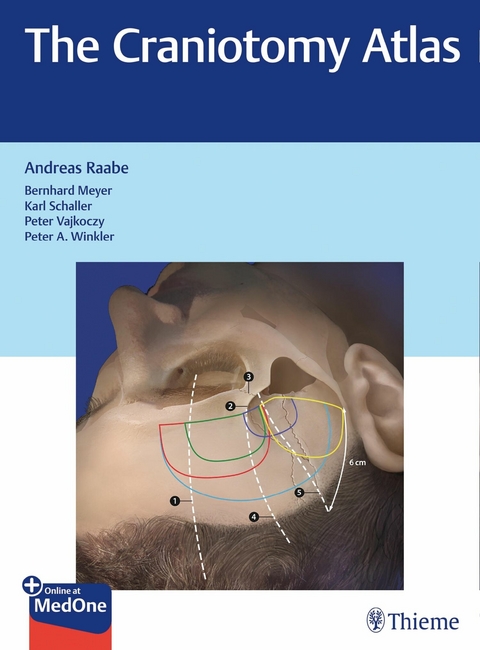
The Craniotomy Atlas (eBook)
256 Seiten
Thieme (Verlag)
978-3-13-258178-4 (ISBN)
1 Basics
1.1 Craniotomies Overview
Andreas Raabe and Peter A. Winkler
There are four basic categories of supratentorial and infratentorial craniotomy:
1. Convexity craniotomies may be performed anywhere according to the surgical target and goal of the operation. They range from burr holes and mini-craniotomy to decompressive hemicraniectomy, which is the most extensive variant.
2. Midline craniotomies are used for midline approaches that take advantage of subdural anatomical corridors to reach superficial, deep, or contralateral targets. The supratentorial suboccipital craniotomy with an intradural approach along the falx and the tentorium or an infratentorial suboccipital craniotomy with a supracerebellar approach are possible variants.
3. Skull base craniotomies range from the frontal midline to the foramen magnum, covering the entire skull base. ▶Fig. 1.1 and ▶Fig. 1.2 demonstrate the continuum of approaches which are often overlapping and are named according to their location at the skull base.
4. Skull base extensions are added to standard skull base craniotomies. They allow access with angles of approach or to structures that cannot be easily reached with standard skull base craniotomies. Typical skull base extensions are anterior clinoidectomy, removal of the orbital rim or zygoma (orbitozygomatic), transpetrosal approaches, the suprameatal extension after retrosigmoid craniotomy or the far-(enough) lateral extension to the foramen magnum (see Chapter 6, Skull Base Extensions).
Supratentorial skull base craniotomies can be divided according to their location, their frontal and temporal extension (size), and their relation to the sylvian fissure. There is no uniform classification, but the following general rules may serve as a guide to the terminology (see ▶Table 1.1).
Table 1.1 Systematics of skull base craniotomies—supratentorial
| Location | Description |
| Median frontobasal | Mostly bilateral. Target: medial frontal base, anterior midline. |
| Frontolateral | Extends 1–3 cm lateral to the midline to approximately the sphenoid wing, but does not cross it. The proximal sylvian fissure is exposed intradurally, and targets within the sylvian fissure, the anterior skull base, and the temporal lobe can be reached. There are mini- and standard sizes. “Frontolateral” is the term that was historically first used for this approach. |
| Supraorbital | Usually a smaller variant of the frontolateral approach; typically by eyebrow (transciliary) incision, which limits the size of the craniotomy. Extends 2.5–3 cm lateral to the midline to approximately the sphenoid wing, but does not cross it. The proximal sylvian fissure is exposed intradurally, and targets in the sylvian fissure, skull base, and temporal lobe can be reached. Some surgeons use the term supraorbital as synonymous with frontolateral. |
| Pterional | Extends 1–3 cm lateral to the midline to the anterior temporal region: centered around the “H” of the sutures that form the pterion (see Chapter 2.2, Craniocerebral Topography). The sphenoid wing is always crossed. Typically defined as two-thirds of the craniotomy frontal and one-third temporal exposure of variable sizes (2:1). There is also a mini-pterional variant. |
| Frontotemporal | Usually a large exposure (1:1 to 2:1 frontal:temporal) centered above the sphenoid wing = sylvian fissure. |
| Anterior temporal | Sphenoid wing is crossed. |
| Temporobasal | The exact position varies according to the surgical target: does not cross the sphenoid wing. Typically used for subtemporal intradural approaches. There may be a more anterior and a more posterior variant. |
Fig. 1.1 Systematics of skull base craniotomies—supratentorial. Supratentorial frontotemporal skull base craniotomies, 45° view (a) and lateral view (b). 1, frontolateral; 2, supraorbital; 3, standard pterional; 4, mini-pterional; 5, frontotemporal; 6, anterior temporal; 7a–c anterior, middle, posterior temporobasal; 8, sylvian fissure/sphenoid wing.
Infratentorial skull base craniotomies are performed along the sigmoid sinus or the foramen magnum (see ▶Table 1.2 for further details).
Table 1.2 Systematics of skull base craniotomies—infratentorial
| Location | Description |
| Suboccipital median infra-transverse-sinus | Midline craniotomy for supracerebellar median or paramedian approaches, e.g., for access to the pineal region or tentorial dural fistulas. |
| Suboccipital lateral infra-transverse-sinus | These are craniotomies based on the same principle as the midline craniotomies for an intradural approach along the subdural space parallel to the tentorium. Typically, they are used for supracerebellar lateral approaches to the midbrain or other regions. They are horizontally oriented compared to the retrosigmoid craniotomy, with more exposure along the transverse sinus and less along the sigmoid sinus. A modification is the suboccipital far-lateral infra-transverse-sinus craniotomy. |
| Retrosigmoid | Typically ranges from the transverse sinus to the base of the posterior fossa along the sigmoid sinus to gain access to the cerebellopontine angle. May vary in size and be centered more superiorly or inferiorly: vertically oriented. |
| Suboccipital median periforaminal craniotomy with opening of the foramen magnum | Typically bilateral, there is a mini-version, for example, in Chiari-decompression surgery. |
| Suboccipital lateral periforaminal craniotomy with opening of the foramen magnum | The lateral suboccipital craniotomy with opening of the foramen magnum is the basic craniotomy for the far lateral approach which can be regarded as a skull base extension of the basal suboccipital craniotomy. |
Fig. 1.2 Systematics of skull base craniotomies—infratentorial. Craniotomies of the posterior fossa. 9, suboccipital median infra-transverse-sinus; 10, suboccipital lateral infra-transverse-sinus; 11, suboccipital far-lateral infra-transverse-sinus; 12, retrosigmoid; 13, suboccipital median periforaminal (with opening of the foramen magnum); 14, mini-suboccipital median periforaminal (with opening of the foramen magnum); 15, suboccipital lateral periforaminal (with opening of the foramen magnum); 16, far-lateral extension.
1.2 Difference between Approach and Craniotomy
Andreas Raabe
Although often used synonymously, there is a difference between a craniotomy and an approach. Approach is the broader term and is often used for craniotomy and intradural preparation. In this book, we discuss only the steps of the craniotomy, i.e., to reach bony exposure. With a few exceptions, we stay outside the dura. We will therefore mostly use the term craniotomy instead of approach, and generally reserve the latter to describe the dissection and exposure after opening the dura mater. Craniotomy and approach may be different as in the examples given below. However, as already mentioned, the term “approach” often overlaps with craniotomy and intradural preparation.
Examples:
• Supraorbital craniotomy and subfrontal approach.
• Pterional craniotomy and transsylvian approach.
• Temporobasal craniotomy and subtemporal approach.
• Suboccipital lateral craniotomy and supracerebellar lateral approach.
• Median suboccipital craniotomy and telovelar approach.
1.3 Craniotomies We Have Omitted from This Book and Why
Andreas Raabe, Bernhard Meyer, Peter Vajkoczy, and Karl Schaller
This book is intended primarily for young residents, to serve as a guide to understanding the various craniotomies. It describes the most often used craniotomies, but we decided not to include those that are used only very rarely. Therefore, it does not cover highly specialized skull base craniotomies and their extension, such as posterior transpetrosal, translabyrinthine, transcochlear, or combined approaches, nor is it our aim to provide a complete atlas of approaches and extensions.
We acknowledge that these specialized skull base approaches had their place in the heyday of skull base surgery. However, nowadays they are often replaced by a staged procedure or a combination of simpler craniotomies that provide a less invasive strategy with lower morbidity than a technically demanding and more invasive approach. Moreover, radiosurgery and endovascular treatment often complete a less invasive treatment for many patients.
We are also aware that the nomenclature for the...
| Erscheint lt. Verlag | 10.7.2019 |
|---|---|
| Verlagsort | Stuttgart |
| Sprache | englisch |
| Themenwelt | Medizin / Pharmazie ► Medizinische Fachgebiete ► Chirurgie |
| Schlagworte | Convexity approaches • craniocerebral topography • Decompressive hemicraniectomy • Midline approaches • Skull base approaches • Transsphenoidal approach |
| ISBN-10 | 3-13-258178-X / 313258178X |
| ISBN-13 | 978-3-13-258178-4 / 9783132581784 |
| Informationen gemäß Produktsicherheitsverordnung (GPSR) | |
| Haben Sie eine Frage zum Produkt? |
 EPUB (Wasserzeichen)
DRM: Digitales Wasserzeichen
Dieses eBook enthält ein digitales Wasserzeichen und ist damit für Sie personalisiert. Bei einer missbräuchlichen Weitergabe des eBooks an Dritte ist eine Rückverfolgung an die Quelle möglich.
Dateiformat: EPUB (Electronic Publication)
EPUB ist ein offener Standard für eBooks und eignet sich besonders zur Darstellung von Belletristik und Sachbüchern. Der Fließtext wird dynamisch an die Display- und Schriftgröße angepasst. Auch für mobile Lesegeräte ist EPUB daher gut geeignet.
Systemvoraussetzungen:
PC/Mac: Mit einem PC oder Mac können Sie dieses eBook lesen. Sie benötigen dafür die kostenlose Software Adobe Digital Editions.
eReader: Dieses eBook kann mit (fast) allen eBook-Readern gelesen werden. Mit dem amazon-Kindle ist es aber nicht kompatibel.
Smartphone/Tablet: Egal ob Apple oder Android, dieses eBook können Sie lesen. Sie benötigen dafür eine kostenlose App.
Geräteliste und zusätzliche Hinweise
Buying eBooks from abroad
For tax law reasons we can sell eBooks just within Germany and Switzerland. Regrettably we cannot fulfill eBook-orders from other countries.
aus dem Bereich