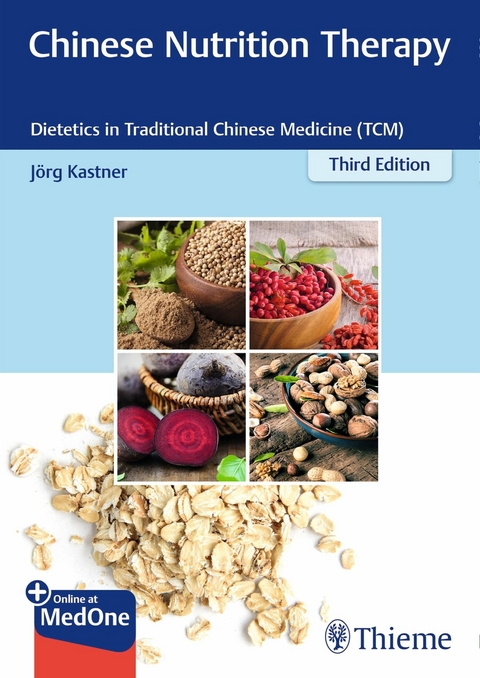
Chinese Nutrition Therapy (eBook)
328 Seiten
Georg Thieme Verlag KG
978-3-13-257932-3 (ISBN)
1A Introduction to the Basic Principles of Traditional Chinese Medicine and Chinese Dietetics
1 Yin and Yang
The basic principles of Traditional Chinese Medicine (TCM) are rooted in the Daoist philosophy of yin and yang. These two polar opposites organize and explain the ongoing process of natural change and transformation in the universe.
According to ancient lore, yang marks the sunny side and yin the shady side of a hill. In the theory of yin and yang, all things and phenomena of the cosmos contain these two complementary aspects. The traditional Daoist symbol for completeness and harmony is the merging monad of yin and yang.
The standard of TCM, the Huang Di Nei Jing, “The Yellow Emperor’s Classic of Medicine,” dates as far back as 500 to 300 BC. This 18-volume classic work has two parts, Ling Shu and Su Wen. The Su Wen explains the theoretical foundations of TCM in the form of a dialogue between the legendary Yellow Emperor Huan Di and his personal physician Shi Po. The Ling Shu, the practical part of the Nei Jing, reports on therapies and their uses in TCM: acupuncture, moxibustion, nutritional therapy, and the use of medicinal herbs.
TCM is rooted in the Daoist worldview employed by physicians and philosophers for centuries as a guide for viewing and interpreting natural phenomena.
Dao means harmony–destination–way, the “all-in-one,” the origin of the world. The teachings of Dao are based on the work Dao de Jing (Daodejing, Tao te Ching), “The Book of the Way and of Virtue,” by the famous Chinese scholar Laozi (Lao Tse) (600 BC).
Fig. 1.1 Monad.
| In Nature |
| Yin | Yang |
| Moon | Sun |
| Shadow/night | Light/day |
| Dark | Light |
| Passive | Active |
| Water | Fire |
| Down | Up |
| Structure | Function |
| Right | Left |
| Cold | Hot |
| Plant-based foods | Animal-based foods |
| Heaven | Earth |
| Autumn, winter | Spring, summer |
| Relative stasis | Evident motion |
| Heavy | Light |
| In People |
| Yin | Yang |
| Woman | Man |
| Receptive | Creative |
| Stomach, front | Back, rear |
| From waist down | From waist up |
| Body interior | Body surface |
| Right | Left |
| Viscera (storage organs) zang (heart) | Bowels (hollow organs) fu (stomach) |
| Organ structure | Organ function |
| Blood, body fluids | Qi, life energy |
| Bones/organs/sinews | Skin/muscles/body hair |
| Viscera | Bowels |
| Gu qi (drum qi) | Defense qi (wei qi) |
| Controlling vessel (ren mai) | Governing vessel (du mai) |
| In Diagnostics |
| Yin | Yang |
| Quiet voice | Loud voice |
| Talks little | Talks a lot |
| Pale face | Red face |
| Shivering, sensation of cold | Warm, sensation of heat |
| Likes warmth | Likes cold |
| Slow, reticent movements | Fast, strong movements |
| Passive, insidious onset of illness | Active, acute onset of illness |
| Chronic illness | Acute illness |
| Urine: clear, frequent | Urine: dark, concentrated |
| Tongue: pale, white fur | Tongue: red, yellow fur |
| Pulse: slow, weak | Pulse: rapid, replete |
| In Diagnostics and Therapy |
| Yin | Yang |
| Vacuity, interior, cold symptoms | Repletion, exterior, heat symptoms |
| Inadequate circulation | Blood repletion |
| Hypofunction (underfunction) | Hyperfunction (overfunction) |
| Flaccid muscles | Tense muscles |
| Depression disorders | States of agitation |
| Low blood pressure (hypotension) | High blood pressure (hypertension) |
| Dull pain | Sharp pain |
| Cool | Warm |
| Beta-blockers | Caffeine |
| Cool packs | Fango (hot packs) |
| Pulse: slow, deep, rough, vacuous, fine | Pulse: rapid, floating, slippery, replete, large, surging |
| In Chinese Nutrition |
| Yin | Yang |
| Tropical fruit | Meat |
| Dairy products | Acrid spices |
| Seaweed | Shrimp |
| Orange juice | Coffee |
| Peppermint tea | Fennel tea |
| Wheat | Oats |
| Soy sauce | Tabasco |
| Wheat beer | Anise schnapps |
| Steamed foods | Grilled foods |
Fig. 1.2 The Chinese character qi.
Guided by the Daoist perspective, “natural scientists” took the findings of these observations of nature and applied them to humans. They regarded the human being as a natural being, a part of nature, subject to and dependent on nature’s processes.
The main principle of Dao is represented by the two polarities yin and yang, which, according to Daoist belief, mirror all phenomena in the universe. The Chinese character for qi is formed by two elements. One element means “air,” “breath,” “steam”; the other element means “rice,” “grains.” This character illustrates how something can be both immaterial and material, in accordance with the Daoist principle of yin and yang.
The energy field between the poles of yin and yang gives rise to the universal primal force qi. According to ancient Chinese belief, vital qi (sheng qi)—or life force—is the primary source of all living processes in the cosmos.
The concept and meaning of qi is only partially translatable into Western languages. Hindus and Yogis use the term “prana” to reflect similar ideas about all-permeating life energy. The ancient Greek term “pneuma” describes a similar concept. Coursing vital qi, as an energetic unit, is an essential element in the various treatment modalities of TCM, such as acupuncture, moxibustion, dietetics, medicinal herb therapy, and qi gong.
Imbalances of qi can take the form of vacuity or repletion. The term “vacuity” comes from the Chinese “xu” (vacuous, empty, lacking, weak). Its opposite is “repletion,” which comes from the Chinese “shi.” Vacuity...
| Erscheint lt. Verlag | 21.5.2021 |
|---|---|
| Übersetzer | Sabine Wilms |
| Verlagsort | Stuttgart |
| Sprache | englisch |
| Themenwelt | Medizin / Pharmazie ► Medizinische Fachgebiete |
| Medizin / Pharmazie ► Naturheilkunde | |
| Schlagworte | diet • Disease • Healing • Health • healthy eating • TCM • Traditional Chinese Medicine |
| ISBN-10 | 3-13-257932-7 / 3132579327 |
| ISBN-13 | 978-3-13-257932-3 / 9783132579323 |
| Informationen gemäß Produktsicherheitsverordnung (GPSR) | |
| Haben Sie eine Frage zum Produkt? |
 EPUB (Wasserzeichen)
DRM: Digitales Wasserzeichen
Dieses eBook enthält ein digitales Wasserzeichen und ist damit für Sie personalisiert. Bei einer missbräuchlichen Weitergabe des eBooks an Dritte ist eine Rückverfolgung an die Quelle möglich.
Dateiformat: EPUB (Electronic Publication)
EPUB ist ein offener Standard für eBooks und eignet sich besonders zur Darstellung von Belletristik und Sachbüchern. Der Fließtext wird dynamisch an die Display- und Schriftgröße angepasst. Auch für mobile Lesegeräte ist EPUB daher gut geeignet.
Systemvoraussetzungen:
PC/Mac: Mit einem PC oder Mac können Sie dieses eBook lesen. Sie benötigen dafür die kostenlose Software Adobe Digital Editions.
eReader: Dieses eBook kann mit (fast) allen eBook-Readern gelesen werden. Mit dem amazon-Kindle ist es aber nicht kompatibel.
Smartphone/Tablet: Egal ob Apple oder Android, dieses eBook können Sie lesen. Sie benötigen dafür eine kostenlose App.
Geräteliste und zusätzliche Hinweise
Buying eBooks from abroad
For tax law reasons we can sell eBooks just within Germany and Switzerland. Regrettably we cannot fulfill eBook-orders from other countries.
aus dem Bereich