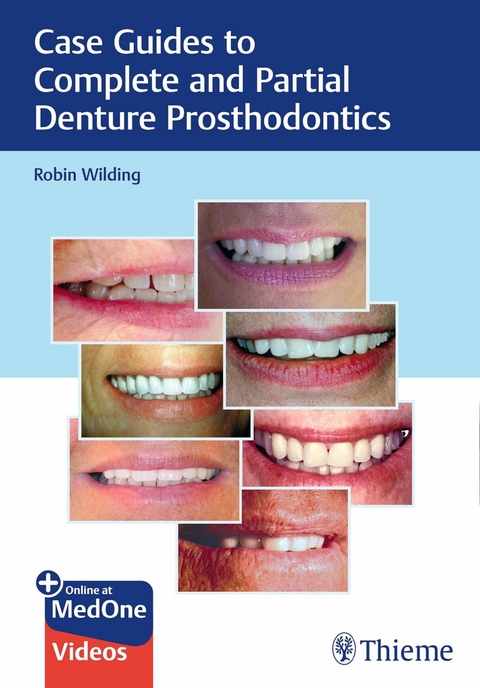
Case Guides to Complete and Partial Denture Prosthodontics (eBook)
152 Seiten
Georg Thieme Verlag KG
978-1-63853-685-7 (ISBN)
Case Guide 1
The Acrylic-Based RPD Replacing Anterior Teeth
Abstract
The replacement of lost teeth in the anterior region of the dentition is a common request from patients. They are well motivated to persevere in the habituation of a denture that replaces anterior teeth in order to improve their appearance and may have quite modest demands for improved function. The aim of this case is to describe the assessment of a patient’s needs, plan appropriate treatment, and inform the patient of the risks and benefits of wearing a removable partial denture (RPD). It must be clear that the patient understands this before giving his or her consent to treatment. The clinical stages of making impressions, planning the RPD, assessing the trial denture, and placement of the finished denture will be described. In Appendix A, there is a review of the patient’s emotional response to the loss of his or her teeth, as it has important implications for patient management and attention to aesthetic requirements. The biological price of a partial denture describes the increased risk of dental caries and periodontal disease caused by the presence of an RPD in the oral cavity.
Keywords: patient assessment, consent, preliminary impressions, final impressions, planning, shade selection, denture placement, immediate replacement dentures
| Clinical Procedures | Dental Science |
| • Assessment of patient needs, examination, and informed consent • Preliminary impressions • Planning the RPD • Making the final impressions • Selecting a shade and mold for denture teeth • Writing a laboratory request • Assessing the trial RPD • Placement of an acrylic-based RPD • Immediate replacement dentures | • Psychology of tooth loss • The biological price of partial dentures • Informed consent • Management of undercut • Dental materials summaries • Cleaning dentures • Resin bonded bridge |
1.1 Assessment of Patient Needs, Examination, and Informed Consent
Removable partial dentures (RPDs) are not routinely successful. They may be loose, painful, appear unattractive when held in the hand, and at best, feel strange in the mouth until the wearer has become used to them. They require care from the dentist and the laboratory in fabricating them to be well adapted to the denture supporting tissues and to be aesthetically pleasing; they require perseverance from the patient in overcoming the natural resistance to having something foreign in the mouth and in learning to masticate with them. The patient’s reasons and motivation for having an RPD fabricated are important indicators of whether or not they will be successful.
1.1.1 Patient Assessment
Ask your patient the following questions to lead off this first step in assessing needs:
• How long have you had the spaces?
• How did you lose these teeth?
• How do you feel about keeping the rest of your teeth?
• What is the worst aspect of having these spaces?
• Have you ever worn an RPD before?
• Are you aware that there are alternatives to an RPD?
These and other questions that you may think are useful should provide some insights into the patient’s attitudes to preserving their dentition and the motivation for wearing an RPD. The loss of anterior teeth has a profound impact on our body image. We need to understand the importance of teeth from a psychological viewpoint in order to empathize fully with a patient (see Appendix A.1 Psychology of tooth loss). If a relative is persuading the patient to have treatment, it may be necessary to advise the patient that unless he or she is well motivated, the treatment may not be successful.
1.1.2 Patient Examination
At this stage, you should ask the patients, if you have not already done so, about their general health and record a medical history. Consult the procedure for obtaining a relevant medical history for determining the contraindications to dental treatment.
• Make a standard dental charting, recording all teeth present, the presence of caries and restorations, and the periodontal condition. Make radiographs, if necessary, to confirm a diagnosis.
• Make a note of the level of oral hygiene practiced by the patient or use a plaque index to be more precise.
• Pay particular attention to those teeth on either side of the edentulous area (abutment teeth). Radiographs should be made of abutment teeth to detect existing periodontal and periapical infection.
• Note any teeth next to edentulous areas that have partly drifted, tilted, overerupted, or rotated.
• Ask the patient to close together on the back teeth (this should bring the teeth into maximum intercuspation), and make sure there is space available between the opposing teeth and the residual alveolar ridge to accommodate the base of an RPD. Less than 2 mm may be inadequate and require modification of the cusps of overerupted teeth.
Draw up a provisional treatment plan to restore carious teeth and to bring under control active periodontal disease. Plan to remove any teeth with a poor prognosis. There is a section at the end of this case guide that will review the modifications in procedure needed to provide immediate replacement of anterior teeth at the time of extraction.
1.1.3 Informed Consent
You should have enough information to explain to the patients the options they have including the risks and benefits of RPDs (see Appendix A.3 Informed consent). An important issue will be retention of the RPD. The replacement of anterior missing teeth by means of acrylic resin–based RPD provides limited opportunities for active retention. The patient should understand that it may be necessary for him or her to use denture fixative to keep the denture in place. Even with fixative, any attempt to bite off pieces of food such as a cookie or apple may cause the denture to tip forward, rotating about the residual ridge.
A treatment option which should be considered and explained to the patients is a resin bonded or implant supported bridge (see Appendix A.7 Resin bonded bridge).
The preservation of the remaining teeth is a priority both to ensure that there is no further tooth loss and that the partial denture does not become redundant in a few years’ time due to further tooth loss. The patient should know that a partial denture increases the levels of plaque even in the presence of good oral hygiene. The risks of dental caries and periodontal disease are increased (see Appendix A.2 The biological price of partial dentures). The patient will need advice on improving plaque control, as every RPD increases the levels of plaque on adjacent teeth. The patient may benefit from prophylactic sessions with an oral hygienist.
When your patient has been well informed and understands what could be achieved with an RPD, and has concluded that the effort and money he or she will be spending is worthwhile, it is time to begin the preparatory restorative work and periodontal treatment.
1.2 Making Preliminary Impression for Study Casts
When preparatory work is underway to control active caries and periodontal disease, you may find it worthwhile to make preliminary impressions so as to be able to study diagnostic casts of the patient’s dentition. Select stock impression trays (dentate) of a suitable size by first trying the average-sized tray in the mouth without material. Apply the technique described for inserting the tray into the mouth as described for the mandibular tray in ▶Fig. 1.1 and the maxillary tray in ▶Fig. 1.2. The tray is suitable if it covers and surrounds the arch of teeth and is not so large as to be difficult to insert.
Read through the section in Appendix A.5 Dental materials summaries on the material properties of alginate impression materials. Make the mandibular impression first. Spray or paint the tray with the recommended adhesive. Prepare a mix of alginate using the correct water powder measures and load the tray up to but not above the tray border. If the water temperature is suitable (15–20°C), you should have sufficient time to place the tray without being hurried. When the material has set, remove the mandibular impression by rotating the tray so as to loosen one side first.
Fig. 1.1 Trials insertion of a mandibular stock impression tray. (a) Stand facing the patient with the chair in an upright position. Hold the tray, facing downward between the first two fingers and the thumb of the right hand. (b) Rotate the tray slightly anticlockwise and then use the right extension of the tray to gently retract the left corner of the patient’s mouth. (c) Use your left forefinger to retract the right...
| Erscheint lt. Verlag | 5.2.2020 |
|---|---|
| Verlagsort | Stuttgart |
| Sprache | englisch |
| Themenwelt | Medizin / Pharmazie ► Gesundheitsfachberufe |
| Medizin / Pharmazie ► Medizinische Fachgebiete | |
| Medizin / Pharmazie ► Zahnmedizin ► Chirurgie | |
| Schlagworte | Case-Based Learning • Complete dentures • Dental • dentistry • Dentures • partial dentures • Patient Management • prosthetics • Prosthodontics |
| ISBN-10 | 1-63853-685-6 / 1638536856 |
| ISBN-13 | 978-1-63853-685-7 / 9781638536857 |
| Informationen gemäß Produktsicherheitsverordnung (GPSR) | |
| Haben Sie eine Frage zum Produkt? |
 EPUB (Wasserzeichen)
DRM: Digitales Wasserzeichen
Dieses eBook enthält ein digitales Wasserzeichen und ist damit für Sie personalisiert. Bei einer missbräuchlichen Weitergabe des eBooks an Dritte ist eine Rückverfolgung an die Quelle möglich.
Dateiformat: EPUB (Electronic Publication)
EPUB ist ein offener Standard für eBooks und eignet sich besonders zur Darstellung von Belletristik und Sachbüchern. Der Fließtext wird dynamisch an die Display- und Schriftgröße angepasst. Auch für mobile Lesegeräte ist EPUB daher gut geeignet.
Systemvoraussetzungen:
PC/Mac: Mit einem PC oder Mac können Sie dieses eBook lesen. Sie benötigen dafür die kostenlose Software Adobe Digital Editions.
eReader: Dieses eBook kann mit (fast) allen eBook-Readern gelesen werden. Mit dem amazon-Kindle ist es aber nicht kompatibel.
Smartphone/Tablet: Egal ob Apple oder Android, dieses eBook können Sie lesen. Sie benötigen dafür eine kostenlose App.
Geräteliste und zusätzliche Hinweise
Buying eBooks from abroad
For tax law reasons we can sell eBooks just within Germany and Switzerland. Regrettably we cannot fulfill eBook-orders from other countries.
aus dem Bereich