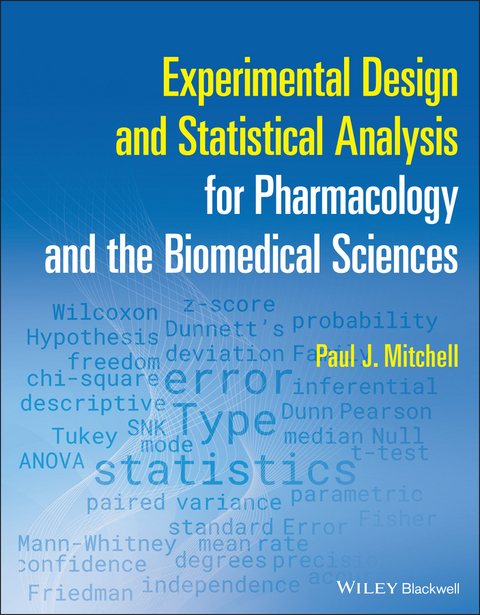
Experimental Design and Statistical Analysis for Pharmacology and the Biomedical Sciences (eBook)
John Wiley & Sons (Verlag)
978-1-119-43766-6 (ISBN)
A practical guide to the use of basic principles of experimental design and statistical analysis in pharmacology
Experimental Design and Statistical Analysis for Pharmacology and the Biomedical Sciences provides clear instructions on applying statistical analysis techniques to pharmacological data. Written by an experimental pharmacologist with decades of experience teaching statistics and designing preclinical experiments, this reader-friendly volume explains the variety of statistical tests that researchers require to analyze data and draw correct conclusions.
Detailed, yet accessible, chapters explain how to determine the appropriate statistical tool for a particular type of data, run the statistical test, and analyze and interpret the results. By first introducing basic principles of experimental design and statistical analysis, the author then guides readers through descriptive and inferential statistics, analysis of variance, correlation and regression analysis, general linear modelling, and more. Lastly, throughout the textbook are numerous examples from molecular, cellular, in vitro, and in vivo pharmacology which highlight the importance of rigorous statistical analysis in real-world pharmacological and biomedical research.
This textbook also:
- Describes the rigorous statistical approach needed for publication in scientific journals
- Covers a wide range of statistical concepts and methods, such as standard normal distribution, data confidence intervals, and post hoc and a priori analysis
- Discusses practical aspects of data collection, identification, and presentation
- Features images of the output from common statistical packages, including GraphPad Prism, Invivo Stat, MiniTab and SPSS
Experimental Design and Statistical Analysis for Pharmacology and the Biomedical Sciences is an invaluable reference and guide for undergraduate and graduate students, post-doctoral researchers, and lecturers in pharmacology and allied subjects in the life sciences.
Dr Paul J. Mitchell is Senior Lecturer and Associate Professor in the Department of Pharmacy and Pharmacology, University of Bath, UK, and Adjunct Lecturer in the Department of Pharmacology and Therapeutics, National University of Ireland (NUI), Galway, Ireland. He has more than 45 years' experience in experimental pharmacology, experimental design, and statistical analysis. For the last 25 years Dr Mitchell has collaborated with colleagues to develop a coherent strategy to teach experimental design and statistical analysis to undergraduate and graduate students across subject areas.
Experimental Design and Statistical Analysis for Pharmacology and the Biomedical Sciences A practical guide to the use of basic principles of experimental design and statistical analysis in pharmacology Experimental Design and Statistical Analysis for Pharmacology and the Biomedical Sciences provides clear instructions on applying statistical analysis techniques to pharmacological data. Written by an experimental pharmacologist with decades of experience teaching statistics and designing preclinical experiments, this reader-friendly volume explains the variety of statistical tests that researchers require to analyze data and draw correct conclusions. Detailed, yet accessible, chapters explain how to determine the appropriate statistical tool for a particular type of data, run the statistical test, and analyze and interpret the results. By first introducing basic principles of experimental design and statistical analysis, the author then guides readers through descriptive and inferential statistics, analysis of variance, correlation and regression analysis, general linear modelling, and more. Lastly, throughout the textbook are numerous examples from molecular, cellular, in vitro, and in vivo pharmacology which highlight the importance of rigorous statistical analysis in real-world pharmacological and biomedical research. This textbook also: Describes the rigorous statistical approach needed for publication in scientific journals Covers a wide range of statistical concepts and methods, such as standard normal distribution, data confidence intervals, and post hoc and a priori analysis Discusses practical aspects of data collection, identification, and presentation Features images of the output from common statistical packages, including GraphPad Prism, Invivo Stat, MiniTab and SPSS Experimental Design and Statistical Analysis for Pharmacology and the Biomedical Sciences is an invaluable reference and guide for undergraduate and graduate students, post-doctoral researchers, and lecturers in pharmacology and allied subjects in the life sciences.
Dr Paul J. Mitchell is Senior Lecturer and Associate Professor in the Department of Pharmacy and Pharmacology, University of Bath, UK, and Adjunct Lecturer in the Department of Pharmacology and Therapeutics, National University of Ireland (NUI), Galway, Ireland. He has more than 45 years' experience in experimental pharmacology, experimental design, and statistical analysis. For the last 25 years Dr Mitchell has collaborated with colleagues to develop a coherent strategy to teach experimental design and statistical analysis to undergraduate and graduate students across subject areas.
Foreward 4
1 Introduction 6
2 So, what are data? 8
3 Numbers; counting and measuring, precision and accuracy 9
4 Data collection: Sampling and populations, different types of data, data distributions 12
5 Descriptive statistics: measures to describe and summarize data sets. 16
6 Testing for Normality and transforming skewed data sets 22
7 The Standard Normal Distribution 28
8 Non-Parametric Descriptive statistics 30
9 Summary of descriptive statistics; so, what values may I use to describe my data? 34
Decision Flowchart 1: Descriptive Statistics - Parametric v Non-parametric data 43
10 Introduction to Inferential statistics 44
11 Comparing 2 sets of data - Independent t-test 50
12 Comparing 2 sets of data - Paired t-test 55
13 Comparing 2 sets of data - Independent non-parametric data 58
14 Comparing 2 sets of data - Paired non-parametric data 62
15 Parametric 1-way Analysis of Variance 66
16 Repeated Measures Analysis of Variance 78
17 Complex Analysis of Variance models 86
18 Non-parametric ANOVA 102
Decision Flowchart 2: Inferential Statistics - Single and multiple pairwise comparisons 115
19 Correlation Analysis 116
20 Regression Analysis 126
21 Chi-Square Analysis 136
Decision Flowchart 3: Inferential Statistics -Tests of Association 145
22 Confidence Intervals 146
23 Permutation Test of Exact Inference 150
24 General Linear Model 152
Appendices Introduction to Appendices 155
A Data distribution: probability mass function and probability density functions
A.1 Binomial Distribution 156
A.2 Exponential Distribution 157
A.3 Normal Distribution 158
A.4 Chi-square Distribution 159
A.5 Student t-Distribution 160
A.6 F Distribution 161
B Standard Normal Probabilities
B.1 AUC values for z values below the mean (i.e. -z) 162
B.2 AUC values for z values above the mean (i.e. +z) 163
C Critical values of the t-distribution 164
D Critical values of the Mann-Whitney U statistic
D.1 Critical values for U; One-tailed test, p = 0.05 165
D.2 Critical values for U; One-tailed test, p = 0.01 166
D.3 Critical values for U; Two-tailed test, p = 0.05 167
D.4 Critical values for U; Two-tailed test, p = 0.01 168
E Critical values of the F distribution
E.1 Critical values of F, p = 0.05 169
E.2 Critical values of F, p = 0.01 170
E.3 Critical values of F, p = 0.001 171
F Critical values of the Chi-square distribution 172
G Critical z values for multiple non-parametric pairwise comparisons
G.1 Critical values of z according to the number of comparisons 173
G.2 Alternative critical values of z according to the number of comparisons when all groups have an equal number of subjects 173
H Critical values of correlation coefficients
H.1 Pearson Product Moment Correlation 174
H.2 Spearman Rank Correlation 174
H.3 Kendall's Rank Correlation (Kendall's tau) 175
Overall Decision Flowchart: Descriptive and Inferential Statistics 176
Index
Acknowledgements
Homo Sapiens – Part 1
Looking back over copious notes and draft versions of this book, I've come to realise that this project has taken me far longer than my initial 12‐month plan envisaged. But let me take you back to the beginning of the 2016–2017 academic year when I confronted a group of pharmacology undergraduate students who had just returned from a year's placement and were about to embark on the final year of their degree programme. My question ‘So, how're your stats skills coming along now you've been in the big wide world?’ was met with a mixture of dismay and disdain, not to say contempt for mentioning the S word! The ensuing conversation quickly dispelled any thoughts on my part regarding their progress and so I quickly put together an intense four‐week package, which covered all my statistics lectures and hands‐on data analysis workshops to get them up to speed. The feedback I received suggested that delivering such material in such a short period was successful, but one important component was missing; they had no access to a suitable concise textbook covering descriptive and inferential statistics suitable for undergraduate pharmacology students. Indeed their major complaint was that currently available textbooks were either focused on statistical theory (suitable only for highly competent students of mathematics) or were simply user guides for statistical software packages; both of which were totally inappropriate for students who simply wanted to know which statistical tests they had to use to analyse different types of experimental data. In short, they needed a concise ‘textbook’ book, which showed them how to use statistics as a tool with which they could analyse their experimental data and arrive at appropriate conclusions, thereby revealing the relationship of their data to the real world. So, it seems obvious to me that the first group of individuals that I should thank, and you, dear reader, should blame for kick‐starting this project which has resulted in the contents of this book, are the infamous seven final year pharmacology students from 2016: Charlotte Bell, Charlotte Day, Sam Groom, James Miles (yes, that cocky bugger), Katy Murrell, Gemma Wilkinson, and Alex Williams – according to my latest information most if not all have now completed (or nearly so) their subsequent PhD studies and are now forging research careers on their own (and most notably without my help!). If this book is in any way successful, then clearly you seven should be held totally accountable!
Of course, when you embark on a project that is clearly not your day job, then you need a lot of support to help you to find the time in the working day that enables you to turn that germ of an idea into fruition. My sincere thanks to all my colleagues in the Department of Pharmacy and Pharmacology at the University of Bath that in many, diverse, ways have enabled me to focus on putting this manuscript together, that have humoured me while I've ranted on regarding the statistical inadequacies in the scientific press or listened quietly while I've bombarded them with different ideas on how to describe quite complex statistical issues that an inexperienced undergraduate student may (hopefully) understand. Most importantly, my thanks to Profs Steve Ward and Roland Jones who agreed for me to move my teaching duties around that created gaps in my teaching load, which allowed me to concentrate on writing. This book is full of data examples, which, I hope, will enable the reader to understand more‐fully descriptive and inferential statistics and to envisage statistics in action. Most of the data examples are my own, and for all other examples I am very grateful to Dr Malcolm Watson. I must also thank Prof Steve Husbands and Dr Christine Edmead for their helpful comments, encouragement, and suggestions after reading the first completed draft version of the manuscript; of course, considering Steve is a medicinal/organic chemist, who (by his own admission) failed to understand anything described in the book, his comments were totally ignored!
For the last 15–20 years or so, I have worked very closely with Prof John Kelly, Department of Pharmacology and Therapeutics, NUIGalway, during which we have tried, successfully it must be said, to develop a fully integrated series of lectures and workshops to teach undergraduate and postgraduate students in pharmacology, neuropharmacology, toxicology, and drug discovery the vagaries of robust experimental design and statistical analysis. I still travel to Galway every year to expose John's postgraduate students to an English sense of humour in my attempt to run hands‐on statistical workshops – I must be doing OK as John keeps inviting me back! My sincere thanks to John for all the support and encouragement he has given me during that time and to other colleagues in Galway, notably Ambrose O’Halloran and Sandra O'Brien, who were instrumental in preparing the initial versions of the lectures, which I now subject my own students to back in Bath and which are closely aligned to the contents and flavour of this book.
During the life of this project, I have worked closely at various times with the management team for the British Pharmacological Society and I would like to convey my thanks to David James (Executive Director, Business Development) for his initial help and advice to get this project off the ground, and latterly to Katherine Wilson (Director, Research Dissemination) and Lee Page (Head of Education and Engagement) for their help and advice on ‘what to do next’!
I am also very grateful to everybody at Wiley from Alison Oliver, who as Publications Manager and Commissioning Editor back in 2016 took a risk and encouraged me to put my ideas into a proposal, which subsequently became a formal agreement between myself and Wiley, to James Watson (Publications Manager), Kimberly Monroe‐Hill (Managing Editor), and Tom Marriott (Assistant Editor, Health and Life Sciences) who have guided me through all the steps following formal submission of the final manuscript through to publication. My thanks also to the reviewers of my initial proposal to Wiley who thought this project was a good idea, who have encouraged me to complete the project ever since (hi John and Steve, you know who you are) and who also opened my eyes that this work may be not only useful within the realm of pharmacology but also throughout the biomedical and life sciences!
My career in pharmacology has taken me from the pharmaceutical industry with Beecham Pharmaceuticals in the 1970s and 1980s, through my PhD studies at the University of Bath in the latter half of the 1980s (under the invaluable supervision of Prof Peter Redfern), then back to the industry with Wyeth‐Ayerst in 1989 before returning to the University of Bath in 1995 where I have remained ever since. Throughout that time in industry and academia, I have worked with a wide range of wonderful, highly skilled, individuals and made life‐long friends too numerous to name individually here (but you should all know who you are on both sides of the Atlantic Ocean). I shall remain eternally grateful for all your help, guidance, encouragement, patience, comments, critique (usually constructive), and tutelage throughout my career in pharmacology.
Statistical Packages
You will note that at the end of most of the chapters in this book, I have been able to provide screenshots from the software packages that I used to analyse the examples used in the book. This was for two purposes. First, this allowed me to check my own calculations for every single example and statistics test described herein (yes; every example has been analysed in the good old‐fashioned way by hand and a good calculator – good God, what a geek I hear you cry – and you'd be right as my academic colleagues keep telling me!), and second, I hope that when you run your own data analysis you will now be forewarned about what to expect (and not be surprised) by the output from the software you have used. To that end, I am most grateful to the software companies concerned for permission to reproduce screenshots from their software. Consequently, screenshots from GraphPad – Prism®Statistics software version 8.2 and above are printed with permission of GraphPad Software, San Diego, California, USA; screenshots from MiniTab software version 18 and above are printed with permission of MiniTab, LLC; screenshots from InVivoStat are reprinted with permission of the InVivoStat team (specifically Simon Bate); and finally screenshots from IBM® SPSS® Statistics software (SPSS) version 26 and above are printed with permission from International Business Machines Corporation (IBM).
Homo Sapiens – Part 2
I've been very lucky to have a number of very close friends who have remained loyal regardless of where my career has taken me, so a special mention to Dave Bragg (‘Braggy’), John Clapham (JC), and Alan Rainbird for your unwavering friendship (which I value more than words can ever express) since we first met over 45 years ago, John Kelly (see above), and more recently to Kevin McDermott for dragging me out most Saturday mornings to the golf course to clear our heads for a few therapeutic hours away from the stress of our professional lives, see you on the first tee mate!
Finally (!), all my love to my wife Angela and my children Matthew and Samantha – how you all ever put up with such a cantankerous old git as myself (especially during...
| Erscheint lt. Verlag | 6.4.2022 |
|---|---|
| Sprache | englisch |
| Themenwelt | Mathematik / Informatik ► Mathematik ► Statistik |
| Mathematik / Informatik ► Mathematik ► Wahrscheinlichkeit / Kombinatorik | |
| Medizin / Pharmazie ► Medizinische Fachgebiete | |
| Schlagworte | Biomedizin • Data Analysis • Datenanalyse • experimental design biomedicine • experimental pharmacology • <p>experimental design pharmacology • Medical Science • Medical Statistics & Epidemiology • Medizin • Medizinische Statistik u. Epidemiologie • Pharmacology & Pharmaceutical Medicine • Pharmakologie • Pharmakologie u. Pharmazeutische Medizin • statistical analysis biomedicine </p> • statistical analysis methods pharmacology • statistical analysis pharmacological data • statistical analysis pharmacology • Statistics • Statistik |
| ISBN-10 | 1-119-43766-0 / 1119437660 |
| ISBN-13 | 978-1-119-43766-6 / 9781119437666 |
| Informationen gemäß Produktsicherheitsverordnung (GPSR) | |
| Haben Sie eine Frage zum Produkt? |
 EPUB (Adobe DRM)
Kopierschutz: Adobe-DRM
Adobe-DRM ist ein Kopierschutz, der das eBook vor Mißbrauch schützen soll. Dabei wird das eBook bereits beim Download auf Ihre persönliche Adobe-ID autorisiert. Lesen können Sie das eBook dann nur auf den Geräten, welche ebenfalls auf Ihre Adobe-ID registriert sind.
Details zum Adobe-DRM
Dateiformat: EPUB (Electronic Publication)
EPUB ist ein offener Standard für eBooks und eignet sich besonders zur Darstellung von Belletristik und Sachbüchern. Der Fließtext wird dynamisch an die Display- und Schriftgröße angepasst. Auch für mobile Lesegeräte ist EPUB daher gut geeignet.
Systemvoraussetzungen:
PC/Mac: Mit einem PC oder Mac können Sie dieses eBook lesen. Sie benötigen eine
eReader: Dieses eBook kann mit (fast) allen eBook-Readern gelesen werden. Mit dem amazon-Kindle ist es aber nicht kompatibel.
Smartphone/Tablet: Egal ob Apple oder Android, dieses eBook können Sie lesen. Sie benötigen eine
Geräteliste und zusätzliche Hinweise
Buying eBooks from abroad
For tax law reasons we can sell eBooks just within Germany and Switzerland. Regrettably we cannot fulfill eBook-orders from other countries.
aus dem Bereich