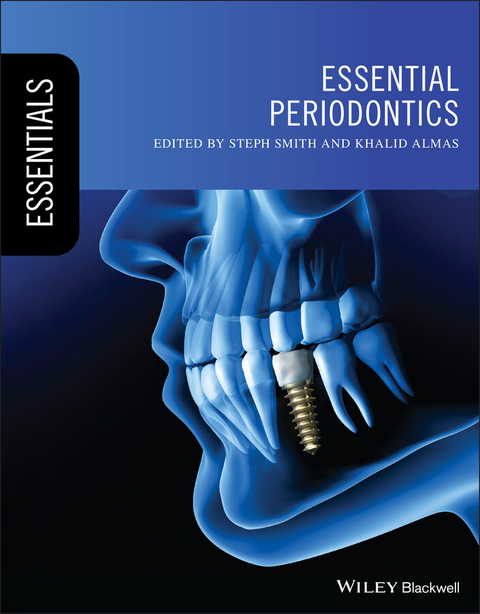
Essential Periodontics (eBook)
John Wiley & Sons (Verlag)
978-1-119-61965-9 (ISBN)
The Dentistry Essentials are an international series of textbooks, designed to support lecture series or themes on core topics within dentistry.
A comprehensive yet accessible reference text designed for dental students and healthcare professionals alike
Essential Periodontics provides rapid reference to key information about periodontal pathology, examination and diagnosis, treatment planning of common diseases, dental implantology, clinical decision making, and more.
Contributions from experienced practitioners cover all the fundamental topics encountered in both periodontic training and practice, such as the anatomy and histology of the periodontium, basic principles of periodontal health, surgical therapies and suturing techniques, interdisciplinary periodontics, and management of periodontal emergencies. Each easy-to-read chapter includes a concise introduction, clearly defined learning objectives, a reference list of relevant scientific publications, tables and figures, and high-quality illustrations and clinical images.
- Aligns with the Classification of Periodontal and Peri-Implant Diseases and Conditions issued by the American Academy of Periodontology (AAP) 2018 World Workshop
- Follows a flexible modular format which can be easily integrated into any dental school's teaching curriculum
- Discusses future advances and research in periodontics
- Includes several useful appendices, references to internet resources, and an extensive index
Reflecting current practice and up-to-date scientific evidence, Essential Periodontics is a valuable resource for undergraduate dental students and healthcare professionals including dental hygienists, dental therapists, and general dentistry practitioners, which also includes interdisciplinary interests.
Steph Smith is Senior Lecturer of Periodontology at Imam Abdulrahman Bin Faisal University, Department of Preventive Dental Sciences, Division of Periodontology, College of Dentistry, Dammam, Kingdom of Saudi Arabia, and a volunteer/visiting Professor of Periodontology at Rawal Institute of Health Sciences, Rawal College of Dentistry, Islamabad, Pakistan. Khalid Almas is Professor of Periodontology and is a founder and former Program Director of Postgraduate Periodontics at Imam Abdulrahman Bin Faisal University, Department of Preventive Dental Sciences, Division of Periodontology, College of Dentistry, Dammam, Kingdom of Saudi Arabia. He is a volunteer/visiting Professor of Periodontology at University of Connecticut, School of Dental Medicine, Farmington, USA, and Rawal Institute of Health Sciences, Rawal College of Dentistry, Islamabad, Pakistan.
CHAPTER 2
Anatomy and histology of the periodontium
Aditi Chopra and Steph Smith
Contents
- Introduction
- Gingiva
- Cementum
- Alveolar bone
- Periodontal ligament
- Blood supply of the periodontium
- Lymphatic system of the periodontium
- Nerve supply of the periodontium
- References
Learning objectives
- Macroscopic anatomy of the periodontium.
- Histology of the anatomic structures of the periodontium.
- Understanding of gingival and periodontal phenotypes.
- Dimensions and histology of the dento‐gingival complex.
- Blood supply, lymphatic drainage, and nerve supply of the periodontium.
Introduction
The oral cavity consists of two types of tissues: hard tissues, comprising 32 teeth and alveolar bone, and soft tissue, comprising the oral mucosa. The oral mucosa consists of three zones: masticatory mucosa, which includes the gingiva and the soft tissue covering of the hard palate; specialized mucosa, which covers the dorsum of the tongue; and the oral mucous membrane, lining the remainder of the oral cavity.
The root of each tooth is embedded into a socket of the alveolar process of the mandible and maxilla, called a gomphosis, also known as a dentoalveolar syndesmosis. It is a joint that binds the teeth to the sockets, and the fibrous connection between a tooth and its socket is a periodontal ligament. The tooth is furthermore supported in its position by the help of the tissues surrounding the tooth, i.e. the periodontium. The periodontium anchors the teeth in position and provides interdental linkage of the teeth within the dental arch. The periodontium, also called “the attachment apparatus” or “the supporting tissues of the teeth,” undergoes certain changes with age and is also subjected to morphological changes related to functional alterations and alterations in the oral environment (Newman et al. 2019). The developmental, biological, and functional unit of the periodontium consists of four types of tissues: gingiva, root cementum, alveolar bone proper, and the periodontal ligament (Ainamo & Löe 1966; Cho & Garant 2000; Cleaton‐Jones et al. 1978; Lindhe & Lang 2015; Listgarten 1964; Melcher & Bowen 1969; Newman et al. 2019; Ten Cate 1975, 1994) (Figure 2.1).
Gingiva
The gingiva is that part of the masticatory mucosa that covers the alveolar process of the jaw and surrounds the neck of the tooth (Ainamo & Löe 1966). Macroscopically, the gingiva is divided into three parts: interdental gingiva (Table 2.1), marginal (free) gingiva (Table 2.2), and attached gingiva (Table 2.3) (Ainamo & Löe 1966; Cho & Garant 2000; Cleaton‐Jones et al. 1978; Lindhe & Lang 2015; Newman et al. 2019). The clinical characteristics of the gingiva are depicted in Table 2.4.
Gingival/periodontal phenotype
The gingival phenotype is determined by gingival thickness and the keratinized tissue width. The periodontal phenotype is determined by the gingival phenotype and the bone morphotype, i.e. the thickness of the buccal bone plate (Jepsen et al. 2018). Determination of the periodontal phenotype is necessitated for assessing therapy outcomes in periodontal and implant therapy, prosthodontics, and orthodontics. Three categories of periodontal phenotypes have been classified, i.e. thin scalloped, thick flat, and thick scalloped (Chambrone & Tatakis 2016; Cortellini & Bisada 2018; Kan et al. 2010; Zweers et al. 2014). For the diagnoses and factors determining the gingival/periodontal phenotypes, see Chapter 10.3.
Histology of the gingiva
Histologically, the gingiva is comprised of two parts: the gingival epithelium and the underlying connective tissue (Ainamo & Löe 1966; Cho & Garant 2000; Cleaton‐Jones et al. 1978; Listgarten 1964).
Figure 2.1 The periodontium.
Courtsey of Dr. Abdulqader Alhammadi.
Table 2.1 The interdental gingiva.
|
Table 2.2 The marginal gingiva.
|
Table 2.3 The attached gingiva.
|
| Erscheint lt. Verlag | 18.2.2022 |
|---|---|
| Reihe/Serie | Essentials (Dentistry) |
| Essentials (Dentistry) | Essentials (Dentistry) |
| Sprache | englisch |
| Themenwelt | Medizin / Pharmazie ► Allgemeines / Lexika |
| Medizin / Pharmazie ► Zahnmedizin | |
| Schlagworte | dental implantology • dentistry • Parodontologie • periodontal assessment • periodontal diseases • PERIODONTAL MEDICINE • Periodontal pathology • Periodontal Therapy • periodontics basics • periodontics fundamentals • periodontics intro • periodontics reference • periodontics textbook • Periodontology • Zahnmedizin |
| ISBN-10 | 1-119-61965-3 / 1119619653 |
| ISBN-13 | 978-1-119-61965-9 / 9781119619659 |
| Informationen gemäß Produktsicherheitsverordnung (GPSR) | |
| Haben Sie eine Frage zum Produkt? |
 EPUB (Adobe DRM)
Kopierschutz: Adobe-DRM
Adobe-DRM ist ein Kopierschutz, der das eBook vor Mißbrauch schützen soll. Dabei wird das eBook bereits beim Download auf Ihre persönliche Adobe-ID autorisiert. Lesen können Sie das eBook dann nur auf den Geräten, welche ebenfalls auf Ihre Adobe-ID registriert sind.
Details zum Adobe-DRM
Dateiformat: EPUB (Electronic Publication)
EPUB ist ein offener Standard für eBooks und eignet sich besonders zur Darstellung von Belletristik und Sachbüchern. Der Fließtext wird dynamisch an die Display- und Schriftgröße angepasst. Auch für mobile Lesegeräte ist EPUB daher gut geeignet.
Systemvoraussetzungen:
PC/Mac: Mit einem PC oder Mac können Sie dieses eBook lesen. Sie benötigen eine
eReader: Dieses eBook kann mit (fast) allen eBook-Readern gelesen werden. Mit dem amazon-Kindle ist es aber nicht kompatibel.
Smartphone/Tablet: Egal ob Apple oder Android, dieses eBook können Sie lesen. Sie benötigen eine
Geräteliste und zusätzliche Hinweise
Buying eBooks from abroad
For tax law reasons we can sell eBooks just within Germany and Switzerland. Regrettably we cannot fulfill eBook-orders from other countries.
aus dem Bereich