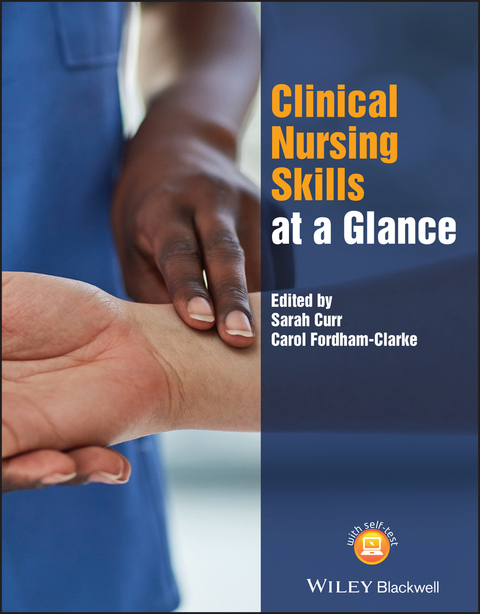
Clinical Nursing Skills at a Glance (eBook)
John Wiley & Sons (Verlag)
978-1-119-03592-3 (ISBN)
Clinical Nursing Skills at a Glance is the must-have study and revision guide for pre-registration nursing students and newly qualified practitioners alike, providing a visual summary of the essential aspects of clinical nursing skills and procedures. The core platforms of professional practice applicable to nursing adults in a variety of clinical settings are emphasised throughout the text, including care planning, assessment, management, prioritisation and co-ordination of care.
Designed to allow rapid reference to critical information, the book is divided into 12 sections organised around systems of the body, with each chapter describing a specific clinical skill. With high-quality images throughout, applications to practice, a review quiz, 'red flags' highlighting important aspects to consider in the clinical environment, and reflecting current NMC standards of proficiency for registered nurses, this new evidence-based guide:
- Allows easy access to the necessary knowledge and skills required by nurses to provide quality care
- Discusses general principles of care applicable to all, including verbal and non-verbal communication, record keeping, and admission and discharge procedures
- Covers mandatory skills such as basic life support, infection control, and medicine management
- Includes access to a companion website featuring interactive multiple-choice questions, case studies, and links to additional resources
Offering superb illustrations, up-to-date information, and a reader-friendly approach, Clinical Nursing Skills at a Glance is an invaluable resource for pre-registration nursing students as well as newly qualified nurses, healthcare assistants, and allied healthcare professionals looking to expand their knowledge of nursing skills and procedures.
Sarah Curr is a Lecturer in Nursing Education with a strong clinical skills and simulation focus at the Faculty of Nursing, Midwifery, and Palliative Care, King's College London, UK.
Carol Fordham-Clarke is a Lecturer and Clinical Skills Lead for Nursing at the Florence Nightingale School of Nursing & Midwifery, King's College London, UK.
Clinical Nursing Skills at a Glance is the must-have study and revision guide for pre-registration nursing students and newly qualified practitioners alike, providing a visual summary of the essential aspects of clinical nursing skills and procedures. The core platforms of professional practice applicable to nursing adults in a variety of clinical settings are emphasised throughout the text, including care planning, assessment, management, prioritisation and co-ordination of care. Designed to allow rapid reference to critical information, the book is divided into 12 sections organised around systems of the body, with each chapter describing a specific clinical skill. With high-quality images throughout, applications to practice, a review quiz, red flags highlighting important aspects to consider in the clinical environment, and reflecting current NMC standards of proficiency for registered nurses, this new evidence-based guide: Allows easy access to the necessary knowledge and skills required by nurses to provide quality care Discusses general principles of care applicable to all, including verbal and non-verbal communication, record keeping, and admission and discharge procedures Covers mandatory skills such as basic life support, infection control, and medicine management Includes access to a companion website featuring interactive multiple-choice questions, case studies, and links to additional resources Offering superb illustrations, up-to-date information, and a reader-friendly approach, Clinical Nursing Skills at a Glance is an invaluable resource for pre-registration nursing students as well as newly qualified nurses, healthcare assistants, and allied healthcare professionals looking to expand their knowledge of nursing skills and procedures.
Sarah Curr is a Lecturer in Nursing Education with a strong clinical skills and simulation focus at the Faculty of Nursing, Midwifery, and Palliative Care, King's College London, UK. Carol Fordham-Clarke is a Lecturer and Clinical Skills Lead for Nursing at the Florence Nightingale School of Nursing & Midwifery, King's College London, UK.
Part 1
1 Introduction: the setup of_this book and_How to_Use It___2
Part 2 Principles of skills ___3
2 Care planning and the nursing process___4
3 Record keeping___6
4 Communication_- fundamentals___8
5 Communication_- de- escalation___10
6 Communication_- difficult conversations___12
7 Informed consent___14
8 Privacy and dignity___16
Part 3 Mandatory skills ___19
9 Moving and handling___20
10 Moving and_handling: turning in bed, transfers, and hoisting___22
11 Basic life support___24
12 The choking patient; the recovery position___26
13 Infection control___28
14 Medicine management___30
15 Injection technique___32
16 National early warning score (news) track and trigger system___34
Part 4 Neurological skills ___37
17 Assessing level of consciousness___38
18 Assessing pupil reaction and limb strength___40
19 Assessing cognition___42
20 Pain Assessment___44
21 Neurovascular Assessment___46
22 Assessing and managing seizures___48
Part 5 Respiratory skills ___51
23 Assessing and managing the airway___52
24 Respiratory assessment___54
25 Monitoring oxygen saturations___56
26 Arterial blood gas analysis___58
27 Chest auscultation___60
28 Peak Expiratory Flow Rate___62
29 Administering oxygen___64
30 Nebulisers and inhalers___66
31 Tracheostomy Care___68
32 Chest Drain Management___70
Part 6 Cardiovascular skills ___73
33 Taking a Pulse___74
34 Blood Pressure___76
35 Temperature Assessment___78
36 Non- invasive Circulatory Assessment___80
37 Central Venous Pressure Monitoring___82
38 Electrocardiogram___84
Part 7 Gastrointestinal skills ___87
39 Nutritional Screening___88
40 Supporting eating and drinking___90
41 Nasogastric Tube Insertion___92
42 Enteral feeding___94
43 Management of Diarrhoea___96
44 Management of Constipation___98
45 Administration of Suppositories and Enemas___100
46 Stoma care___102
Part 8 Genitourinary skills ___105
47 Urinalysis___106
48 Continence assessment___108
49 Urinary Catheterisation___110
50 Catheter Care___112
51 Catheter Removal___114
Part 9 Musculoskeletal skills __117
52 Assessing tone and ability to mobilise___118
53 Venous Thromboembolism Assessment and Risk Reduction___120
54 Anti- embolic Stockings___122
55 Musculoskeletal Minor Injuries: Assessment and Treatment___124
56 Falls_- Prevention, Assessment and Management___126
57 Stabilisation: neck collar___128
58 Care of the patient with spinal cord injuries_- log roll___130
Part 10 Integumentary skills ___133
59 Personal Hygiene___134
60 Personal Hygiene_- Mouth and Hair Care___136
61 Pressure Ulcer_- Prevention and Management___138
62 Venous Ulcer Assessment___140
63 Wound Dressing using Aseptic Non- touch Technique (ANTT)___142
64 Burns Management___144
65 Care after Death___146
66 Management of Surgical Drains___148
67 Suture and staple removal___150
Part 11 Endocrine skills ___153
68 Capillary Blood Glucose Monitoring___154
Part 12 Circulatory Skills ___157
69 Venepuncture___158
70 Cannulation___160
71 Intravenous fluid therapy___162
72 Fluid Balance Monitoring___164
73 Blood transfusions___166
17
Assessing level of consciousness
Figure 17.1 ACVPU recording.
Table 17.1 The ACVPU assessment tool.
| Assessment | Response |
|---|
| Alert | The person is fully awake, eyes open, and able to move and respond appropriately |
| Confusion | Coherent but inappropriate, unoriented response |
| Voice | Any kind of response to the sound of voice, but without being fully awake |
| Pain | Any kind of response to a painful stimulus |
| Unresponsive | No eye, verbal, or motor responses to pain stimuli |
Table 17.2 Structured assessment of Glasgow Coma Scale (GCS).
| Check | For factors that can interfere with ability to communicate |
|---|
| Observe | Eye opening, verbal and motor response |
| Stimulate | Sound; a spoken or shouted request Pressure; on fingertip, trapezius or supraorbital notch |
| Rate | Record best response |
Table 17.3 The Glasgow Coma Scale (GCS) assessment tool.
Source: Adapted from Teasdale et al. (2014).
| Assessment | Rating | Score | Response |
|---|
| Eye response | Spontaneous | E4 | Open before stimulus |
| To sound | E3 | Open after spoken or shouted request |
| To pressure | E2 | Open in response to application of pressure to the lateral aspect of the finger or fingernail (Figure 17.2) |
| None | E1 | No opening at any time and no interfering factors. Ensure that pressure has increased over the 10‐second period and is an adequate pressure before recording as E1 |
| Non‐testable | NT | Closed due to local factors, e.g. swelling |
| Verbal response | Orientated | V5 | Orientated to name, place, and date |
| Confused | V4 | Not orientated, communicates coherently |
| Words | V3 | Intelligible single words |
| Sounds | V2 | Moans and groans |
| None | V1 | No audible response and interfering factor |
| Non‐testable | NT | Factors influencing communication |
| Motor response | Obeys commands | M6 | Obeys two‐part request |
| Localising | M5 | Brings hands above clavicle to central stimulus |
| Normal flexion | M4 | Bends arm at elbow rapidly but does not appear abnormal |
| Abnormal flexion | M3 | Bends arm at elbow abnormally |
| Extension | M2 | Extends arm at elbow |
| None | M1 | No movement in limbs and no interfering factors |
| Non‐testable | NT | Due to factors influencing movement, e.g. paralysis |
| NB: If there are different responses from the right and left sides of the body, record the best response. |
Figure 17.2 Applying pressure: fingernail.
Figure 17.3 Applying pressure: trapezium pinch.
Figure 17.4 Applying pressure: supraorbital pressure.
Figure 17.5 Abnormal motor responses.
Background
- Level of consciousness measures a person's responsiveness to environmental stimuli and is a measure of overall neurological function.
- Consciousness is dependent upon arousal and awareness.
- Arousal is determined by a functioning reticular activating system (RAS) within the brain stem.
- Awareness is determined by the cerebral cortex processing information.
- Many factors can alter the level of consciousness, such as alcohol consumption, drugs, raised intracranial pressure, decreased oxygen or blood flow to the brain, hypoglycaemia, and electrolyte imbalance – in particular, sodium.
- Two tools are commonly used in clinical practice to assess consciousness: ACVPU (alert, confusion, verbal, pain, unresponsive) and Glasgow Coma Scale (GCS) (Kelly et al. 2005).
Influencing Factors
- Intoxication.
- Some drugs and medications.
- Existing disability.
- Post‐ictal (post‐seizure) drowsiness.
- Sleep disorders and consequent drowsiness.
- Eyes closed by swelling.
- Presence of endotracheal tube or tracheostomy.
- Communication problems.
Professional Approach
- Communicate clearly with the patient, and obtain informed consent when possible.
- Use the most appropriate assessment tool for the patient, remembering that a full neurological assessment includes:
- GCS.
- Limb movement and strength.
- Pupil size and reaction to light (Chapter 18).
- Full vital signs (Chapter 16).
- Be aware of the previous recording and baseline assessment.
- Accurate record keeping is essential, including areas that are unable to be assessed for a patient.
- Escalate changes in level of consciousness immediately to allow for early intervention.
- People sometimes require neurological observation at specific time intervals. It is important to be accurate with the required timings and follow local Trust guidance.
Equipment – The ACVPU Tool
- This is commonly used by following the section on the National Early Warning Score 2 (NEWS 2) chart (Royal College of Physicians 2017) (Figure 17.1).
Procedure – The ACVPU Tool
- The ACVPU is a tool for rapid assessment and is not suitable for a detailed assessment of consciousness.
- Responses can be alert (eyes opening), verbal (response to voice command) or motor (response to stimulus).
- “New confusion” is an additional response that has been added, which changed the abbreviation AVPU to ACVPU (Royal College of Physicians 2017) (Table 17.1).
- New confusion in an otherwise alert patient is a warning sign of serious underlying illness.
Equipment – Glasgow Coma Scale
- Refer to local neurological guidance.
Procedure – Glasgow Coma Scale
- This a structured assessment that must follow specific steps (Tables 17.2 and 17.3; Teasdale et al. 2014).
- Detailed scores for each response (as outlined in Table 17.3) are required and as they provide detailed information on consciousness they are more useful for diagnostic purposes.
- An overall total score of between 3 and 15 indicates severity (Table 17.3).
Procedure
- Where possible, explain the assessment to the patient to obtain informed consent.
- Initially assess for spontaneous behaviour.
- If the patient is not alert or awake, talk to them, asking them to open their eyes – this is to assess the arousal mechanisms in the brain stem (RAS).
- Table 17.3 details the full approach to follow for “eyes opening”.
- Then move to check for verbal response and thus level of consciousness.
- Check orientation by asking their name, where they are and the month (Table 17.3).
- Finally assess motor response by asking the patient to grasp and release your hand or open their mouth and stick their tongue out.
- If the patient does not obey commands and there is no response, apply increasing pressure to the trapezius muscle (Figure 17.3) for up to 10 seconds.
- If this stimulus does not elicit a localising response, apply pressure to the supraorbital notch (Figure 17.4) to distinguish between the motor responses: flexion, abnormal flexion, and extension (Figure 17.5).
- Remember to record eyes, verbal, and motor separately, as well as the total score (Table 17.3).
- Escalate as appropriate.
NB: When checking conscious level, ascertain that the patient can understand English (or the language you are speaking in).
Red Flags
- Avoid applying supraorbital pressure (as a central painful stimulus) if there are any injuries to the face.
- A GCS score ≤ 8 requires intubation to maintain the airway.
- Unconsciousness following a head...
| Erscheint lt. Verlag | 15.2.2022 |
|---|---|
| Reihe/Serie | At a Glance (Nursing and Healthcare) |
| Wiley Series on Cognitive Dynamic Systems | Wiley Series on Cognitive Dynamic Systems |
| Sprache | englisch |
| Themenwelt | Medizin / Pharmazie ► Pflege ► Ausbildung / Prüfung |
| Schlagworte | clinical nurse guide • clinical nurse procedures </p> • clinical nurse reference • clinical nurse study guide • clinical nursing handbook • clinical nursing principles • clinical nursing revision guide • Clinical Skills • General Clinical Nursing • Klinische Fertigkeiten • Klinische Krankenpflege • Krankenpflege • <p>clinical nursing • Medical Science • Medizin • NMC proficiencies • nursing |
| ISBN-10 | 1-119-03592-9 / 1119035929 |
| ISBN-13 | 978-1-119-03592-3 / 9781119035923 |
| Informationen gemäß Produktsicherheitsverordnung (GPSR) | |
| Haben Sie eine Frage zum Produkt? |
 EPUB (Adobe DRM)
Kopierschutz: Adobe-DRM
Adobe-DRM ist ein Kopierschutz, der das eBook vor Mißbrauch schützen soll. Dabei wird das eBook bereits beim Download auf Ihre persönliche Adobe-ID autorisiert. Lesen können Sie das eBook dann nur auf den Geräten, welche ebenfalls auf Ihre Adobe-ID registriert sind.
Details zum Adobe-DRM
Dateiformat: EPUB (Electronic Publication)
EPUB ist ein offener Standard für eBooks und eignet sich besonders zur Darstellung von Belletristik und Sachbüchern. Der Fließtext wird dynamisch an die Display- und Schriftgröße angepasst. Auch für mobile Lesegeräte ist EPUB daher gut geeignet.
Systemvoraussetzungen:
PC/Mac: Mit einem PC oder Mac können Sie dieses eBook lesen. Sie benötigen eine
eReader: Dieses eBook kann mit (fast) allen eBook-Readern gelesen werden. Mit dem amazon-Kindle ist es aber nicht kompatibel.
Smartphone/Tablet: Egal ob Apple oder Android, dieses eBook können Sie lesen. Sie benötigen eine
Geräteliste und zusätzliche Hinweise
Buying eBooks from abroad
For tax law reasons we can sell eBooks just within Germany and Switzerland. Regrettably we cannot fulfill eBook-orders from other countries.
aus dem Bereich