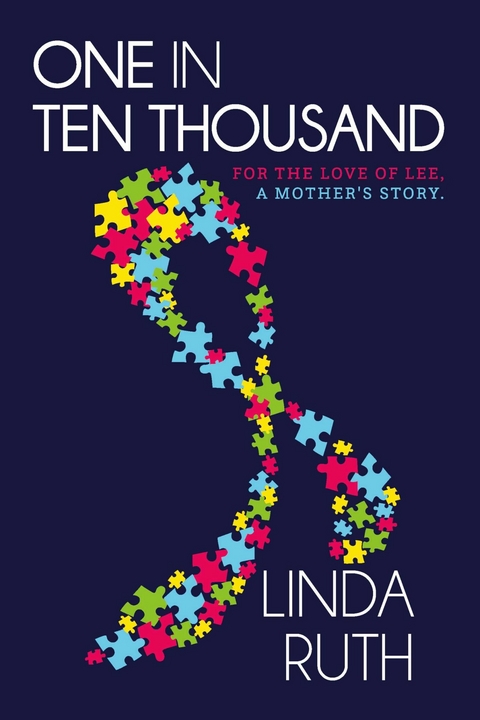
One in Ten Thousand (eBook)
138 Seiten
Bookbaby (Verlag)
978-1-6678-2013-2 (ISBN)
"e;One in Ten Thousand"e; is a captivating story that details the life, trials, and challenges of Lee Ruth, an autistic individual, as seen through the eyes of his mother, his advocate, champion, and caregiver. Vulnerable, real, and compelling, this book focuses on the struggles, adversity, perseverance, faith, and love, that have been hallmarks of his journey. Lee's story is heartwarming and hopeful, and is meant to inspire and encourage other mothers and caregivers who live with similar circumstances. As a child, Lee struggled. When he was diagnosed with autism in 1976 at the age of three, the rate of autism was one in ten thousand children. Today, that number is one in fifty-four. Throughout the book, Linda Ruth details the adversity and struggle of his early years and his callous diagnosis. This is a must-read for all who have a loved one with disabilities. In these pages, you will embark on a four-decade-long journey of a normal American family who does everything in their power to support their child despite profound challenges. In the end, there is always hope, and there will always be a better tomorrow.
Chapter 2:
“Is He Retarded?”
One early summer day in 1976, when Lee was three years old, I went grocery shopping with the boys and my mother-in-law, Anna. On the way out of the supermarket, with my cart full of groceries and the boys in tow, my mother-in-law turned to me and mentioned that the cashier asked her if Lee was retarded. “Of course, he’s not retarded!” I snapped. “How could she ask such a question?”
I didn’t ask at the time, but I doubt my mother-in-law responded to the clerk in defense of Lee. As a woman born in 1912 and living on a rural farm, she probably didn’t feel comfortable engaging in conversation with others, especially strangers. Looking back over the years, I think women her age didn’t feel that they had a voice or the empowerment that women experience today. I imagine she would have had difficulty defending Lee because she more than likely had the same question as the cashier. She wasn’t at all familiar with anyone in her family having unusual behaviors of any kind.
Driving in silence, I held back my tears until I dropped off my mother-in-law at her home. Then, alone in the car with the boys, I quietly cried the rest of the way home. I couldn’t understand why someone would ask such a question. At the time, I was already self-conscious about Lee’s behaviors. He sometimes held his hands over his ears and whined to himself. His aloofness was obvious to others. I waited anxiously for John to come home from work that day, and I tearfully told him what had happened. He couldn’t believe a total stranger would say such a thing. Neither John nor I had experience dealing with issues of mental illness, and we both struggled with worry over what could be wrong with Lee. We decided to take more active steps in order to determine what exactly was going on with our precious, but puzzling, little boy. From that moment, we had to forge our own path for Lee.
After infancy, the boys made routine visits every year to our area children’s clinic for their wellness pediatrician appointments, usually rotating with one of the clinic’s different doctors. These visits felt like a struggle, because the doctors never suggested that anything was wrong with Lee. They all took a hands-off approach. They kept giving Lee his inoculations, but never questioned me about his behavior and never offered suggestions or support when I mentioned concerns. It was all business as usual. No one ever said Lee wasn’t perfect. We were told Lee was a very special child and we were sent on our way with mounting worry and doubt. We knew by the looks of questioning family members that they didn’t agree that Lee was just special. Quite honestly, deep down, we didn’t believe it either, but we were afraid of what we might learn.
After the incident at the grocery store, I became frantic. I scheduled an immediate appointment with the pediatrician. I pressed the issue of his delayed speech and motor development and received a referral to a child psychologist. Well-respected in the pediatric community, the doctor was in her mid-forties or early fifties, with short, curly brown hair. Her casual dress gave me the impression she didn’t worry too much about her appearance. She had a calming voice with soothing mannerisms and she began our late-June appointment by carefully interviewing John and me about our concerns. She wanted to know about Lee’s medical history in addition to our family and living situation, along with our social habits. She noted in her exam report: “The family lives in what Mrs. Ruth describes as ‘total isolation’ on two acres near Robesonia. There are no other children in the area.” Why would she underline this statement in an effort to emphasize it? Why was she concerned about living in a rural area? How did our home’s location relate to Lee’s behaviors? I wondered.
She also took Lee aside for a thorough physical and neurological examination, measuring his weight, height, and head circumference. She took his pulse and checked his neck, thyroid, chest, belly, genitals, spine, skin, arms, and legs. She left no stone unturned in her examination. She attempted to elicit speech and observed him at play.
“Lee is an unusual child with mild delay in all areas of development,” read her final analysis. “His responses today arouse suspicion of a high-frequency hearing loss. Many of his deficiencies in fine motor skills have a dystonic quality consisting of sporadic movements. He certainly has many signs of neurological immaturity. Much of his behavior suggests a tendency toward volitional withholding, and this may be a factor in his slow speech.”
As follow-up, she recommended we have Lee’s hearing tested, consult a speech therapist concerning language stimulation, and have a complete psychological evaluation by a highly-skilled child psychologist. Before leaving our appointment she said, “Lee doesn’t need to speak at this time. He could make his way to New York and back without talking.” How bizarre and unhelpful to frame my son’s behavior like that, I thought. I left the appointment with more questions than answers. I didn’t have the courage to question authority, so I began following through with her recommendations.
I made arrangements with a friend of our family who was an audiologist at the Reading Hospital. Lee was fearful of the equipment and the soundproof room where his hearing was tested. Lee also didn’t understand the audiologist’s directions such as “Put your finger up if you hear this sound,” so it was difficult to test accurately as a result. The audiologist was also trying to observe Lee’s eye movements in an attempt to observe when he heard sounds, but Lee’s whining and behavior couldn’t validate accurate results. The results of that test were inconclusive.
John was not in favor of Lee seeing another psychologist. He seemed to have a hard time admitting that Lee might have a mental illness. John was much more deliberate than I was. He had an ability to stand back and observe a situation before reacting to it. I, on the other hand, felt panicked and needed to act immediately. Slow and steady as opposed to fast and impulsive. Perhaps John thought Lee’s symptoms would eventually work out in their own time or that disabilities happen to other people’s children, other families. I felt bewildered by what the mental-health community was telling us, yet instinctively I knew something wasn’t right with Lee. Fear, confusion, denial, an awful cocktail of all three—something drove us to keep searching for answers and pursue the psychologist’s recommendations.
While the barrage of evaluations all happened within just a few weeks, the answers to our questions seemed to take an eternity. I had no idea how long the process would take. I unknowingly believed this was going to be a quick fix. In the meantime, we focused on the one thing we could control: loving Lee and treating him the same way we treated his big brother, Matt. I continued to hug and kiss him as much as I did Matt. Not a day went by that I did not cuddle with him and sing lullabies to him. He squirmed in my arms and I can’t say he enjoyed this time, but I did it anyway. I massaged his body with sweet-smelling baby lotion after his daily bath. I was trying to unlock the door to my son’s problem, but I was unable to find the key.
Eventually, I convinced John to agree to a complete psychological evaluation for Lee. We made an appointment at the Berks County Intermediate Unit (BCIU) with a highly recognized child psychologist. The psychologist was a slightly built man who commanded the room as though he were much taller. He was impeccably dressed, giving me the impression that he paid attention to detail. I felt comfortable with him as he talked and tried to play with Lee. I felt that he had his suspicions about the nature of Lee’s problems, as he suggested we make an appointment with a child psychiatrist in the Reading area. With his gentle voice the psychologist assured us that we would get help for our son.
A few more days went by until we obtained an appointment with a psychiatrist. My first impression of this doctor was quite different. He appeared disorganized as he walked into the room. He wore a plaid sport coat, a mismatched tie and shirt, and brown pants. How funny that I remember that so vividly. He was in his fifties, with dark, graying hair styled in a college cut, a hairstyle typically worn by much younger men. He had no smile and came across as very matter of fact, giving us only information with no emotion.
Both professionals took Lee into a play-room where they evaluated him by showing him simple picture cards and asking him to do certain tasks that were considered age appropriate. After what seemed like a very long time, John and I were called back into the room. We sat with the doctors around a tiny children’s table. From behind his horn-rimmed glasses, the psychiatrist looked us in the eyes and said, “Lee is autistic.” “He’s artistic?” I asked. “No,” he replied. “He’s autistic. I recommend you put him in an institution. I know a few in Philadelphia that I can recommend.”
After he mentioned the institution, I went blank and didn’t hear another word that was said at that meeting. John and I sat dumbfounded and...
| Erscheint lt. Verlag | 31.1.2022 |
|---|---|
| Sprache | englisch |
| Themenwelt | Literatur ► Biografien / Erfahrungsberichte |
| Medizin / Pharmazie ► Medizinische Fachgebiete ► Psychiatrie / Psychotherapie | |
| ISBN-10 | 1-6678-2013-3 / 1667820133 |
| ISBN-13 | 978-1-6678-2013-2 / 9781667820132 |
| Informationen gemäß Produktsicherheitsverordnung (GPSR) | |
| Haben Sie eine Frage zum Produkt? |
 EPUB (Ohne DRM)
Größe: 3,3 MB
Digital Rights Management: ohne DRM
Dieses eBook enthält kein DRM oder Kopierschutz. Eine Weitergabe an Dritte ist jedoch rechtlich nicht zulässig, weil Sie beim Kauf nur die Rechte an der persönlichen Nutzung erwerben.
Dateiformat: EPUB (Electronic Publication)
EPUB ist ein offener Standard für eBooks und eignet sich besonders zur Darstellung von Belletristik und Sachbüchern. Der Fließtext wird dynamisch an die Display- und Schriftgröße angepasst. Auch für mobile Lesegeräte ist EPUB daher gut geeignet.
Systemvoraussetzungen:
PC/Mac: Mit einem PC oder Mac können Sie dieses eBook lesen. Sie benötigen dafür die kostenlose Software Adobe Digital Editions.
eReader: Dieses eBook kann mit (fast) allen eBook-Readern gelesen werden. Mit dem amazon-Kindle ist es aber nicht kompatibel.
Smartphone/Tablet: Egal ob Apple oder Android, dieses eBook können Sie lesen. Sie benötigen dafür eine kostenlose App.
Geräteliste und zusätzliche Hinweise
Buying eBooks from abroad
For tax law reasons we can sell eBooks just within Germany and Switzerland. Regrettably we cannot fulfill eBook-orders from other countries.
aus dem Bereich