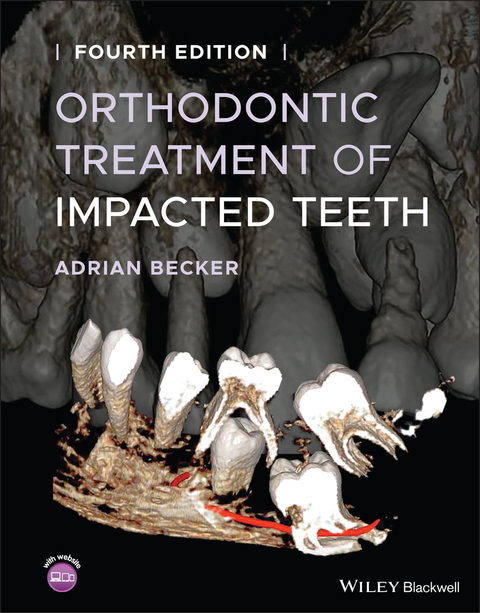
Orthodontic Treatment of Impacted Teeth (eBook)
John Wiley & Sons (Verlag)
978-1-119-56538-3 (ISBN)
The new edition of the gold-standard clinical reference on addressing common, complex, and multifactorial clinical scenarios
Orthodontic Treatment of Impacted Teeth integrates the latest developments and scientific evidence to provide authoritative coverage of orthodontic diagnosis and treatment, radiographic methods, surgical access, treatment strategies, and more.
This new edition incorporates recent advances in research and presents up-to-date treatment recommendations for clinical practice. New and expanded chapters address topics such as abnormal root growth associated with tooth Impaction, improvements in the diagnosis of pathologic entities using cone-beam computed tomography (CBCT), root and crown resorption, and treating abnormal incisor root development caused by past trauma. Throughout the text, readers gain valuable insight into the management of impacted teeth in real-world practice, illustrated by updated cases from the author's own clinic.
- Provides protocols for common cases as well as complex and rare presentations
- Contains individual chapters on the specific aspects of the diagnosis and treatment of impaction in each of the different types of teeth
- Covers prevalence, etiology, diagnosis, attitudes to treatment, treatment timing, treatment methods, and prognosis
- Features more than 1,000 high-quality color images and illustrations
Orthodontic Treatment of Impacted Teeth, Fourth Edition, remains essential reading for all specialist orthodontists, academic researchers and instructors, oral and maxillofacial surgeons, and advanced students in orthodontics.
The Author
DR. ADRIAN BECKER, BDS, LDS RCS, DDO RCPS, is Clinical Associate Professor Emeritus in the Department of Orthodontics, Hebrew University-Hadassah School of Dental Medicine, Jerusalem, Israel.
The new edition of the gold-standard clinical reference on addressing common, complex, and multifactorial clinical scenarios Orthodontic Treatment of Impacted Teeth integrates the latest developments and scientific evidence to provide authoritative coverage of orthodontic diagnosis and treatment, radiographic methods, surgical access, treatment strategies, and more. This new edition incorporates recent advances in research and presents up-to-date treatment recommendations for clinical practice. New and expanded chapters address topics such as abnormal root growth associated with tooth Impaction, improvements in the diagnosis of pathologic entities using cone-beam computed tomography (CBCT), root and crown resorption, and treating abnormal incisor root development caused by past trauma. Throughout the text, readers gain valuable insight into the management of impacted teeth in real-world practice, illustrated by updated cases from the author's own clinic. Provides protocols for common cases as well as complex and rare presentations Contains individual chapters on the specific aspects of the diagnosis and treatment of impaction in each of the different types of teeth Covers prevalence, etiology, diagnosis, attitudes to treatment, treatment timing, treatment methods, and prognosis Features more than 1,000 high-quality color images and illustrations Orthodontic Treatment of Impacted Teeth, Fourth Edition, remains essential reading for all specialist orthodontists, academic researchers and instructors, oral and maxillofacial surgeons, and advanced students in orthodontics.
Dr. Adrian Becker, BDS, LDS RCS, DDO RCPS, is Clinical Associate Professor Emeritus in the Department of Orthodontics, Hebrew University-Hadassah School of Dental Medicine, Jerusalem, Israel.
List of Contributors vi
Preface to the First Edition vii
Preface to the Second Edition ix
Preface to the Third Edition xi
Preface to the Fourth Edition xii
About the Companion Website xv
1 General Principles Related to the Diagnosis and Treatment of Impacted Teeth 1
2 The Logistics of Orthodontic Treatment for Impacted Teeth 12
3 Biomechanics for Aligning Ectopic Teeth 25
4 Diagnostic Imaging for Impacted Teeth 42
5 Surgical Exposure of Impacted Teeth 66
6 Impacted Maxillary Central Incisors 95
7 Palatally Impacted Canines 147
8 Buccally Impacted Maxillary Canines 215
9 Resorption of the Roots of Neighbouring Teeth 229
10 Resorption of the Impacted Tooth 259
11 Impacted Permanent Molars 283
12 Premolars and Mandibular Canines 309
13 The Root Form of Impacted Teeth 329
14 Rescuing Teeth Impacted in Dentigerous Cysts 346
15 Impacted Teeth in the Adult Patient 363
16 Lingual Appliances, Implants and Impacted Teeth 377
17 Clear Aligners in the Treatment of Impacted Teeth 385
18 The Anatomy of Failure 403
19 Traumatic Impaction 441
20 Extreme Impactions, Unusual Phenomena, Difficult Decisions 453
21 Cleidocranial Dysplasia 480
Index 515
"Prof Adrian Becker is a true connoisseur of dental impaction...Every chapter in this book is generously illustrated with clinical photographs and radiographic images, and the latest scientific research is referenced.The reader can also access the companion website, where video case presentations with animated CBCTs are available. Overall, this is an indepth, indispensable source of knowledge that you will return to again and again."
- Alex Ditmarov, DDS, Published in Journal of Clinical Orthodontics (June 23)
Every chapter in this book is generously illustrated
with clinical photographs and radiographic
images, and the latest scientific research is referenced.
The reader can also access the companion
website, where video case presentations with animated
CBCTs are available. Overall, this is an indepth,
indispensable source of knowledge that you
will return to again and again.
"The text is supplemented with first-rate animations of clinical photographs and diagnostic imaging. There is a plethora of cases illustrating routine clinical situations but also a chapter on less common cases where difficult decisions have to be made. There are separate chapters dedicated to the root form of impacted teeth, the special challenges of treating impacted teeth associated with dentigerous cysts and caring for patients with Cleidocranial dysplasia. There is also an excellent chapter entitled 'The Anatomy of Failure' on patient- and clinician-dependent reasons for unfavourable treatment outcomes. Many of the chapters give an excellent historical perspective on how treatment has changed over the recent decades"
- Prof David P Rice, University of Helsinki and Editor of European Journal of Orthodontics. Published in Issue 44:6 Nov 22
Preface to the Fourth Edition
As the fourth edition of this book goes to print, I am happy to present a much‐enhanced text, both in terms of the verbal discussion and the illustrated figures, which is offered in a similar pattern to its predecessors. The third edition of Orthodontic Treatment of Impacted Teeth, published in 2012, had 15 chapters. This new edition comprises 21 chapters, of which several are completely new and, together with the significant additions and improvements, the overall content is now approximately 60% larger.
Video clips and other 3D illustrations cannot be published in book form, thus preventing the printed literature from matching the advances in the recording of radiographic imaging that is now commonplace in dental schools, in radiographic imaging centres and in private dental offices. This is particularly so in relation to orthodontics, in general and to accurate positional and pathological diagnosis, that are so essential in the resolution of tooth impaction, in particular. In order to overcome these serious illustrative limitations, I have included a Companion website adjacent to the text, to enhance the orthodontist’s ability to use the existing presentation modes (secondary reconstructions), to extract the maximum information that is available in a cone beam CT scan. A number of 3D video clips are presented, to illustrate how to refine the diagnostic know‐how, which can only be to the benefit of the patient. These are embedded in PowerPoint presentations, with concise accompanying comment to highlight the salient points at issue. This should assist those who still have 3D comprehension difficulty in accurately locating the impacted tooth.There are many new areas in the present text that feature aspects that have not been fully described in the literature to date. There are also a number of supposed truths that are shown to be spurious and contrary to our understanding of the biological process.
Just to mention a few of the many examples that the reader will find in this edition:
- Did you know that hooked roots are not a reason that teeth do not erupt (see Chapter 13)?
- Unerupted incisor teeth that have been severely damaged by trauma inflicted in infancy remain high in the maxilla adjacent to the nasal floor, neither growing their roots nor showing any signs of ever erupting into the mouth. Can these teeth be mechanically erupted? Will they develop roots of a sufficient length that will contribute to the tooth surviving into adulthood? Will the eruption of these teeth generate new bone that could naturally rehabilitate the formerly deficient alveolar ridge (see Chapter 6)?
- Instead of developing a long straight root, the severely traumatized central incisor in a 2‐year‐old child may develop a root that continues to grow at an acute angle to the calcified portion of the tooth, to form a tightly curved or angled dilaceration. The root continues to grow in the wrong direction, necessitating root canal treatment and root amputation to enable the orthodontist to re‐align the majority portion of the tooth. Perhaps there is a way to correct the direction of the further root growth and thereby achieve a normally apexified vital tooth with a perfect crown, indistinguishable from and aligned with its beautiful adjacent counterpart (see Chapter 6).
- There appears to be a cut‐off age of 9 years for the maxillary lateral incisor to develop at least half its normal root length. If there is less than a half root at this age, as seen in a small or peg‐shaped tooth, the chances that the unerupted canine will become the victim of eruption disturbance become notably exaggerated (see Chapter 6).
- Conventional wisdom has it that mandibular second and third molars are sometimes impacted because their roots are being ‘held down’ by entanglement with the inferior alveolar canal (mandibular branch of the trigeminal nerve). We maintain that this view is unfounded (see Chapter 13). It is more likely that another factor, such as invasive cervical root resorption (ICRR), enlarged dental follicle, crowding of adjacent teeth and even possibly pre‐eruption intra‐coronal resorption, represents the primary aetiology that prevents eruption (the ‘cause’). With the root apices then growing in cramped circumstances, in close proximity to pathological entities or anatomical limits, the further erratic development of the root ends inevitably results in entanglement with the nerve and vascular bundle (the ‘effect’).
- You have just finished the phase 1 treatment of a child, for the treatment of a cross‐bite or an impacted incisor or for maxillary anterior crowding, and he is now 8 years old. As the final flourish, you have aligned the incisors and paralleled their roots into their final adult orientation. The four incisors look beautiful and the parents are happy. In order to hold on to this delightful result, a fixed or removable retainer will need to be placed, until the child is ready for phase 2 treatment in 3–4 years’ time. The question that needs to be asked is: Will the ‘attention to detail’ at this early stage and the apparently laudable ‘intention to fully exploit the capabilities of an existing orthodontic appliance’ be to the patient’s overall benefit, or will they raise the spectre of iatrogenic damage in the long term, by potentially disturbing the eruption of the canine (see Chapters 6, 7 and 18)?
A word about the tooth‐numbering convention used in this book. For the most part, the narrative in this volume refers to the individual teeth by their full descriptive title. Thus, we may refer to an impacted maxillary left permanent canine tooth or an infra‐occluded deciduous mandibular second molar tooth – a six‐word definition for a very small entity. However, for the sake of brevity and particularly for the annotation of teeth in an illustration, an author will prefer to use a shortened code for each tooth. The numbering system we have used here is the Fédération Dentaire Internationale (FDI) numbering system. This system has been widely accepted in many parts of the world, being easy to understand, logical and adaptable to the various tooth groups. It is compatible with computerized representation and uses the same description of the teeth on either side and in either jaw in a symmetrical and rapidly recognizable manner.
The method assigns a two‐number code to each tooth. The first number defines the quadrant in which the tooth is found. Thus, the right maxillary quadrant, from midline to last molar, is given the number 1. The left maxillary quadrant is number 2; the left mandibular quadrant number 3; and the right mandibular quadrant number 4. The individual teeth are then numbered from 1 to 8, beginning from the midline and proceeding to the last molar. In this manner, all impacted canines will be recognized by the second number 3: a right maxillary canine would be denoted 13; a left mandibular second molar would be assigned 37; and a mandibular right lateral incisor 42. All four canines are rarely impacted in the same individual, but when this occurs, it will be appreciated that 13, 23, 33 and 43 will be more easily recognizable than the 6, 11, 22 and 27 of the so‐called ‘universal’ numbering system, which seems to have achieved acceptance largely in the USA. (We have occasionally used the hash sign # in front of the number, in order to clearly differentiate the tooth number from other numbers in the text.)
Similarly, numbering the deciduous teeth employs the quadrant system in the same order, labelled from 5 to 8 and the teeth numbered 1 to 5. Thus, the maxillary deciduous right central incisor is defined as 51 and an infra‐occluded mandibular right deciduous second molar is numbered 85.
I am grateful to each of my co‐authors for having enthusiastically responded to my invitation to write a specific chapter in this volume and for having submitted their finished manuscripts ahead of the deadline I set for them. The chapter on biomechanics as it relates to impacted teeth was written and illustrated by Dr Ulrich Kritzler, who is in private practice in Warendorf, Germany and a regular contributor to the international orthodontic literature. The rapidly expanding popularity of clear aligners in orthodontics prompted me to invite a discussion of their use, suitability and the limitations of their application to the treatment of cases with impacted teeth. This has been authored by Prof. Dror Aizenbud, Chair of the Unit for Orthodontics and Craniofacial Anomalies in Haifa, Israel.
For the past several years, I have availed myself of the expert services of Mr Amnon Leitner, perhaps the most knowledgeable and skilled master radiographic imaging technician I have ever had the good fortune to meet and to work with. I invited him to enlarge and update the chapter on diagnostic imaging, specifically with regard to cone beam computerized tomography. Several of his highly informative secondary reconstructions, 3D screenshots and video clips appear in that chapter and additional examples of his work may be seen in a number of other chapters.
I am grateful to Dr Athina‐Maria Mavridou of KU Leuven (University of Leuven) in Belgium, a trained endodontist and an accomplished research scientist, who provided helpful comment on the histopathological aspect of my description of invasive cervical root resorption. ICRR is a specific pathological entity in its own right and is discussed in Chapter 10. The positive diagnosis of ICRR has serious...
| Erscheint lt. Verlag | 6.1.2022 |
|---|---|
| Sprache | englisch |
| Themenwelt | Medizin / Pharmazie ► Allgemeines / Lexika |
| Medizin / Pharmazie ► Zahnmedizin | |
| Schlagworte | dentistry • impacted teeth diagnosis • impacted teeth management • impacted teeth treatment • Orthodontics • orthodontics CBCT • orthodontics clinical guide • orthodontics practice • orthodontics radiography • orthodontics reference • orthodontics research • orthodontics textbook • Orthodontik • Zahnmedizin |
| ISBN-10 | 1-119-56538-3 / 1119565383 |
| ISBN-13 | 978-1-119-56538-3 / 9781119565383 |
| Informationen gemäß Produktsicherheitsverordnung (GPSR) | |
| Haben Sie eine Frage zum Produkt? |
 EPUB (Adobe DRM)
Kopierschutz: Adobe-DRM
Adobe-DRM ist ein Kopierschutz, der das eBook vor Mißbrauch schützen soll. Dabei wird das eBook bereits beim Download auf Ihre persönliche Adobe-ID autorisiert. Lesen können Sie das eBook dann nur auf den Geräten, welche ebenfalls auf Ihre Adobe-ID registriert sind.
Details zum Adobe-DRM
Dateiformat: EPUB (Electronic Publication)
EPUB ist ein offener Standard für eBooks und eignet sich besonders zur Darstellung von Belletristik und Sachbüchern. Der Fließtext wird dynamisch an die Display- und Schriftgröße angepasst. Auch für mobile Lesegeräte ist EPUB daher gut geeignet.
Systemvoraussetzungen:
PC/Mac: Mit einem PC oder Mac können Sie dieses eBook lesen. Sie benötigen eine
eReader: Dieses eBook kann mit (fast) allen eBook-Readern gelesen werden. Mit dem amazon-Kindle ist es aber nicht kompatibel.
Smartphone/Tablet: Egal ob Apple oder Android, dieses eBook können Sie lesen. Sie benötigen eine
Geräteliste und zusätzliche Hinweise
Buying eBooks from abroad
For tax law reasons we can sell eBooks just within Germany and Switzerland. Regrettably we cannot fulfill eBook-orders from other countries.
aus dem Bereich