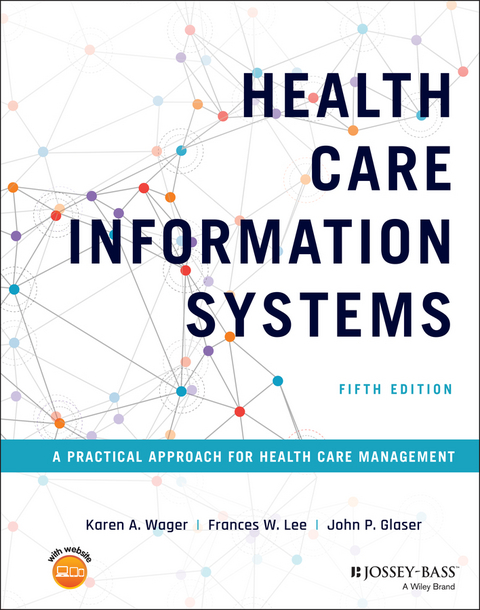
Health Care Information Systems (eBook)
John Wiley & Sons (Verlag)
978-1-119-85387-9 (ISBN)
In the newly revised Fifth Edition of Health Care Information Systems, veteran healthcare information management experts and educators Karen A. Wager and Frances Wickham Lee, along with nationally-recognized leader in health information technology, John P. Glaser, deliver a one-stop resource for graduate and upper-level undergraduate students to gain the knowledge and develop the skills they need to manage information and information systems technology in the new healthcare environment.
The latest edition sees its focus shift from the adoption of health care information systems and electronic health records to making effective use of health care data, information, and systems and optimizing their impact. New additions to this celebrated text include:
- Explorations of how health care information systems and information technology can be used to support national quality initiatives, value-based payment, population health management, and precision health and quality reporting
- Discussions of how issues like interoperability, electronic health record usability, and health IT safety are being (or not being) addressed
- Treatments of the roles played by data governance and analytics in clinical decision making and healthcare operations.
Filled with case studies, supplemental resources, and engaging examinations of critical areas in health care information system use, management, implementation, and support, Health Care Information Systems is an ideal reference for students taking courses in business administration, public health, health administration, medicine, health informatics and health care management.
KAREN A. WAGER, DBA, is Professor and Associate Dean for Student Affairs at the Medical University of South Carolina in Charleston, SC, USA. She teaches management and health information systems to graduate students.
FRANCES W. LEE, DBA, is Professor and Director of the Healthcare Simulation Center at the Medical University of South Carolina. She teaches graduate-level courses in health administration, health informatics, and health sciences.
JOHN P. GLASER, PhD, is an Executive-in-Residence at Harvard Medical School Executive Education. He was previously a Senior VP of Population Health at Cerner Corporation, Chief Executive Officer of Siemens Health Services, and Chief Information Officer at Partners HealthCare.
KAREN A. WAGER, DBA, is Professor and Associate Dean for Student Affairs at the Medical University of South Carolina in Charleston, SC, USA. She teaches management and health information systems to graduate students. FRANCES W. LEE, DBA, is Professor and Director of the Healthcare Simulation Center at the Medical University of South Carolina. She teaches graduate-level courses in health administration, health informatics, and health sciences. JOHN P. GLASER, PhD, is an Executive-in-Residence at Harvard Medical School Executive Education. He was previously a Senior VP of Population Health at Cerner Corporation, Chief Executive Officer of Siemens Health Services, and Chief Information Officer at Partners HealthCare.
Tables, Figures, and Exhibits xi
Preface xv
Acknowledgments xxi
The Authors xxiii
About the Companion Website xxv
PART ONE Foundational Concepts
1 Evolution of Health Care Information Systems in the United States 3
2 Electronic Health Record Systems 15
3 Role of HCIS in Improving Healthcare Delivery 39
4 Realizing the Digital Health Promise with Electronic Health Records 65
PART TWO Managing Health Care Information Systems
5 Health Care IT Strategic Planning 93
6 Health Care Information Technology Management 113
7 System Acquisition 143
8 System Implementation and Support 165
9 Assessing and Achieving Value in Health Care Information Systems 189
PART THREE Focused Topics
10 Engaging Patients and Consumers in Managing Their Health 215
11 Data Governance and Analytics 237
12 Privacy and Security 259
13 Emerging Technology Management 287
PART FOUR Case Studies and Supplemental Resources
14 Health IT Leadership Case Studies 309
Appendix A Overview of the Health Care IT Industry 347
Appendix B Sample Project Charter, Sample Job Descriptions, and Sample User Satisfaction Survey 357
Index 369
Preface
Health care delivery is still in the fairly early stages of a profound shift in its core strategies, organization, financing, operations, and care processes. When the COVID pandemic swept the world in 2020, however, health care organizations and providers pivoted quickly to offer care through video chats, telehealth, and remote patient monitoring. Federal and state regulations were loosened to facilitate the rapid response needed to provide safe care during a public health crisis. With the genie out of the bottle, telehealth and virtual care options will likely remain an integral part of how we deliver health care services.
The pandemic accelerated the shift to value-based care. Reactive sick care continues to be replaced by proactive efforts to keep people well and out of the hospital. Fragmented care delivery capabilities are being supplanted by initiatives to create and manage cross-continuum systems of care. Providers that were rewarded for volume are increasingly being rewarded for quality and efficiency.
New forms of reimbursement, such as bundles and various types of shared savings, are causing this shift. To thrive in the new era of health care delivery, providers are leveraging health systems, such as accountable care organizations, that include venues along the care spectrum.
In addition, providers are introducing new processes to support the need to manage care between encounters, keep people healthy, and ensure that utilization is appropriate. Moreover, as reimbursement continues to shift to incent improved provider performance these organizations will have a common need to optimize operational efficiency, improve financial management, and effectively engage consumers in managing their health and care.
These changes in business models and processes follow on the heels of the extraordinary increase in electronic health record (EHR) adoption spurred by the Meaningful Use program of the US federal government. Although EHR use is widespread in the United States today across care delivery settings, important work continues in improving interoperability, security, and usability and safety of systems.
On top of a foundation of electronic health records, the industry continues to add population health management applications, systems that support extensive patient engagement, broader interoperability, and more significant use of analytics. Providers involved in patient care will need immediate access to electronic decision-support tools, the latest relevant research findings on a given topic, and patient-specific reminders and alerts. Health care executives will need to be able to devise strategic initiatives that take advantage of access to real-time, relevant administrative and clinical information.
In parallel with the changes in health care, information technology (IT) innovation continues at a remarkable pace. The Internet of Things (IoT) is creating a reality of intelligent homes, cars, and equipment, such as environmental sensors and devices attached to patients. Social media use continues to grow and become more sophisticated and capable. Mobile personal devices have become the device of choice for personal and professional activities. Big data has exceptional potential to help identify new diagnostic and therapeutic algorithms, conduct most market surveillance, and assess the comparative effectiveness of treatments. While surrounded by hype, artificial intelligence had demonstrated the ability to advance an impressive array of IT capabilities.
For providers to prosper in this new era they must be very effective in developing IT strategies, implementing the technology, and leveraging the technology to improve organizational performance. They must understand the nature of health care data and the challenges of privacy and security. Clinicians and managers must appreciate the breadth of health care IT and emerging health care IT trends.
The transformation of the health care industry means that IT is no longer a necessary back-office evil—it is an essential foundation if an organization is to survive. That has not been true in the past; provider organizations could do quite well in a fee-for-service world without EHR systems and other advanced IT applications.
Having ready access to timely, complete, accurate, legible, and relevant information is critical to health care organizations, providers, and the patients they serve. Whether it is a nurse administering medication to a comatose patient, a physician advising a patient on the latest research findings for a specific cancer treatment, a billing clerk filing an electronic claim, a chief executive officer justifying to the board the need for building a new emergency department, or a health policy analyst reporting on the cost-effectiveness of a new prevention program to the state's Medicaid program, each individual needs access to high-quality information with which to effectively perform his or her job.
The need for quality information in health care, already strong, has never been greater, particularly as this sector of our society strives to provide quality care, reduce health disparities and ensure health equity, contain costs, provide adequate access and convenience, and improve the health of populations.
PURPOSE OF THIS BOOK
The purpose of this book is to prepare future health care executives with the knowledge and skills they need to manage information and information systems technology effectively in this new environment. We wrote this book with the graduate student (or upper-level undergraduate student) enrolled in a health care management program in mind.
Our definition of health care management is fairly broad and includes a range of academic programs from health administration, health information management, and public health programs to master of business administration (MBA) programs with an emphasis in health to nursing administration and physician executive educational programs. This book may also serve as an introductory text in health informatics programs and as a resource to individuals studying for certification in health and/or clinical informatics.
The previous four editions (2005, 2009, 2013, and 2017) have been widely used by a variety of health care management and health information systems programs throughout the United States and abroad. Although we have maintained several core chapters from the previous edition, this edition has gone through significant changes in composition and structure. Our focus in this edition reflects the shift from adopting health care information systems and EHRs to using and optimizing health care information systems (and data) to transform health care and achieve the Triple Aim.
Five new or near-new chapters have been added to this edition addressing important trends, including:
- How health care information systems and IT capabilities can or may be used to support national quality initiatives, value-based payment, population health management, precision health, and quality reporting.
- How issues such as interoperability, EHR usability (and clinician burnout and frustration), and health IT safety issues are being addressed and the role that both public and private sectors play.
- How health care organizations/providers are leveraging digital tools as part of their organization's overall strategy to engage patients and their families more fully in managing health and care, including factors to consider in incorporating patient-generated health data into the care delivery process.
- How data governance and data analytics are being used to support clinical decision making, improve operations, and improve health outcomes.
- A discussion on emerging technologies (e.g., telehealth, artificial intelligence) and how to assess technological maturity and readiness of organizational change.
ORGANIZATION OF THIS BOOK
The chapters in this book are organized into four major parts.
Part One: Foundational Concepts
- Chapter 1: Evolution of Health Care Information Systems in the United States
- Chapter 2: Electronic Health Record Systems
- Chapter 3: Role of HCIS in Improving Healthcare Delivery*
- Chapter 4: Realizing the Digital Health Promise with Electronic Health Records*
Part Two: Managing Health Care Information Systems
- Chapter 5: Health Care IT Strategic Planning
- Chapter 6: Health Care Information Technology Management
- Chapter 7: System Acquisition
- Chapter 8: System Implementation and Support
- Chapter 9: Assessing and Achieving Value in Health Care Information Systems
Part Three: Focused Topics
- Chapter 10: Engaging Patients and Consumers in Managing Their Health*
- Chapter 11: Data Governance and Analytics*
- Chapter 12: Privacy and Security
- Chapter 13: Emerging Technology Management*
Part Four: Case Studies and Supplemental Resources
- Chapter 14: Health IT Leadership Case Studies
- Appendix A: Overview of the Health Care IT Industry
- Appendix B: Sample Project Charter, Sample Job Descriptions, and Sample User Satisfaction Survey
*New to fifth edition
The purpose of Part One (“Foundational Concepts”) is to provide the reader with the foundation needed for the rest of the book. This foundation includes an overview of the...
| Erscheint lt. Verlag | 1.12.2021 |
|---|---|
| Sprache | englisch |
| Themenwelt | Medizin / Pharmazie ► Allgemeines / Lexika |
| Studium ► Querschnittsbereiche ► Prävention / Gesundheitsförderung | |
| Schlagworte | Clinical psychology • EHR, health information systems • electronic health records • Gesundheits- u. Sozialwesen • Health & Social Care • health care information systems textbook • Health care information technology • health care IT value-based payment • health care national quality • Klinische Psychologie • Öffentlicher Gesundheitsdienst u. Gesundheitspolitik • Precision Health • Psychologie • Psychology • Public Health • Public Health Services & Policy • Value-based Healthcare |
| ISBN-10 | 1-119-85387-7 / 1119853877 |
| ISBN-13 | 978-1-119-85387-9 / 9781119853879 |
| Informationen gemäß Produktsicherheitsverordnung (GPSR) | |
| Haben Sie eine Frage zum Produkt? |
 EPUB (Adobe DRM)
Kopierschutz: Adobe-DRM
Adobe-DRM ist ein Kopierschutz, der das eBook vor Mißbrauch schützen soll. Dabei wird das eBook bereits beim Download auf Ihre persönliche Adobe-ID autorisiert. Lesen können Sie das eBook dann nur auf den Geräten, welche ebenfalls auf Ihre Adobe-ID registriert sind.
Details zum Adobe-DRM
Dateiformat: EPUB (Electronic Publication)
EPUB ist ein offener Standard für eBooks und eignet sich besonders zur Darstellung von Belletristik und Sachbüchern. Der Fließtext wird dynamisch an die Display- und Schriftgröße angepasst. Auch für mobile Lesegeräte ist EPUB daher gut geeignet.
Systemvoraussetzungen:
PC/Mac: Mit einem PC oder Mac können Sie dieses eBook lesen. Sie benötigen eine
eReader: Dieses eBook kann mit (fast) allen eBook-Readern gelesen werden. Mit dem amazon-Kindle ist es aber nicht kompatibel.
Smartphone/Tablet: Egal ob Apple oder Android, dieses eBook können Sie lesen. Sie benötigen eine
Geräteliste und zusätzliche Hinweise
Buying eBooks from abroad
For tax law reasons we can sell eBooks just within Germany and Switzerland. Regrettably we cannot fulfill eBook-orders from other countries.
aus dem Bereich