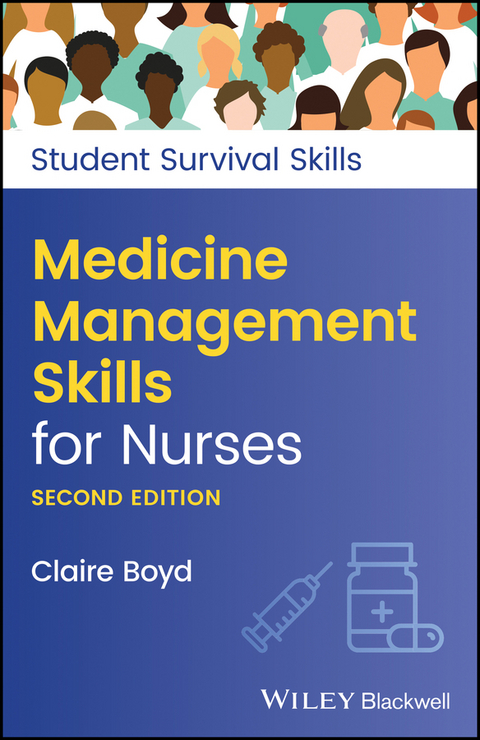
Medicine Management Skills for Nurses (eBook)
John Wiley & Sons (Verlag)
978-1-119-80797-1 (ISBN)
An invaluable nursing handbook to increase your confidence with medicine management
In the newly revised Second Edition of Medicine Management Skills for Nurses, renowned nursing trainer Claire Boyd delivers a concise, pocket-sized companion to the subject of medicines management and drug administration that's perfect for student nurses, associate practitioners, and newly qualified registered nurses.
Part of the popular Student Survival Skills series, this edition includes tips, advice, and words of wisdom from nursing students written for people working through the nursing curriculum. It mirrors the standards set by the Nursing and Midwifery Council and contains interactive student activities throughout the book.
An ideal companion to the forthcoming Calculation Skills for Nurses, 2nd Edition, the latest edition of Medicine Management Skills for Nurses is packed with conversational, accessible guidance to help you understand and handle medicines with confidence and competence. It also includes:
- Thorough introductions to the general principles of drug administration and to pharmacokinetic and pharmacodynamic concepts
- Comprehensive explorations of oral drug administration and administration by injection
- Practical discussions of calculations for working out medicine dosages
- In-depth examinations of specific, commonly used drugs and individual medical conditions, as well as pain management
Ideal for pre-registration nursing students and nursing associates, the latest edition of Medicine Management Skills for Nurses is an indispensable resource for anyone seeking practical and student-centered advice for managing medicines in a clinical environment.
An invaluable nursing handbook to increase your confidence with medicine management In the newly revised Second Edition of Medicine Management Skills for Nurses, renowned nursing trainer Claire Boyd delivers a concise, pocket-sized companion to the subject of medicines management and drug administration that's perfect for student nurses, associate practitioners, and newly qualified registered nurses. Part of the popular Student Survival Skills series, this edition includes tips, advice, and words of wisdom from nursing students written for people working through the nursing curriculum. It mirrors the standards set by the Nursing and Midwifery Council and contains interactive student activities throughout the book. An ideal companion to the forthcoming Calculation Skills for Nurses, 2nd Edition, the latest edition of Medicine Management Skills for Nurses is packed with conversational, accessible guidance to help you understand and handle medicines with confidence and competence. It also includes: Thorough introductions to the general principles of drug administration and to pharmacokinetic and pharmacodynamic concepts Comprehensive explorations of oral drug administration and administration by injection Practical discussions of calculations for working out medicine dosages In-depth examinations of specific, commonly used drugs and individual medical conditions, as well as pain management Ideal for pre-registration nursing students and nursing associates, the latest edition of Medicine Management Skills for Nurses is an indispensable resource for anyone seeking practical and student-centered advice for managing medicines in a clinical environment.
Claire Boyd was Practice Development Trainer in the Learning and Research Centre at North Bristol Healthcare Trust. She develops, designs, delivers and evaluates learning programmes, and organises the transition training program for student nurses and support of these nurses in clinical areas.
Preface vii
Introduction ix
Acknowledgements xi
The 24-Hour Clock xii
1 Drug Administration: General Principles 1
2 Pharmacokinetics and Pharmacodynamics 23
3 Drugs and Medicines 41
4 Calculations For Working Out Dosages 63
5 Oral Drug Administration 79
6 Administration of Injections 97
7 Administration of Rectal And Vaginal Preparations 117
8 Administration of Topical Preparations 131
9 Administration of Inhalation Medications And Nebulisers 147
10 Administration of Intravenous Fluids 161
11 Administration of Intravenous Bolus Medications 179
12 Administration of Continuous Intravenous Infusions 193
13 Administration via Percutaneous Endoscopic Gastrostomy, Percutaneous Endoscopic Jejunostomy, Or Nasogastric Tube 201
14 Oxygen Therapy 215
15 Drugs and Specific Medical Conditions 233
16 Pain Management 245
17 Case Study 261
18 Knowledge Test 271
Answers to Activities, Questions, and 'Test Your Knowledge' 279
Appendix 1: Specific Competencies: Medicines Management 301
Appendix 2: A Typical Prescription Chart 307
Index 313
Chapter 1
DRUG ADMINISTRATION: GENERAL PRINCIPLES
Medicine Management Skills for Nurses, Second Edition. Claire Boyd.
© 2022 John Wiley & Sons, Ltd. Published 2022 by John Wiley & Sons Ltd.
LEARNING OUTCOMES
By the end of this chapter you will have an understanding of the general principles of drug administration, including improving medication safety factors.
PROFESSIONALISM
You may well worry about making mistakes. Everyone is human after all and prone to error (known as ‘Human Factors’). The key is to minimise where the faults can occur. As health carers we always put the patient first and apply our professionalism. As with any clinical skill we need to highlight the importance of vigilance, knowledge, and professionalism when administering drugs, as many drug errors occur when staff fail to follow correct procedures or do not recognise the limitations of their own knowledge and skill. Let's look at the cost of drug errors, both monetary and to the individual.
Professionalism in nursing
Nurses are expected to display competent and skilful behaviour.
PROFESSIONAL JUDGEMENT
When administering medication, we need to be aware of the following:
- It is not solely a mechanistic task to be performed in strict compliance with the written prescription of a medical practitioner.
- It requires thought and the exercise of professional judgement (Lister, Hofland, and Grafton 2020).
What does this actually mean? Let's look at an example.
Question 1.1
- If a patient has senna and lactulose prescribed and informs you that they have opened their bowels four times that day, do you administer their prescribed laxatives?
Also remember, it is very easy to get distracted, and lose concentration in the clinical area, so always concentrate on the job in hand.
MEDICATION ERRORS
What is a drug error? Well, the Department of Health informs us that:
A medication error is any preventable event that may cause or lead to inappropriate medication use or patient harm while the medication is in the control of health professional, patient, or consumer.
Because nurses predominately administer drugs, they are often the last potential barrier between a medication error and serious harm to a patient, with drug errors frequently featuring in professional misconduct cases.
It is estimated that there are more than 230 million medication errors per year in the National Health Service (NHS). The cost to the NHS was estimated at £98.5 million for the 712 confirmed deaths from drug errors in hospital. However, if we add on the extra cost of patients made seriously ill, or potentially killed by drug errors in primary care, the estimated cost to the NHS is £1.6 billion (yes – billion!) equating to 3.8 million bed days.
So, why do drug errors occur? Well, we have been informed from the same report giving us the facts and figures above that they occur due to:
- Failure to properly monitor patients on powerful drugs,
- Poor communication between general practitioner (GP)'s and hospitals,
- Giving patients the wrong medication.
We also know that mistakes happen due to:
- Drugs that look or sound alike,
- High staff workload,
- Low staffing levels,
- Inexperienced staff.
As a means to combat some of these medication errors, the UK government pledged an investment of £75 million to implement electronic prescribing in hospitals.
Drug Errors and Adverse Reactions
The NHS has graded drug errors and adverse reactions, as follows:
- Medication errors that do not result in patient harm, i.e. near misses (example: a dose of 500 mg amoxycillin is prepared instead of 250 mg, but corrected before reaching the patient).
- Medication errors that result in patient harm (example: giving an antibiotic to a patient with a known allergy to that drug).
- An adverse drug reaction that is not the result of a medication error (example: giving antibiotics to a patient with no previous history of drug reactions, but who then reacts: this is the only non‐preventable type of mistake).
Question 1.2
What is a near miss? Think of an example.
Question 1.3
Apart from killing the patient, what is the worst thing you can do when you have made a drug error?
Worldwide Facts and Figures
Some facts and figures concerning drug errors worldwide:
- Worldwide: 17% of medication errors involve errors in calculations.
- Almost 50% of all intravenous injections feature a mistake, and the number of patients requiring intravenous therapy is increasing.
In medicines management, not only do we have to contend with long, hard to pronounce drug names, but we need to get our heads around all the abbreviations, including Latin ones!
LATIN ABBREVIATIONS
We have all seen the medic on the TV hospital soap opera shouting ‘adrenaline stat!’ in the emergency room but what does ‘stat’ actually mean? Well, it means we need to be conversant with Latin abbreviations, that's what it means.
Have a go at seeing how many of the Latin abbreviations you know in Activity 1.1.
Activity 1.1
Here is a list of Latin abbreviations used when prescribing. What do they mean?
| STAT | OM | QDS |
| AC | ON | QQH |
| BD | PC | TDS |
| OD | PRN | TID |
We tend to use specific accepted abbreviations in health care to do with medicines, such as mg, pro re nata (PRN), IV, etc. but not mcg as we write microgrammes in full so as not to get confused with mg. Healthcare workers are told not to use abbreviations in their written care plans, medical records, etc. as mistakes can happen. Terms may have two meanings: for instance, DOA can be taken to mean dead on arrival or date of admission.
MEDICAL ABBREVIATIONS
There are many medical abbreviations you will see in practice in patients' medical notes. You will also see them used throughout this book. See how many of them you can work out. Don't worry if it is all alien to you, you can find the answers at the back of this book.
Activity 1.2
| AF | DKA | INR |
| BNF | DM | MAOI |
| BP | DVT | MHRA |
| CHD | GI | MI |
| COPD | GTN | NG |
| CR | IDDM | NHS |
| DH | NMC | NICE |
| NPSA | OTC | NIDDM |
| NSAID | WHO | PEG |
| PPI | GP | CD |
DID YOU KNOW?
Doctors would often write abbreviations in patients notes – often being very derogatory to them! Thankfully this practice is not seen so much today. Here are just a few:
- LOBNH Lights on but nobody home
- TEETH Tried everything else, try homoeopathy
- PIP Pyjama Induced Paralysis
- TMB Too many birthdays
DRUG WASTAGE
It has been found that Primary Care Trusts could save almost £7 million each year if GPs prescribed more efficiently. Wastage costs the NHS approximately £200 million. I'm sure we have all met the elderly neighbour with bottles of pills dating back 10 years or more collecting dust in their bathroom cabinets. As health carers we all need to deliver better patient education, explaining why that course of antibiotics that the GP prescribed needs to be completed, even if the patient is feeling better.
Here's a question: what do you think about schemes to recycle drugs back to the pharmacist to be redistributed to other patients? What if the bottles have been opened and the drugs spilled over a dirty floor and put back in the bottle (perhaps even licked by the dog!). Would you like to take them? Only use sealed bottles and unopened blister packs, I hear you say, but what if these had been stored on top of a heater for the last six months and their active ingredients have now become unstable?
MEDICATION PROCESS
The medication process is made up of four parts.
- Prescribing: it is often the nurse who notices that a doctor has prescribed something to which the patient is allergic, perhaps because the nurse knows the patient...
| Erscheint lt. Verlag | 18.11.2021 |
|---|---|
| Reihe/Serie | Student Survival Skills |
| Student Survival Skills | Student Survival Skills |
| Sprache | englisch |
| Themenwelt | Medizin / Pharmazie ► Pflege |
| Schlagworte | Basic Pharmacology • Clinical nursing handbook • clinical nursing textbook • Drug management • Einführungen in die Krankenpflege • Grundlagen der Pharmakologie • Introductions to Nursing • Krankenpflege • managing medicines • Medical Science • medicine management assessments • medicine management handbook • Medizin • nursing • Nursing and Midwifery Council • nursing guide • Nursing Handbook • nursing resource |
| ISBN-10 | 1-119-80797-2 / 1119807972 |
| ISBN-13 | 978-1-119-80797-1 / 9781119807971 |
| Informationen gemäß Produktsicherheitsverordnung (GPSR) | |
| Haben Sie eine Frage zum Produkt? |
 EPUB (Adobe DRM)
Kopierschutz: Adobe-DRM
Adobe-DRM ist ein Kopierschutz, der das eBook vor Mißbrauch schützen soll. Dabei wird das eBook bereits beim Download auf Ihre persönliche Adobe-ID autorisiert. Lesen können Sie das eBook dann nur auf den Geräten, welche ebenfalls auf Ihre Adobe-ID registriert sind.
Details zum Adobe-DRM
Dateiformat: EPUB (Electronic Publication)
EPUB ist ein offener Standard für eBooks und eignet sich besonders zur Darstellung von Belletristik und Sachbüchern. Der Fließtext wird dynamisch an die Display- und Schriftgröße angepasst. Auch für mobile Lesegeräte ist EPUB daher gut geeignet.
Systemvoraussetzungen:
PC/Mac: Mit einem PC oder Mac können Sie dieses eBook lesen. Sie benötigen eine
eReader: Dieses eBook kann mit (fast) allen eBook-Readern gelesen werden. Mit dem amazon-Kindle ist es aber nicht kompatibel.
Smartphone/Tablet: Egal ob Apple oder Android, dieses eBook können Sie lesen. Sie benötigen eine
Geräteliste und zusätzliche Hinweise
Buying eBooks from abroad
For tax law reasons we can sell eBooks just within Germany and Switzerland. Regrettably we cannot fulfill eBook-orders from other countries.
aus dem Bereich