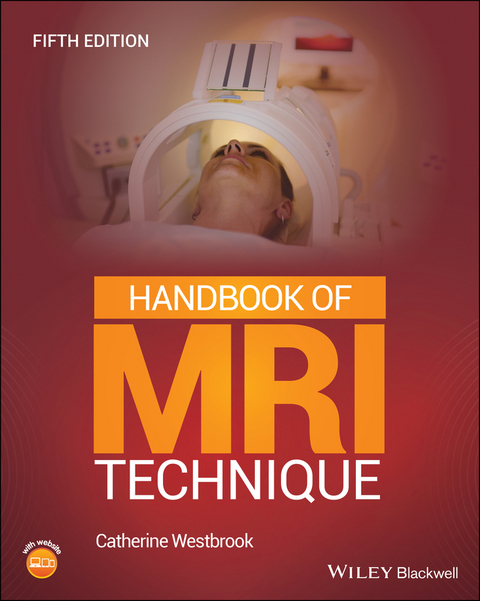
Handbook of MRI Technique (eBook)
John Wiley & Sons (Verlag)
978-1-119-75946-1 (ISBN)
HANDBOOK OF MRI TECHNIQUE
FIFTH EDITION
Distinguished educator Catherine Westbrook delivers a comprehensive and intuitive resource for radiologic technologists in this newly revised Fifth Edition of the Handbook of MRI Technique. With a heavy emphasis on protocol optimisation and patient care, the book guides the uninitiated through scanning techniques and assists more experienced technologists with image quality improvement.
The new edition includes up-to-date scanning techniques and an additional chapter on paediatric imaging. The latest regulations on MRI safety are referenced and there are expanded sections on slice prescription criteria. The book also includes the contributions of several clinical experts, walking readers through key theoretical concepts, discussing practical tips on cardiac gating, equipment use, patient care, MRI safety, and contrast media. Step-by-step instruction is provided on scanning each anatomical area, complete with patient positioning and image quality optimisation techniques.
The book includes:
- A thorough introduction to the concepts of parameters and trade-offs, as well as pulse sequences, flow phenomena, and artefacts
- Comprehensive explorations of cardiac gating and respiratory compensation techniques, patient care and safety, contrast agents, and slice prescription criteria
- Practical discussions of a wide variety of examination areas, including the head and neck, spine, chest, abdomen, pelvis, the upper and lower limbs, and paediatric imaging
- A companion website with self-assessment questions and image flashcards
Perfect for radiography students and newly qualified practitioners, as well as practitioners preparing for MRI-based certification and examination, the Handbook of MRI Technique will also prove to be an invaluable addition to the libraries of students in biomedical engineering technology and radiology residents.
Catherine Westbrook is a former Senior Lecturer in Magnetic Resonance Imaging (MRI), Faculty of Medical Science, Anglia Ruskin University, Cambridge, UK, and is a founder and co-director of the MRI Education Company.
Catherine Westbrook is a former Senior Lecturer in Magnetic Resonance Imaging (MRI), Faculty of Medical Science, Anglia Ruskin University, Cambridge, UK, and is a founder and co-director of the MRI Education Company.
ii Contributors
iii Preface
iv Acknowledgments
01 How to use this book
Part 1 - Theoretical and Practical Concepts
02 Protocol parameters and trade-offs
03 Pulse sequences
04 Flow phenomena and artefacts
05 Gating and respiratory compensation techniques
06 Patient care and safety
07 Contrast agents
Part 2 - Examination Areas
08 Head and neck
Brain
Temporal lobes
Posterior fossa and internal auditory meatus
Pituitary fossa
Orbits
Paranasal sinuses
Pharynx
Larynx
Thyroid and parathyroid glands
Salivary glands
Temporomandibular joints
Vascular imaging
09 Spine
Cervical spine
Thoracic spine
Lumbar spine
Whole spine
10 Chest
Lungs and mediastinum
Heart and great vessels
Thymus
Breast
Axilla
Brachial plexus
11 Abdomen
Liver and biliary system
Kidneys and adrenal glands
Pancreas
Bowel
Vascular imaging
12 Pelvis
Prostate
Rectum and testes
Uterus and cervix
13 Upper limb
Shoulder
Humerus
Elbow
Forearm
Wrist and hand
14 Lower limb
Hips
Femur
Knee
Tibia and fibula
Ankle
Foot
Vascular imaging
15 Paediatric Imaging
Index
1
How to Use This Book
- Introduction
- Common indications
- Basic anatomy
- Equipment
- Patient positioning
- Slice prescription
- Suggested protocol
- Protocol optimization
- Patient considerations
- Contrast usage
- Summary
- Terms and abbreviations used in Part 2
- Conclusion
INTRODUCTION
This book has been written with the intention of providing a step‐by‐step explanation of the most common examinations currently carried out using magnetic resonance imaging (MRI). It is divided into two parts.
Part 1 contains reviews or summaries of those theoretical and practical concepts that are frequently discussed in Part 2. These are:
- protocol parameters and trade‐offs
- pulse sequences
- flow phenomena and artefacts
- gating and respiratory compensation (RC) techniques
- patient care and safety
- contrast agents.
These summaries are not intended to be comprehensive but contain only a brief description of definitions and uses. For a more detailed discussion of these and other concepts, the reader is referred to MRI physics books. MRI in Practice by C. Westbrook and J. Talbot (Wiley Blackwell, 2019, fifth edition) is a particularly useful companion to this book.
Part 2 is divided into the following examination areas:
- head and neck
- spine
- chest
- abdomen
- pelvis
- upper limb
- lower limb
- paediatric imaging.
Each anatomical region is subdivided into separate examinations. For example, the section entitled Head and neck includes explanations on imaging the brain, temporal lobes, pituitary fossa, and so on. Under each examination, the following categories are described:
- common indications
- basic anatomy
- equipment
- patient positioning
- slice prescription
- suggested protocol
- protocol optimization
- patient considerations
- contrast usage.
COMMON INDICATIONS
These are the most usual reasons for scanning each area, although occasionally some rarer indications are included.
BASIC ANATOMY
Simple anatomical diagrams are provided for most examination areas to assist the reader.
EQUIPMENT
This contains a list of the equipment required for each examination and includes coil type, gating leads, bellows and immobilization devices. The correct use of gating and RC is discussed in Part 1 (see Gating and respiratory compensation techniques). The coil types described are the most common currently available. These are as follows.
- Volume coils that both transmit and receive radiofrequency (RF) pulses and are specifically called transceivers. Most of these coils are quadrature in design, which means that they generate two RF fields perpendicular to each other. This maximises coupling between the coils and the spin population, thus improving image quality factors such as the signal‐to‐noise ratio (SNR). Volume coils often encompass large areas of anatomy and yield a uniform signal across the whole field of view (FOV). The head and body coil are examples of this type of coil.
- Linear phased array coils consist of multiple coils and receivers. The signal from the receiver of each coil is combined to form one image. The image has the advantages of both a small coil (improved SNR) and those of the larger volume coils (increased coverage). Therefore, linear phased array coils can be used either to examine large areas such as the entire length of the spine, or to improve signal uniformity and intensity in small areas such as the breast.
Figure 1.1 Correct placement of a flat surface receive coil.
- Volume phased array (parallel imaging) uses the data from multiple coils or channels arranged around the area under examination to decrease scan time, increase phase resolution or a combination of both. Additional software and hardware are required. The hardware includes several coils perpendicular to each other or one coil with several channels. The number of possible coils/channels varies but currently ranges from 2 to 32 for routine imaging and up to 128 for cardiac imaging. During data acquisition, each coil fills its own lines of k‐space (e.g., if two coils are used together, one coil fills the even lines of k‐space and the other the odd lines. k‐space is therefore filled either twice as quickly or with twice the phase resolution in the same scan time). The number of selected coils/channels is generically called the reduction factor and is similar in principle to the turbo factor (TF)/echo train length (ETL) in fast or turbo spin echo (FSE/TSE) (see Pulse sequences). Every coil/channel produces a separate image that often displays aliasing artefact (see Flow phenomena and artefacts). Software called sensitivity encoding and additional algorithms remove this artefact and combine the images from each coil/channel to produce a single unwrapped image. This technology can be used in most examination areas and with any pulse sequence. It is often discussed in the Protocol optimization section in Part 2.
- Surface/local coils are traditionally used to improve the SNR when imaging structures near to the skin surface. They are often specially designed to fit a certain area and in general they only receive signal. Surface coils increase SNR compared with volume coils. This is because they are placed close to the region under examination increasing signal amplitude that is generated in the coil, while noise is only received in the vicinity of the coil. However, surface coils only receive signal up to the edges of the coil and to a depth equal to the diameter of the conductive loop of the coil. To visualize structures deep within the patient, either a volume, linear or volume phased array coil or, more rarely, a local coil inserted into an orifice must be utilized (e.g., a rectal coil).
The choice of coil is one of the most important factors that determines the SNR. When using any type of coil remember to:
- Check that the cables are intact and undamaged.
- Check that the coil is plugged in properly and that the correct connector box is used.
- Ensure that the receiving side of the coil faces the patient. This is usually labelled on the coil itself. Note that both sides of the coil usually receive signal, but coils are designed so that one side receives optimum signal. This is especially true of shaped coils that fit a certain anatomical area. If the wrong side of the coil faces the patient, signal is lost, and image quality suffers.
- Place the coil as close as possible to the area under examination.
- The coil should not directly touch the patient’s skin as it may become warm during the examination and cause discomfort. A small foam pad placed between the skin surface and the coil is usually sufficient insulation.
- Ensure that the coil does not move when placed on the patient. A moving coil during data acquisition always produces a moving image.
- Ensure that the receiving surface of the coil is parallel to the z (long) axis of the magnet. This guarantees that the transverse component of magnetization is perpendicular to the coil and that maximum signal is induced. Placing the coil at an angle to this axis, or parallel to the x or y axis, results in a loss of signal (Figure 1.1). Note that the axes discussed here relate to a superconducting magnet. Open systems may label their axes differently, but the principle remains the same. To generate signal in a receiver coil on any type of system, the receiver coil must be located perpendicular to the transverse component of magnetization.
PATIENT POSITIONING
This contains a description of the correct patient position, placement of the patient within the coil and proper immobilization techniques. Centring and landmarking are described relative to the laser light system on a superconducting system as follows (Figure 1.2):
- The longitudinal alignment light refers to the light running parallel to the bore of the magnet in the z axis.
- The horizontal alignment light refers to the light that runs from left to right of the bore of the magnet in the x axis.
- The vertical alignment light refers to the light that runs from the top to the bottom of the magnet in the y axis.
It is assumed in Part 2 that the following areas are examined with the patient placed head‐first in the magnet:
- head and neck (all areas)
- cervical, thoracic and whole spine
- chest (all areas)
- abdomen (for areas superior to the iliac crests)
- shoulders and upper limb (except where specified).
The remaining anatomical regions are examined with the patient placed feet‐first in the magnet. These are:
- pelvis
- hips
- lower limbs.
Figure 1.2 Positioning of the alignment lights.
SLICE...
| Erscheint lt. Verlag | 7.10.2021 |
|---|---|
| Sprache | englisch |
| Themenwelt | Medizin / Pharmazie ► Allgemeines / Lexika |
| Medizin / Pharmazie ► Gesundheitsfachberufe | |
| Medizinische Fachgebiete ► Radiologie / Bildgebende Verfahren ► Radiologie | |
| Schlagworte | Computertomographie • Computertomographie (MRI) • Gesundheits- u. Sozialwesen • Health & Social Care • Medical Science • Medizin • MRI • Radiographie • radiography • Radiologie • Radiologie u. Bildgebende Verfahren • Radiology & Imaging |
| ISBN-10 | 1-119-75946-3 / 1119759463 |
| ISBN-13 | 978-1-119-75946-1 / 9781119759461 |
| Informationen gemäß Produktsicherheitsverordnung (GPSR) | |
| Haben Sie eine Frage zum Produkt? |
 EPUB (Adobe DRM)
Kopierschutz: Adobe-DRM
Adobe-DRM ist ein Kopierschutz, der das eBook vor Mißbrauch schützen soll. Dabei wird das eBook bereits beim Download auf Ihre persönliche Adobe-ID autorisiert. Lesen können Sie das eBook dann nur auf den Geräten, welche ebenfalls auf Ihre Adobe-ID registriert sind.
Details zum Adobe-DRM
Dateiformat: EPUB (Electronic Publication)
EPUB ist ein offener Standard für eBooks und eignet sich besonders zur Darstellung von Belletristik und Sachbüchern. Der Fließtext wird dynamisch an die Display- und Schriftgröße angepasst. Auch für mobile Lesegeräte ist EPUB daher gut geeignet.
Systemvoraussetzungen:
PC/Mac: Mit einem PC oder Mac können Sie dieses eBook lesen. Sie benötigen eine
eReader: Dieses eBook kann mit (fast) allen eBook-Readern gelesen werden. Mit dem amazon-Kindle ist es aber nicht kompatibel.
Smartphone/Tablet: Egal ob Apple oder Android, dieses eBook können Sie lesen. Sie benötigen eine
Geräteliste und zusätzliche Hinweise
Buying eBooks from abroad
For tax law reasons we can sell eBooks just within Germany and Switzerland. Regrettably we cannot fulfill eBook-orders from other countries.
aus dem Bereich