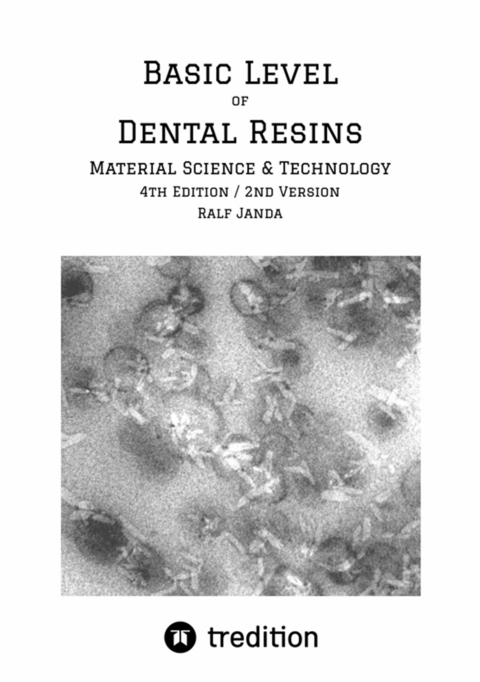
Basic Level of Dental Resins - Material Science & Technology (eBook)
270 Seiten
tredition (Verlag)
978-3-347-37360-0 (ISBN)
Ralf Janda was born in 1953 in Berlin. He obtained his Abitur (secondary school-leaving examination in 1973 and pursued chemistry at the Free University Berlin (FUB) from 1973 to 1978, thereby obtaining the degree Diploma-Chemist (summa cum laude). While working as a scientific assistant and researcher at the FUB he wrote his doctoral thesis and graduated in 1979 as a natural science doctor, Dr. rer. nat. (summa cum laude). His professional career as a scientific assistant and lecturer at the FUB came to an end in 1980. Ralf Janda also joined the dental industry in this year as head of research and development. He worked for many internationally leading dental companies (Kulzer GmbH, Germany, Degussa AG-Dental Division, today Degudent/Dentsply GmbH, Germany, Dentsply/Detech GmbH, Germany, Dentsply INC., USA, Dentaurum GmbH & Co. KG, Germany) in different leading positions as head of: R&D, production, quality assurance, dental technology, worldwide project leader until 2003. During this time, he was a member of many dental standard commissions, and from 1987 to 2000, he was also a member of the drug commission A at the drug institute of the Federal Republic of Germany. In 2003, he joined the cosmetic industry specialized on light-curing artificial nail products and stayed there until 2017. In addition to his professional pursuits, Ralf Janda has maintained a lengthy and extensive scientific career as a researcher and lecturer at numerous universities, beginning at the FUB in 1978. From 1988 to 1990, he was a lecturer at the Faculty of Material Sciences of the Technical University Berlin, where he taught resin composite materials. From 1991 to 1999, he worked as a researcher and lecturer for non-metallic dental materials at the dental department of the Medical Faculty of the Johann Wolfgang Goethe-University, Frankfurt/M. In 1992, he obtained his Habilitation (qualification for a teaching career at universities) and the degree Privatdozent (associate professor) in dental material science at the same university. From 1999 to 2004, Ralf Janda was Privatdozent at the Center of Dental Medicine of the Medical Faculty, Charité, Humboldt-University Berlin. From 2004 to 2021 he worked as a researcher and lecturer at the dental clinic of the Medical Faculty of the Heinrich Heine University, Düsseldorf. In 2006, he was appointed as apl. Professor (adjunct professor) in dental material science. Since 2021 he put his focus on writing textbooks about dental materials.
Ralf Janda was born in 1953 in Berlin. He obtained his Abitur (secondary school-leaving examination in 1973 and pursued chemistry at the Free University Berlin (FUB) from 1973 to 1978, thereby obtaining the degree Diploma-Chemist (summa cum laude). While working as a scientific assistant and researcher at the FUB he wrote his doctoral thesis and graduated in 1979 as a natural science doctor, Dr. rer. nat. (summa cum laude). His professional career as a scientific assistant and lecturer at the FUB came to an end in 1980. Ralf Janda also joined the dental industry in this year as head of research and development. He worked for many internationally leading dental companies (Kulzer GmbH, Germany, Degussa AG-Dental Division, today Degudent/Dentsply GmbH, Germany, Dentsply/Detech GmbH, Germany, Dentsply INC., USA, Dentaurum GmbH & Co. KG, Germany) in different leading positions as head of: R&D, production, quality assurance, dental technology, worldwide project leader until 2003. During this time, he was a member of many dental standard commissions, and from 1987 to 2000, he was also a member of the drug commission A at the drug institute of the Federal Republic of Germany. In 2003, he joined the cosmetic industry specialized on light-curing artificial nail products and stayed there until 2017. In addition to his professional pursuits, Ralf Janda has maintained a lengthy and extensive scientific career as a researcher and lecturer at numerous universities, beginning at the FUB in 1978. From 1988 to 1990, he was a lecturer at the Faculty of Material Sciences of the Technical University Berlin, where he taught resin composite materials. From 1991 to 1999, he worked as a researcher and lecturer for non-metallic dental materials at the dental department of the Medical Faculty of the Johann Wolfgang Goethe-University, Frankfurt/M. In 1992, he obtained his Habilitation (qualification for a teaching career at universities) and the degree Privatdozent (associate professor) in dental material science at the same university. From 1999 to 2004, Ralf Janda was Privatdozent at the Center of Dental Medicine of the Medical Faculty, Charité, Humboldt-University Berlin. From 2004 to 2021 he worked as a researcher and lecturer at the dental clinic of the Medical Faculty of the Heinrich Heine University, Düsseldorf. In 2006, he was appointed as apl. Professor (adjunct professor) in dental material science. Since 2021 he put his focus on writing textbooks about dental materials.
Matrix Resins
1 Introduction
Matrix resins are unpolymerized monomer/oligomer blends or polymerized solid materials that may contain different types of fillers (organic or inorganic), initiators, catalysts, stabilizers, pigments or various types of other additives (Fig. 1b).
Unpolymerized matrix resins are more or less viscous materials that are blended with the necessary ingredients in special mixers or kneaders mostly under vacuum and/or warmth. Then the matrix resin is polymerized to solid state to obtain the final product that fulfills the requirements for the respective application.
In case the starting matrix resin is a solid polymer no initiator or catalyst is needed. Such matrixes must be thermoplastic to be transformed by heat to a more or less viscous molten mass to admix the requested ingredients. This is also done, sometimes under vacuum, in special kneaders, extruders or injection devices. When cooled down directly in the requested shape the final product is obtained. It is also possible that an intermediate product is received after cooling which is granulated by milling. To obtain the final product the granules are plasticized again in injection devices and are injected into a mold to cool in the final shape (injection molding). Matrix resins are unpolymerized monomer/oligomer blends or polymerized solid materials that may contain different types of fillers (organic or inorganic), initiators, catalysts, stabilizers, pigments or various types of other additives (Fig. 1b).
Unpolymerized matrix resins are more or less viscous materials that are blended with other ingredients in special mixers or kneaders mostly under vacuum and/or warmth. Then the matrix resin is polymerized to solid state to obtain the final product that fulfills the requirements for the respective application.
In case the starting matrix resin is a solid polymer no initiator or catalyst is needed. Such matrices must be thermoplastic to be transformed by heat to a more or less viscous molten mass to admix the requested ingredients. This is also done, sometimes under vacuum, in special kneaders, extruders or injection devices. When cooled down in a mold representing the requested shape the final product is obtained. It is also possible that an intermediate product is received after cooling which is granulated by milling. To obtain the final product the granules are plasticized again in injection devices and are injected into a mold to cool in the final shape (injection molding).
2 Functional Groups and Monomer Links
Polymers or macromolecules are formed when numerous monomer molecules link with each other according to particular chemical principles. To transform the monomeric/oligomeric state into the solid state the monomers/oligomers must provide special molecular groups, so called polymerizable or functional groups, which can perform the polyreaction. Depending on the type of functional group various kinds of polyreactions can be executed and various kinds of links between the reacting molecules are possible to be formed (Figs. 2b-1 and 2b-2).
Fig. 2b-1: Polymers, links and polyreactions.
Fig. 2b-2: Polymers, links and polyreactions.
The functional groups (Fig. 3b) of the reacting molecules determine the type of links that are characteristic for the created macromolecule. Few different polyreactions and their characteristic links give rise to many different polymers. Although the carbon-carbon link is characteristic for very many different polymers these differ significantly in their chemical and physical properties. This reveals that the properties do not to depend only on the type of link but to a greater extent on the molecular structure of the chosen monomers/oligomers.
Fig. 3b: Functional groups, examples of unsaturated molecule structures.
3 Polyreactions
Polyreactions are chemical reactions that link appropriate monomers to polymers under appropriate conditions. There are several types of polyreactions in polymer chemistry but for dental polymers three types are the most important ones
- polymerization (free radical, cationic, anionic)
- polycondensation
- polyaddition
This sounds simple but hundreds of different monomers are known to form thousands of different polymers according to the aforesaid reaction mechanisms. A huge variety of tailor-made resin composite materials not only for dental purposes but also for technical, medical or household applications can be produced.
This textbook considers only the basic principles of the chemical reactions which are of special interest for dental materials. Figure 4b classifies the different polyreactions.
Fig. 4b: Classification of polyreactions.
3.1 Polymerization
Polymerization means the reaction of unsaturated monomeric molecules to macromolecules. Such unsaturated molecules are for instance olefins, also called alkenes, carbonyls or ring structures such as epoxides or dioxanes (Fig. 5b). Polymerization reactions are started by appropriate initiators or catalysts and principally run according to the same reaction scheme
- chain initiation
- chain propagation
- chain termination
But there are some essential facts in which the polymerization mechanisms differ and, therefore, they are subdivided in
a) free radical polymerization
b) anionic polymerization
c) cationic polymerization
d) special forms of polymerization: ring-opening polymerization and thiol-ene polymerization
All these mechanisms will be discussed because they are important for dental resins.
The tendency of a monomer to react radically, ionically or coordinately on metalorganic complexes depends on its structure and polarity:
- terminal double bonds polymerize fast, centrally located or placed in cyclic systems ones only slow
- non-polar monomers polymerize preferably radically
- carbon-carbon double bonds with electron-attracting substituents polymerize preferably anionically
- carbon-carbon double bonds with electron-repellent substituents polymerize preferably cationically
As already shown in figures 2b-1 and 2b-2 various polymers can be synthesized via polymerization reactions and mostly the carbon-carbon link is created.
Fig. 5b: Examples of unsaturated molecules.
3.1.1 Free Radical Polymerization
The free radical polymerization is a chain reaction (Fig. 6b). This is undoubtedly the most important and most often performed polyreaction to synthesize dental polymers. In a first step, initiator molecules must provide energy-rich free radicals to start the free radical polymerization. The free radicals attack the monomers’ carbon-carbon double bonds and then the monomer molecules become radicals themselves; this is called chain initiation. The newly formed monomeric radicals attack the next monomer molecules creating new but now one monomeric unit longer chain radicals and so on; this is called chain propagation. In case that two chain radicals react with each other - called recombination (Fig. 6b, No. 4.a) - the chain propagation terminates; this is called chain termination. The chain termination also occurs when no further monomeric molecules are available or when their concentration is too low and the chain too long so that the probability of a monomeric molecule to find a chain end-radical tends to zero. The non-converted molecules remain in the polymer and are called residual monomer.
When certain initiator molecules are exposed to certain energy forms they create energy-rich radicals that are able to start the polymerization. This means that thermal or heat initiators decompose when temperature is applied and photoinitiators when light is applied. When radicals are created by “chemical energy” redox-initiators are involved in the process (see chapter “Initiators”).
But there is also a further very important termination reaction called disproportionation. The termination by disproportionation occurs frequently and simultaneously creates new double bonds (Fig. 6b, No. 4.b). Two chain radicals react in such a way that one chain radical is saturated by taking a hydrogen atom from the other chain radical which keeps one electron and forms a carbon-carbon double bond. The double bond can start again a new chain reaction when initiator molecules are available. This is very remarkable, because it makes it possible to graft a new chain onto the surface of an already existing polymer. This reaction is of high importance especially for light-curing resin composites because unpolymerized new material layers are possible to graft (bond) onto already polymerized material.
Atmospheric oxygen is also a very good inhibitor/stabilizer because of its biradical character (Fig. 6b, No. 4c). The unpaired electrons of the oxygen molecule react with chain end-radicals forming non-reactive terminations. The...
| Erscheint lt. Verlag | 8.10.2021 |
|---|---|
| Reihe/Serie | Dental Resins - Material Science & Technology | Dental Resins - Material Science & Technology |
| Verlagsort | Ahrensburg |
| Sprache | englisch |
| Themenwelt | Geisteswissenschaften |
| Medizin / Pharmazie ► Zahnmedizin | |
| Schlagworte | 3D Printing • Adhesion • Anionic • Antioxidant • artificial teeth • autopolymerizing • Bond strength • Book • bulk-fill • cad/cam technology • catalysts • cationic • ceramic resin bond • cojet • Color Stability • compomer • curing device • Dental • Dental adhesives • dental composites • dental curing devices • Dental materials • dental material science • Dental polymers • dental resins • dental technology • dentin adhesive • dentin etchant • dentistry • denture base resins • denture reline resins • Dentures • discoloration • enamel adhesive • enamel-dentin adhesives • enamel etchant • filler for resin composites • filling composites • free radical • Giomer • heat curing • heat-curing • Hybrid composite • Impression materials • Inhibition • inhibition layer • initiators • intraoral scanning • light curing • light-curing • light curing composites • luting cements • luting composites • Material Testing • metal resin bond • microfill • microfiller • micro-hybrid composite • Nanocomposite • Nanoparticle • Ormocer • photocuring • photoinitiators • Polyaddition • polyaddition silicone • polycondensation • polycondensation silicone • Polymerization • polysiloxanes • Radiation curing • resin cements • resin luting composites • resin resin bond • resins for crowns and bridges • resin teeth • resin veneers • Review • ring-opening polymerization • rocatec • Sealant • self-adhesive • self curing • Self-curing • Self-etch • silicoater • stabilizer • Surface energy • surface treatment • Test Methods • thiol-ene • toxicology of dental resins • veneer resins |
| ISBN-10 | 3-347-37360-X / 334737360X |
| ISBN-13 | 978-3-347-37360-0 / 9783347373600 |
| Informationen gemäß Produktsicherheitsverordnung (GPSR) | |
| Haben Sie eine Frage zum Produkt? |
 EPUB (Wasserzeichen)
DRM: Digitales Wasserzeichen
Dieses eBook enthält ein digitales Wasserzeichen und ist damit für Sie personalisiert. Bei einer missbräuchlichen Weitergabe des eBooks an Dritte ist eine Rückverfolgung an die Quelle möglich.
Dateiformat: EPUB (Electronic Publication)
EPUB ist ein offener Standard für eBooks und eignet sich besonders zur Darstellung von Belletristik und Sachbüchern. Der Fließtext wird dynamisch an die Display- und Schriftgröße angepasst. Auch für mobile Lesegeräte ist EPUB daher gut geeignet.
Systemvoraussetzungen:
PC/Mac: Mit einem PC oder Mac können Sie dieses eBook lesen. Sie benötigen dafür die kostenlose Software Adobe Digital Editions.
eReader: Dieses eBook kann mit (fast) allen eBook-Readern gelesen werden. Mit dem amazon-Kindle ist es aber nicht kompatibel.
Smartphone/Tablet: Egal ob Apple oder Android, dieses eBook können Sie lesen. Sie benötigen dafür eine kostenlose App.
Geräteliste und zusätzliche Hinweise
Buying eBooks from abroad
For tax law reasons we can sell eBooks just within Germany and Switzerland. Regrettably we cannot fulfill eBook-orders from other countries.
aus dem Bereich