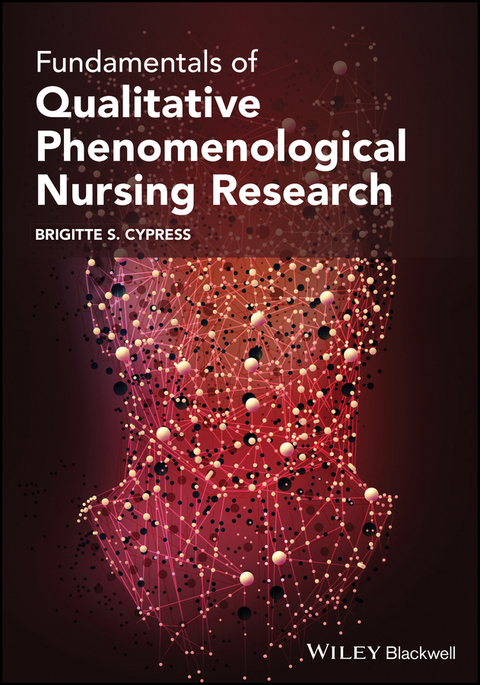
Fundamentals of Qualitative Phenomenological Nursing Research (eBook)
John Wiley & Sons (Verlag)
978-1-119-78009-0 (ISBN)
Fundamentals of Qualitative Phenomenological Nursing Research is the first book of its kind to specifically link the findings of qualitative research to evidence-based practice, policy, theory, and theory development. Designed for novice researchers, graduate students, and experienced practitioners alike, this comprehensive resource provides up-to-date coverage of research methods and techniques, the use of data analysis software, phenomenological writing and publishing, and more.
The text opens with a general introduction to qualitative research and its components, followed by detailed description of the philosophical, paradigmatic, and conceptual aspects of phenomenological inquiry. Subsequent sections address topics including the practical aspects of phenomenological investigations, the concepts of rigor and validity in qualitative studies, and the methods of phenomenological data, collection, reduction, analysis, interpretation, and presentation. Throughout the book, author Brigitte S. Cypress offers expert guidance and real-world tips regarding the challenges researchers encounter when conducting a qualitative study.
- Provides simple, straightforward descriptions of qualitative research methods with actual phenomenological examples
- Features numerous in-depth exemplars of the philosophical and paradigmatic aspects of qualitative research from the author's own studies
- Includes practical advice on teamwork, mentoring relationships, data organization, and reporting phenomenological studies
- Presents approaches for dealing with ethical issues, methods for collecting, recording, and storing data, and techniques for analyzing and interpreting findings
- Examines the role of computer-assisted qualitative data analysis software
Fundamentals of Qualitative Phenomenological Nursing Research is a must-have guide for qualitative researchers from any discipline, academics and faculty members, and undergraduate and graduate nursing students wanting to learn more about phenomenology as a research approach.
BRIGITTE S. CYPRESS, EdD, RN, CCRN, Associate Professor, Rutgers University School of Nursing, Camden, New Jersey, USA. Her clinical expertise is adult medical, surgical, neuro-surgical, and trauma intensive care. Dr. Cypress is a phenomenologist with a clinical focus in patient-family-nurse lived experiences. She has taught research for many years and has been in dissertation committees at the PhD level as a qualitative research methodologist. She is the author of The Lived ICU Experiences of Nurses, Patients and Family Members and numerous peer-reviewed journal articles.
Fundamentals of Qualitative Phenomenological Nursing Research is the first book of its kind to specifically link the findings of qualitative research to evidence-based practice, policy, theory, and theory development. Designed for novice researchers, graduate students, and experienced practitioners alike, this comprehensive resource provides up-to-date coverage of research methods and techniques, the use of data analysis software, phenomenological writing and publishing, and more. The text opens with a general introduction to qualitative research and its components, followed by detailed description of the philosophical, paradigmatic, and conceptual aspects of phenomenological inquiry. Subsequent sections address topics including the practical aspects of phenomenological investigations, the concepts of rigor and validity in qualitative studies, and the methods of phenomenological data, collection, reduction, analysis, interpretation, and presentation. Throughout the book, author Brigitte S. Cypress offers expert guidance and real-world tips regarding the challenges researchers encounter when conducting a qualitative study. Provides simple, straightforward descriptions of qualitative research methods with actual phenomenological examples Features numerous in-depth exemplars of the philosophical and paradigmatic aspects of qualitative research from the author s own studies Includes practical advice on teamwork, mentoring relationships, data organization, and reporting phenomenological studies Presents approaches for dealing with ethical issues, methods for collecting, recording, and storing data, and techniques for analyzing and interpreting findings Examines the role of computer-assisted qualitative data analysis softwareFundamentals of Qualitative Phenomenological Nursing Research is a must-have guide for qualitative researchers from any discipline, academics and faculty members, and undergraduate and graduate nursing students wanting to learn more about phenomenology as a research approach.
Brigitte S. Cypress, EdD, RN, CCRN, Associate Professor, Rutgers University School of Nursing, Camden, New Jersey, USA. Her clinical expertise is adult cardiac, medical, surgical, neuro-surgical, and trauma intensive care. Dr Cypress is a phenomenologist with a clinical focus in patient-family-nurse lived experiences. She has taught research many years and has been in dissertation committees at the PhD level as a qualitative research methodologist. She is the author of The Lived ICU Experiences of Nurses, Patients and Family Members and numerous peer-reviewed journal articles.
The textbook Fundamentals of Qualitative Phenomenological Nursing Research by Dr. Brigitte Cypress is a great resource for not only novice researchers, but also anyone who is interested in conducting phenomenological qualitative research. Phenomenological research requires expertise, and this textbook provides a systematic approach from conception to dissemination of a phenomenological qualitative research. Dr. Brigitte Cypress, who has extensive experience in conducting this phenomenological research, has written the textbook in a simple and accessible way.
Dr. Brigitte Cypress' was a professor of mine when I was studying for my PhD in Nursing at the Graduate Center City University of New York. Her passion for philosophy and phenomenological research was evident then, and it shows in her scholarly works. Her vast knowledge and expertise of phenomenological research makes her an authority in this method. Great job Dr. Cypress!
Meriam Caboral-Stevens, PhD, RN, NP-C
Associate Professor
School of Nursing
Eastern Michigan University
Dr. Brigitte Cypress is a mentor and educator to PhD students. When I embarked on using phenomenology as the philosophical approach for my dissertation, I called upon her scholarly expertise, and I am honored to have her on my committee. She is an expert when it comes to deciphering and explaining the nuances between all of the different philosophical and phenomenological paradigms, which this textbook so aptly covers.
Dr. Cypress established my foundation as a PhD student and piqued my interest in philosophy and using phenomenology to answer my research question. She was my first professor when I commenced my PhD journey at Pace University. Thank you, Dr Cypress, for all of your patience as I stumble through learning the complicated material, finding my way as a scholar, and for writing this book.
Cindy Paradiso MA, RN-BC, CNE
PhD candidate
Pace University
Adjunct Clinical Professor
Preface
Quoting the title of Wanda Pillow's writing in Merriam's (2002) book, “Looking Back to Move Forward: Reflections on How I Did Research Impacts What I Know Now,” this is how I want to start this book: to look back at how I conducted my first qualitative phenomenological research, 11 years ago – my lived experiences of it; the many years of intensive, non‐stop reading and learning; meeting with experts; networking with philosophers, phenomenologists, scholars, and researchers of qualitative research; presenting multiple times in conferences around the world; teaching and mentoring undergraduate and graduate students about research; being in dissertation committees of my PhD students; how I grew and flourished in this field and expertise – to become today a phenomenologist, qualitative researcher, scholar, and professor. I have been trained and I prepared well to write this book. Eleven years of phenomenological research: conducting inquiries, writing and applying for grants, writing and publishing consistently through the years – which is not so easy to do, and also not for everyone. The experience has been tedious, intense at times, but rewarding as well, and it becomes part of one's life. Philosophy and phenomenology are what I am passionate about.
As a professor of research at all levels for 13 years now, and as a committee member of qualitative research dissertations, I enjoy guiding and mentoring students in the long and difficult journey of conducting a qualitative inquiry. I am always honest that it is not easy, in fact rather difficult, and could consume one's life. But if it is really what a novice researcher plans for and would love to do, it is also exciting and gratifying. Starting with the hardest step of research, selecting a topic, the question is: “What will I study?” – this could take months or even years to answer, with the new researcher unable to figure out a topic. A lot of times, once a topic is thought of, the novice changes it again and again (which is also normal!). I have a renewed appreciation of the fact that I love to mentor and teach my students that to start delving into a naturalistic study, a “good” mentor is needed. It might not be the chair of the dissertation committee, but the chair can also be one. No doctoral student is fully prepared to go about the methods of a qualitative phenomenological research project, which are: writing the research proposal and getting it approved by the institutional review board (IRB); selecting a setting; obtaining ethical approval; gaining entry to the site; recruiting participants; interviewing and observing participants; writing field notes, journals, and memos; and the hard tasks of data reduction and analysis – not to forget doing the “write‐up” later, and trying to publish the findings. All are agonizing tasks! Dissertation templates and protocols are given to students, but these are not sufficient to guide them in this daunting and overwhelming project.
I have seen firsthand the “agony” and difficulty of my doctoral students through the years of being in dissertation committees, and have witnessed the work of novice qualitative researchers. As a reviewer of journals for many years, I have also seen the variations, bewilderment, and confusion with qualitative methodology and methods, especially phenomenology. I continuously see it still. It inspired me to write this book. I intend that the text will be a one‐stop resource that can be used by those planning to embark on a qualitative phenomenological study. By all means, this book is not perfect nor an exhaustive reference, but rather a simple, straightforward, and honest guide for new phenomenological researchers and experts alike. Aside from research methods per se, I include topics about the use of data analysis software, phenomenological writing and publishing (including practical tips and recommendations regarding the challenges and dilemmas in conducting phenomenological research), and effective mentoring relationships. What is unique to this book is the articulation and discussion of the outcomes of phenomenological qualitative research: linking findings to evidence‐based practice, policy, theory, and theory development, all in one resource that includes actual exemplars.
As I reflect back on how I did my first research, it does impact what I know now. The biggest flaw I continuously see in phenomenological studies is the confusion between phenomenology‐as‐philosophy (PP) and phenomenology‐as‐qualitative research (PQR). No one has discussed these two terms more eloquently than John Paley, a colleague at my group – the International Philosophy of Nursing Society (IPONS). He stated these two terms and acronyms in his 2018 book, Phenomenology as Qualitative Research: A Critical Analysis of Meaning Attribution, as he rigorously analyzed the methodological aspect of research studies in the literature using the approaches of experts and PQR methodologists like Amedeo Giorgi, Max van Manen, Jonathan Smith, Paul Flowers, and Michael Larkin. A lot of phenomenological inquiries I have read in the literature are labeled as “phenomenological” but on closer attention to the methods prove to be short of what a correct phenomenological study should be. When I say “methods,” I am referring to the philosophical stance, paradigmatic underpinnings, and approach that are evident in the application of methods of data collection, phenomenological reduction, analysis, and rigor. The debate about PP versus PQR continues to this day. More so, the criticisms by other disciplines of the nursing discipline's “faulty” use of phenomenology as a research method seem to be never‐ending and are still evident.
I cannot forget the first time I presented the findings of my first phenomenological study 10 years ago, to an audience of phenomenologists, philosophers, and scholars of qualitative research from different countries. Not that I was nervous – but I was anticipating what these experts would ask me about the study (mostly on phenomenology) and how I conducted the research. The president of the group (whom I had great respect for, and who is now deceased) stated, “Okay kiddo, let's hear it!” – and he sat in the front row. After my presentation, I was amazed that he actually said to the audience that he appreciated very much having me as the only nurse member in the group, and that he wished that more nurses would try to present in the conference in the future, or become a member of the organization. He did not ask me questions (maybe because it was my first time and he decided to cut me some slack!). In the many years that I presented in conferences after that first one, I was gradually asked respectfully the questions specific to phenomenology as a qualitative research method in nursing studies. I tried answering based on what I knew and had experienced. My answers got better after many years of learning. This is one of the ways in which I learned the right way of conducting a phenomenological study: answering the questions and applying them to my work. Other issues I have been asked about are specific to the methods.
The other big aspects of phenomenological research that are many times put into question are the never‐ending issues with rigor and the techniques of sampling, bracketing, and data saturation. My work on these aspects continues. All these steps/techniques, the biggest question on phenomenology‐as‐research, and how to conduct the research correctly – I cannot blame students and novices for stumbling at these hurdles. They are the hardest topics for me to write about in this book. One significant contributing factor is the lack of knowledge of philosophy, because philosophy is not taught, or is not included in the undergraduate and graduate (master's level) curriculum, at most nursing schools. Even at the doctorate level, there is only one philosophy course – which is labeled differently in every school (philosophy of science, philosophies of education, philosophical and theory perspectives in nursing, and many others), and taught in varied ways. One philosophy course at the doctorate level is not sufficient to equip a neophyte researcher for a qualitative phenomenological study. I only learned all the details after being exposed to my philosophy colleagues, co‐phenomenologists, and other scholars from different parts of the world. Eleven years of networking, countless discussions and consultations, presenting in conferences, being critiqued and learning from and with colleagues in seminars, including endless and continuous reading of philosophical texts – all that to reach what I know now. I am still continuously learning, and I don't intend to stop.
Philosophy and phenomenology are difficult for students and novices embarking for the first time on a journey of phenomenological study. There is no chance, I would say, that philosophy will be taught more in curriculums in the future (although there are a few schools with curriculums that are more focused on philosophy, and even phenomenology). Thus, a novice or graduate student has to be interested, motivated, and passionate, learn on their own, read a whole lot, try to understand and apply the knowledge gained to the endeavor – but guidance is needed. This is where a “good” mentor comes in. I would hope that the mentor first has a background in conducting qualitative studies as a whole, and more importantly, has some knowledge of philosophy and phenomenology. As we...
| Erscheint lt. Verlag | 20.9.2021 |
|---|---|
| Sprache | englisch |
| Themenwelt | Medizin / Pharmazie ► Pflege |
| Schlagworte | Forschung im Gesundheitswesen • Gesundheits- u. Sozialwesen • Gesundheitswesen • Health & Social Care • health care research • Krankenpflege • Krankenpflegeforschung • nursing • Nursing Research • phenomenological nursing research • phenomenological nursing research guide • phenomenology guide • qualitative nursing research • qualitative nursing research methods • qualitative nursing research techniques • qualitative nursing research textbook |
| ISBN-10 | 1-119-78009-8 / 1119780098 |
| ISBN-13 | 978-1-119-78009-0 / 9781119780090 |
| Informationen gemäß Produktsicherheitsverordnung (GPSR) | |
| Haben Sie eine Frage zum Produkt? |
 EPUB (Adobe DRM)
Kopierschutz: Adobe-DRM
Adobe-DRM ist ein Kopierschutz, der das eBook vor Mißbrauch schützen soll. Dabei wird das eBook bereits beim Download auf Ihre persönliche Adobe-ID autorisiert. Lesen können Sie das eBook dann nur auf den Geräten, welche ebenfalls auf Ihre Adobe-ID registriert sind.
Details zum Adobe-DRM
Dateiformat: EPUB (Electronic Publication)
EPUB ist ein offener Standard für eBooks und eignet sich besonders zur Darstellung von Belletristik und Sachbüchern. Der Fließtext wird dynamisch an die Display- und Schriftgröße angepasst. Auch für mobile Lesegeräte ist EPUB daher gut geeignet.
Systemvoraussetzungen:
PC/Mac: Mit einem PC oder Mac können Sie dieses eBook lesen. Sie benötigen eine
eReader: Dieses eBook kann mit (fast) allen eBook-Readern gelesen werden. Mit dem amazon-Kindle ist es aber nicht kompatibel.
Smartphone/Tablet: Egal ob Apple oder Android, dieses eBook können Sie lesen. Sie benötigen eine
Geräteliste und zusätzliche Hinweise
Buying eBooks from abroad
For tax law reasons we can sell eBooks just within Germany and Switzerland. Regrettably we cannot fulfill eBook-orders from other countries.
aus dem Bereich