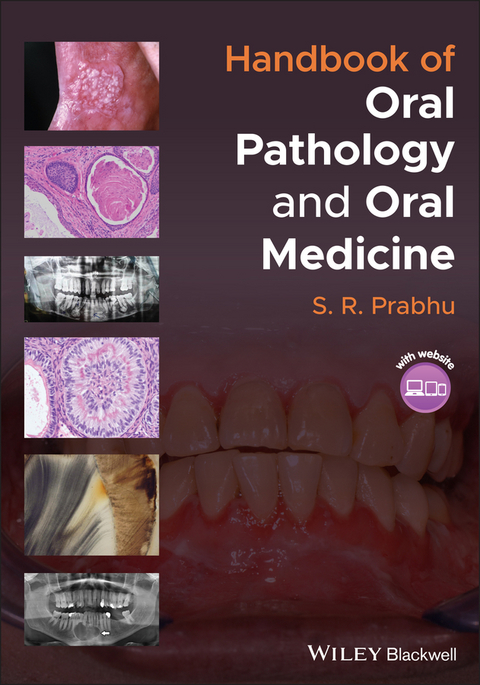
Handbook of Oral Pathology and Oral Medicine (eBook)
496 Seiten
Wiley-Blackwell (Verlag)
978-1-119-78115-8 (ISBN)
Discover a concise overview of the most common oral diseases in a reader-friendly book
Handbook of Oral Pathology and Oral Medicine delivers a succinct overview of a range of oral diseases. The book contains up-to-date evidence-based information organized by clinical topic and supported by over 300 clinical, radiological, and microscopic images. Each chapter includes topics following universally respected curricula of oral pathology and oral medicine.
Divided into seven parts, it covers core topics such as pathology of teeth, pulp, and supporting structures, pathology of jawbones, pathology of the oral mucosa, pathology of the salivary glands, clinical presentation of mucosal disease, orofacial pain, and miscellaneous topics of clinical relevance.
Written for undergraduate dental students, dental hygienists and oral health therapists, Handbook of Oral Pathology and Oral Medicine is an ideal quick reference and is also useful to dental educators and practitioners.
S.R. PRABHU is Honorary Associate Professor of Oral Medicine at the School of Dentistry at the University of Queensland in Brisbane, Australia. He is a Fellow of Dental Faculty of all four United Kingdom and Ireland based Royal Surgical Colleges. He has taught oral pathology and oral medicine in a number of dental schools internationally, and has authored numerous book chapters, papers and reviews, and edited books.
S.R. PRABHU is Honorary Associate Professor of Oral Medicine at the School of Dentistry at the University of Queensland in Brisbane, Australia. He is a Fellow of Dental Faculty of all four United Kingdom and Ireland based Royal Surgical Colleges. He has taught oral pathology and oral medicine in a number of dental schools internationally, and has authored numerous book chapters, papers and reviews, and edited books.
Nomenclature Used in The Study of Human Disease
Nomenclature of diseases:
- Disease: impairment of normal physiological function affecting all or part of an organism manifested by signs and symptoms.
- Disorder: deviation from the usual way the body functions.
- Condition: an abnormal state of health that interferes with the usual activities or feeling of wellbeing.
- Risk factor: something that increases a person's chances of developing a disease.
- Aetiology: the study of the underlying cause of the disease/disorder.
- Pathogenesis: the development and chain of events leading to a disease.
- Epidemiology: a branch of medical science that deals with the incidence, distribution, and control of disease in a population.
- Incidence: the measure of the probability of occurrence of new cases of a disease over a certain period.
- Prevalence: total number of individuals in a population who have a disease or health condition at a specific period, usually expressed as a percentage of the population.
- Prognosis: prediction of the likely course and outcome of a disease.
- Morbidity: the extent to which a patient’s overall health is affected by a disease.
- Mortality: the likelihood of death from a particular disease.
- Acute and chronic illnesses:
- Acute illnesses are of rapid onset.
- Chronic conditions usually have a gradual onset and are more likely to have a prolonged course.
- Syndrome refers to a collection or set of signs and symptoms that characterize or suggest a particular disease.
Clinical nomenclature of oral mucosal lesions:
- Lesion: clinically detectable surface changes in the skin or mucous membranes can be termed ‘lesions’. They include the following:
- Macule: a macule is a change in surface colour, without elevation or depression and therefore nonpalpable, well‐ or ill‐defined, but generally considered less than 1.5 cm in diameter at the widest point.
- Patch: a patch is a large macule equal to or greater than 1.5 cm across. Patches may have some subtle surface change, such as a fine scale or wrinkling but although the consistency of the surface is changed, the lesion itself is not palpable.
- Papule: a papule is a circumscribed, solid, palpable elevation of skin/mucous membrane with no visible fluid, varying in size from a pinhead to less than 1.5 cm in diameter at the widest point.
- Plaque: a plaque is a broad, flat‐topped papule, or confluence of papules, equal to or greater than 1.5 cm in diameter, or alternatively as an elevated, plateau‐like lesion that is often greater in its diameter than in its depth.
- Nodule: a nodule is morphologically similar to a papule and is a palpable spherical lesion in all three directions: length, width, and depth. A nodule is usually a solid lesion of 1.5 cm or less in diameter. It may be sessile (attached directly by the base) or pedunculated (attached by a peduncle – a stem).
- Tumour: similar to a nodule but larger than 1.5 cm in diameter.
- Vesicle: a vesicle is a small blister; a circumscribed, fluid‐filled, epithelial elevation generally less than 1.5 cm in diameter at the widest point. The fluid is a clear serous fluid.
- Bulla: a bulla is a large, rounded or irregularly shaped blister of the skin or mucous membrane containing serous or seropurulent fluid. Bullae are greater than 1.5 cm in diameter.
- Pustule: a pustule is a small elevation of the skin or mucous membrane containing cloudy or purulent material (pus) usually consisting of necrotic inflammatory cells. When haemorrhagic, the colour of the pustule may be red or blue.
- Cyst: a cyst is an epithelial‐lined pathological cavity containing liquid, semisolid, or solid material.
- Pseudocyst: a cyst‐like lesion that is not lined by epithelium.
- Fissure: a fissure is a crack in the skin or mucous membrane that is usually narrow and deep.
- Erosion: an erosion is a lesion that lacks the full thickness of the overlying epithelium and is moist, circumscribed, and usually depressed.
- Ulcer: an ulcer is a discontinuity of the skin or mucous membrane exhibiting complete loss of the epidermis or epithelium, with some amount of destruction of the subepithelial connective tissue.
- Telangiectasia: a telangiectasia represents an enlargement of superficial blood vessels in the skin or mucous membrane to the point of being visible.
- Scale: a skin lesion that consists of dry or greasy laminated masses of keratin.
- Crust: a skin lesion that is dried sebum, pus, or blood, usually mixed with epithelial and sometimes bacterial debris. Can occur on the vermilion as well.
- Lichenification: epidermal thickening of the skin characterized by visible and palpable thickening with accentuated skin markings.
- Excoriation: a punctate or linear abrasion of the skin produced by mechanical means (often scratching), usually involving only the epidermis, but commonly reaching the papillary dermis.
- Induration: dermal or mucosal thickening causing the cutaneous or mucosal surface to feel thicker and firmer.
- Atrophy: a loss of epithelial or submucous tissue. With epithelial atrophy, the mucous membrane appears thin, translucent, and wrinkled. Atrophy should be differentiated from erosion.
- Maceration: in maceration, the skin softens and turns white, due to being consistently wet.
- Umbilication: formation of a depression at the top of a papule, vesicle, or pustule.
- Rash: presence of multiple non‐vesicular skin eruptions.
- Sinus/fistula: a sinus or fistula is a tract connecting cavities to each other or to the surface.
- Sessile lesion: a lesion attached to the underlying tissues with a broad base.
- Pedunculated lesion: a lesion attached to the underlying tissues with a narrow base, such as a stalk or pedicle.
- Serpiginous lesion: a lesion with a wavy border.
- Discoid lesion: a round or disc‐shaped lesion.
- Annular or circinate lesion: a ring‐shaped lesion.
- Herpetiform lesions: lesions resembling those of herpes.
- Reticular or reticulated lesion: a lesion resembling a net or lace.
- Verrucous lesion: a wart‐like lesion.
- Stellate lesion: a star‐shaped lesion.
- Target lesion or ‘bull’s eye lesion: named for its resemblance to the bullseye of a shooting target. Also referred to as an ‘iris’ lesion.
- Purpura: haemorrhage into the surface of the skin or mucous membrane. Purpura measure 3–10 mm whereas petechiae measure less than 3 mm, and ecchymoses greater than 10 mm. The appearance of an individual area of purpura varies with the duration of the lesions. Early purpura is red and becomes darker, purple, and brown, yellow as it fades. Purpuric spots do not blanch on pressure.
- Petechiae: petechiae are small sharply outlined and slightly elevated red‐ or purple‐coloured purpuric macules of about 1–3 mm in diameter. They contain extravasated blood.
- Ecchymoses: ecchymoses are larger purpuric lesions that are macular and deeper in origin than petechiae. They are to be distinguished from hematoma caused by extravasation of blood.
- Hematoma: a localized swelling that is filled with blood caused by a break in the wall of a blood vessel.
- Hamartoma: a benign (non‐neoplastic) tumour‐like growth consisting of a disorganized mixture of cells and tissues normally found in the body where the growth occurs.
- Epulis: a nonspecific exophytic gingival mass.
Histological nomenclature of oral mucosal lesions:
- Hyperplasia: an increase in the amount of organic tissue that results from cell proliferation.
- Parakeratosis: a mode of keratinization characterized by the retention of nuclei in the stratum corneum.
- Hyperkeratosis: thickening of the stratum corneum associated with the presence of an abnormal quantity of keratin.
- Orthokeratosis: hyperkeratosis without parakeratosis. No nucleus is seen in the cells as in the normal epidermis (skin) or epithelium (mucous membrane).
- Acanthosis: a benign abnormal thickening (hyperplasia) of the stratum spinosum, or prickle cell layer of the epidermis (skin) or epithelium (mucous membrane).
- Acantholysis: the loss of intercellular connections (desmosomes), resulting in loss of cohesion between keratinocytes in the skin or mucous membrane.
- Spongiosis: intercellular oedema (abnormal accumulation of fluid) in the epidermis in the skin or the epithelium in the mucous membrane.
- Dyskeratosis: abnormal keratinization occurring prematurely within individual cells or groups of cells below the stratum granulosum.
- Vacuolization: the formation of vacuoles within or adjacent to cells and often confined to the basal cell‐basement membrane zone area.
- Cellular or epithelial dysplasia: an epithelial anomaly of growth and differentiation often...
| Erscheint lt. Verlag | 10.8.2021 |
|---|---|
| Sprache | englisch |
| Themenwelt | Medizin / Pharmazie ► Gesundheitsfachberufe |
| Medizin / Pharmazie ► Medizinische Fachgebiete | |
| Medizin / Pharmazie ► Zahnmedizin | |
| Schlagworte | dentistry • <p>Oral pathology textbook • Mucosal lesions • Mundheilkunde • Mundheilkunde / Biologie • Oral Biology • oral manifestations of systemic disease • oral medicine handbook • oral medicine textbook • oral mucosa pathology • Oralpathologie • Oral Pathology • oral pathology handbook • Orofacial Pain • Salivary Gland Pathology • tooth pathology</p> • Zahnmedizin |
| ISBN-10 | 1-119-78115-9 / 1119781159 |
| ISBN-13 | 978-1-119-78115-8 / 9781119781158 |
| Informationen gemäß Produktsicherheitsverordnung (GPSR) | |
| Haben Sie eine Frage zum Produkt? |
 EPUB (Adobe DRM)
Kopierschutz: Adobe-DRM
Adobe-DRM ist ein Kopierschutz, der das eBook vor Mißbrauch schützen soll. Dabei wird das eBook bereits beim Download auf Ihre persönliche Adobe-ID autorisiert. Lesen können Sie das eBook dann nur auf den Geräten, welche ebenfalls auf Ihre Adobe-ID registriert sind.
Details zum Adobe-DRM
Dateiformat: EPUB (Electronic Publication)
EPUB ist ein offener Standard für eBooks und eignet sich besonders zur Darstellung von Belletristik und Sachbüchern. Der Fließtext wird dynamisch an die Display- und Schriftgröße angepasst. Auch für mobile Lesegeräte ist EPUB daher gut geeignet.
Systemvoraussetzungen:
PC/Mac: Mit einem PC oder Mac können Sie dieses eBook lesen. Sie benötigen eine
eReader: Dieses eBook kann mit (fast) allen eBook-Readern gelesen werden. Mit dem amazon-Kindle ist es aber nicht kompatibel.
Smartphone/Tablet: Egal ob Apple oder Android, dieses eBook können Sie lesen. Sie benötigen eine
Geräteliste und zusätzliche Hinweise
Buying eBooks from abroad
For tax law reasons we can sell eBooks just within Germany and Switzerland. Regrettably we cannot fulfill eBook-orders from other countries.
aus dem Bereich