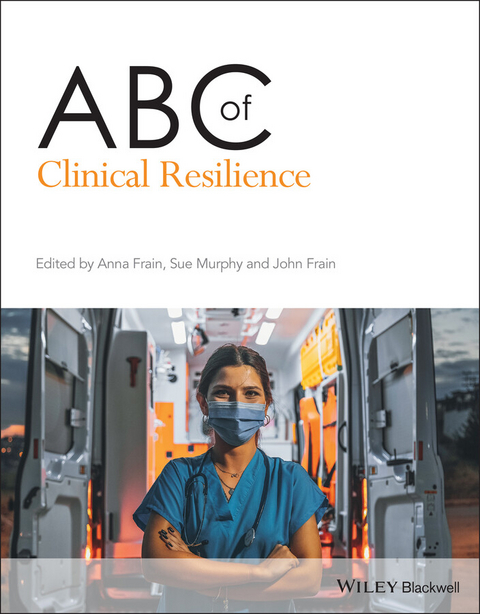
ABC of Clinical Resilience (eBook)
John Wiley & Sons (Verlag)
978-1-119-69344-4 (ISBN)
Professional burnout remains a constant and increasing concern. With ABC of Clinical Resilience, you'll learn how to connect with those impulses that motivated you to become a healthcare professional in the first place. You'll rediscover that 'joy of practice' that nourishes and replenishes your energy even as you do the hard work of caring for your patients, and practice the self-care necessary to maintain a positive and consistently productive outlook.
ABC of Clinical Resilience delivers a concise and perceptive treatment of what it means to be a resilient healthcare professional. The book describes the concept of resilience and how organisations and healthcare teams can use intelligent kindness to help their team members maintain their efficacy and avoid burnout in the long term.
Readers will also benefit from the inclusion of:
A thorough introduction to the concept of resilience and why it's important at this moment in time in the healthcare profession
- An exploration of the emotional impact of working in healthcare
- Practical discussions of resilience and how it affects cognitive performance, as well as organisational kindness and the teaching of resilience and compassion
- Treatments of self-care, the physiology of resilience and well-being, and an examination of intelligent kindness in healthcare teams
Perfect for healthcare professionals, especially mental healthcare professionals, ABC of Clinical Resilience will also earn a place in the libraries of professionals who treat healthcare workers and readers interested in the psychology and prevention of burnout, vicarious trauma, and compassion fatigue.
Anna Frain, Programme Director Derby GP Training Scheme; GP Teaching Fellow, Division of Medical Sciences & Graduate Entry Medicine, University of Nottingham, UK.
Sue Murphy, Head, Department of Physical Therapy, Faculty of Medicine, University of British Columbia, Vancouver, Canada.
John Frain, Clinical Associate Professor and Director of Clinical Skills, Division of Medical Sciences & Graduate Entry Medicine, University of Nottingham, UK.
ABC of Clinical Resilience ABC of Clinical ResilienceFor the healthcare professional, clinical resilience is about reconnecting with those stirrings which first motivated us to spend a career in the service of others. It is about recovering and maintaining the ???joy of practice??? which nourishes and satisfies our curiosity about the uniqueness of every person in our care. Being a resilient practitioner is essential for our personal wellbeing and also for the safety of our patients, who depend on our ability to optimise our physical and cognitive performance. Yet many healthcare professionals report experiencing burnout. ABC of Clinical Resilience summarises current evidence on how cognitive performance and wellbeing of healthcare professionals are affected by the emotional context of providing care and the organisational culture of working environments. As well as considering impacts of individuals and teams, we also consider how resilience can be recovered for the benefit of everyone. Topics include: The emotional impact of working in healthcare Resilience and cognitive performance Practicing self-care The physiology of resilience Intelligent kindness Kindness in teams Resilience in practice Organisational kindness Teaching resilience Perfect for both novice and experienced healthcare professionals, including those working in mental health, ABC of Clinical Resilience will also earn a place in the libraries of professionals who treat healthcare workers and readers interested in the psychology and prevention of burnout, vicarious trauma, and moral injury. About the ABC series The ABC series has been designed to help you access information quickly and deliver the best patient care, and remains an essential reference tool for GPs, junior doctors, medical students and healthcare professionals. Now offering over 80 titles, this extensive series provides you with a quick and dependable reference on a range of topics in all the major specialties. The ABC series is the essential and dependable source of up-to-date information for all practitioners and students in primary healthcare. To receive automatic updates on books and journals in your specialty, join our email list. Sign up today at www.wiley.com/email
Anna Frain, Programme Director Derby GP Training Scheme; GP Teaching Fellow, Division of Medical Sciences & Graduate Entry Medicine, University of Nottingham, UK. Sue Murphy, Head, Department of Physical Therapy, Faculty of Medicine, University of British Columbia, Vancouver, Canada. John Frain, Clinical Associate Professor and Director of Clinical Skills, Division of Medical Sciences & Graduate Entry Medicine, University of Nottingham, UK.
Contributors
Preface
1. Why resilience? Why now?
2. Emotional impact of working in healthcare
3. Resilience and cognitive performance
4. Practising self-care
5. The physiology of resilience and wellbeing
6. Intelligent kindness
7. Kindness in healthcare teams
8. Organisation kindness
9. Resilience and intelligent kindness in practice
10. Can we really teach resilience, intelligent kindness and compassion?
Recommended Books, Articles and Websites
Index
CHAPTER 1
Why resilience? Why now?
Anna Frain1, Sue Murphy2, and John Frain3
1 University of Nottingham, Graduate Entry Medical School, Derby Speciality Training Programme for General Practice, Nottingham, UK
2 Faculty of Medicine, Department of Physical Therapy, University of British Columbia, Vancouver Campus, Canada
3 Division of Medical Sciences and Graduate Entry Medicine, University of Nottingham, UK
OVERVIEW
- Those entering healthcare professions are motivated by the potential ‘joy of practice’.
- Healthcare practitioners are being harmed by the impact of the systems in which they work.
- Burnout is an occupational hazard for all healthcare workers and increases the risks of both major and minor errors in caring for patients.
- Equality and inclusion in healthcare are not only morally right but enables all to fulfil their potential to improve patient outcomes and maintain practitioner well‐being.
- The Covid‐19 pandemic has brought into sharper focus the impact and current challenges of the working environment upon healthcare workers.
- Organisations have a duty of care to protect patient safety by supporting healthcare workers with intelligent kindness.
Introduction
Healthcare workers are human beings trying to help other human beings. This invariably leads to a discussion of human frailty and shortcomings. Yet, the skills and abilities of practitioners are awesome, and we often have an insufficient sense of awe regarding them – to listen and to understand the effects of suffering on patients, to use our senses to examine and to diagnose, to provide comfort and support, to restore to health, to witness both the greatest joys in patients’ lives as well as their darkest moments. Undoubtedly, this work requires the full use of our talents and is rewarded by the joy of practice.
Alongside this, advances in treatments across the multidisciplinary spectrum of healthcare in the past century enables us to do more and achieve more for patients and to genuinely feel we are making a difference to peoples’ lives. Those entering healthcare training should be confident they are entering an occupation at the cutting edge of human endeavour and characterised by the sense of the well‐being and resilience of those working in it.
Yet, the reality for many practitioners is very different. Confronted by the uncertainties and ambiguities of practice as well as the stresses of the healthcare environment, new entrants to the professions show increased reluctance to undertake specialty training, deciding to take career breaks or leave the profession completely (Figure 1.1). This established problem is so significant and widespread that it must be considered to genuinely threaten the future sustainability of modern healthcare. Resilience implies an ability to ‘bounce back’, to regain our well‐being after a distorting experience. The data suggests we are not bouncing back as well as perhaps we once did. This is impacting patient care and providing immeasurable harm to healthcare providers.
‘First, do no harm’
For UK healthcare professions, the past decade is bookended by two events. First, a private citizen’s Freedom of Information request in 2012 led to the publication of an internal review by the General Medical Council (GMC) which revealed that, during the 2005–2013 period, 28 doctors had committed suicide whilst undergoing the GMC’s fitness‐to‐practice (FTP) investigations (Horsfall, 2014). Casey and Choong argued that these deaths were preventable and the GMC has a duty of care towards doctors under investigation (Casey and Choong, 2016) (Box 1.1).
Practitioner suicide and distress is not unique to the UK, nor is it confined to doctors (Hofmann, 2018). Nonetheless, these healthcare professionals likely entered training with the same aspirations and hopes as their peers. In their deaths, they left behind people who loved and needed them. A healthcare culture which seemingly leaves people viewing suicide as their only alternative should concern us all – as John Dunne said, ‘Any man's death diminishes me, because I am involved in Mankind’.
Second, the initial phase in the UK of the Covid‐19 pandemic was characterised by shortages of personal protective equipment (PPE), with the result that staff felt they were being required either to place themselves at risk without adequate protection, or to decline to care for patients and risk disciplinary action. This impression of a lack of concern for healthcare staff reached its apotheosis when a prominent UK politician suggested that shortages of PPE were occurring due to wasteful usage by healthcare staff (see Chapter 6). Subsequently, reports emerged of higher‐risk staff feeling unable to request the PPE to which they were entitled.
Figure 1.1 Change in reason for leaving given by staff (for voluntary resignations), 2011–2012 to 2018–2019 (Index at 2011/2012 = 100).
Source: The Health Foundation (2019). © 2019, The Health Foundation.
On a more mundane level, healthcare staff report day‐to‐day shortages in their work in terms of access to food, rest breaks and adequate on‐call facilities, such that these provisions are not in step with employment law (GMC, 2019). Even a cursory look at Maslow’s triangle (Chapter 3) suggests that meeting a practitioner’s basic psychological and physical needs is required to safeguard and provide support for the high‐level problem‐solving necessary in clinical decision‐making; it is unlikely that depriving people of food, drink and adequate rest improves patient safety. When we consider clinical resilience, it is important that we do not impose on practitioners yet another burden of fearing failure. Rather, it is about enabling clinicians to optimise their cognitive performance, be the best they can be and recover the joy of practice. In this, organisations have a particular responsibility (Chapter 8). With resilience, our recurring theme is kindness. Kind health systems and organisations will more greatly facilitate the potential of their teams and the safety of patients.
Box 1.1 Suicide whilst under GMC's fitness to practise investigation: were those deaths preventable?
In their review of suicides whilst under the GMC’s FTP procedures, Casey and Choong argued that the GMC has a duty of care towards its members and that these suicides were preventable. Coroners were also identified as having a duty to report these suicides as preventable to the GMC. However, Casey and Choong could not identify that these deaths had been reported in line with established legislation. They also commented: ‘The high prevalence of suicide among physicians in general should not obscure the fact that suicide whilst under the GMC's FTP investigations is sufficiently unique and deserves special attention. It is thereby a matter of profound regret that it had to take a random FOI request by an independent party to eventually highlight just how serious and extensive the problem is. That FTP investigation has never, prior to that, been isolated and identified as a distinct risk factor for physician suicide meant that practically nothing has been done to avert such deaths’.
Source: Based on Casey and Choong (2016).
Increasing patient expectations, complaints and litigation
Zuzsanna Jakab (WHO) emphasises that peoples’ expectations of healthcare have changed, and that they wish for greater involvement in their healthcare, including in making decisions about treatment (Jakab, 2011). However, many health inequalities still exist and indicate a need for patient empowerment. Patients may not have the material, educational or political means to access health, now considered a basic human right.
Increasing patient expectations has led to an increasing number of complaints and litigation. In UK Primary Care, patients’ written complaints about care increased by 4058 (4.5%) – from 90579 in 2016–2017 to 94637 (NHS Digital. Data on written complaints in the NHS, 2017–2018). In terms of impact on all parties, this is not sustainable. Where practitioners are unable to cope with understandable negative feelings of shock, burnout and anger following a complaint, there is a risk of post‐traumatic stress disorder (PTSD), leading to their being described as a ‘second victim’ of the event (Chapter 4).
Maintaining resilience is challenging where a practitioner works in an organisation in which they feel undervalued and which appears to favour a culture of punishment rather than one of learning. Bourne found that complaints not only seriously impact doctors’ psychological well‐being but are also associated with defensive practice (Bourne et al., 2016). This has a detrimental effect on patient care. Resolution of complaints and significant event analysis is essential for patient safety and service improvement. However, investigation procedures require transparency and timeliness to actually facilitate patient safety and practitioner resilience. A more resilient approach by practitioners to receiving complaints and their role in learning may then be possible to ensure better patient care.
...| Erscheint lt. Verlag | 19.5.2021 |
|---|---|
| Reihe/Serie | ABC Series |
| ABC Series | ABC Series |
| Sprache | englisch |
| Themenwelt | Medizin / Pharmazie ► Allgemeines / Lexika |
| Medizin / Pharmazie ► Medizinische Fachgebiete | |
| Medizin / Pharmazie ► Pflege | |
| Medizin / Pharmazie ► Studium | |
| Schlagworte | Ausbildung • Ausbildung u. Perspektiven i. d. Krankenpflege • Berufe u. Ausbildung im Gesundheitswesen • Burnout • compassion burnout • compassion in healthcare • Gesundheits- u. Sozialwesen • Health & Social Care • healthcare burnout • Health Care Professional Development & Education • healthcare trauma • healthcare worker wellbeing • kindness in healthcare • Krankenpflege • <p>Compassion fatigue • Medical Professional Development • Medical Science • Medizin • moral injury • nursing • Nursing Education & Professional Development • Perspektiven in medizinischen Berufen • physiology of resilience • Professional Burnout • resilience and cognition</p> • Resilience in Healthcare • Resilienz • vicarious trauma |
| ISBN-10 | 1-119-69344-6 / 1119693446 |
| ISBN-13 | 978-1-119-69344-4 / 9781119693444 |
| Informationen gemäß Produktsicherheitsverordnung (GPSR) | |
| Haben Sie eine Frage zum Produkt? |
 EPUB (Adobe DRM)
Kopierschutz: Adobe-DRM
Adobe-DRM ist ein Kopierschutz, der das eBook vor Mißbrauch schützen soll. Dabei wird das eBook bereits beim Download auf Ihre persönliche Adobe-ID autorisiert. Lesen können Sie das eBook dann nur auf den Geräten, welche ebenfalls auf Ihre Adobe-ID registriert sind.
Details zum Adobe-DRM
Dateiformat: EPUB (Electronic Publication)
EPUB ist ein offener Standard für eBooks und eignet sich besonders zur Darstellung von Belletristik und Sachbüchern. Der Fließtext wird dynamisch an die Display- und Schriftgröße angepasst. Auch für mobile Lesegeräte ist EPUB daher gut geeignet.
Systemvoraussetzungen:
PC/Mac: Mit einem PC oder Mac können Sie dieses eBook lesen. Sie benötigen eine
eReader: Dieses eBook kann mit (fast) allen eBook-Readern gelesen werden. Mit dem amazon-Kindle ist es aber nicht kompatibel.
Smartphone/Tablet: Egal ob Apple oder Android, dieses eBook können Sie lesen. Sie benötigen eine
Geräteliste und zusätzliche Hinweise
Buying eBooks from abroad
For tax law reasons we can sell eBooks just within Germany and Switzerland. Regrettably we cannot fulfill eBook-orders from other countries.
aus dem Bereich