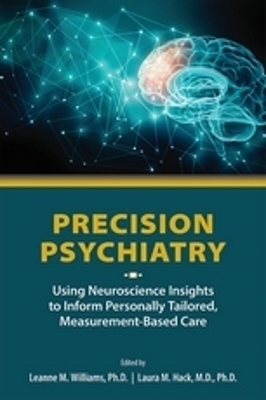
Precision Psychiatry
American Psychiatric Association Publishing (Verlag)
978-1-61537-158-7 (ISBN)
What if the principles of precision medicine already at work in fields such as cardiology, oncology, and infectious disease—where biomarkers are combined with clinical features to tailor treatments to specific patients—were applied to psychiatry?
It's a bold path forward, and one that Precision Psychiatry presents exhaustively. More than three dozen experts in areas of expertise ranging from neuroimaging, neurocognition, and pharmacotherapy to behavioral science and machine learning illustrate the push to develop biomarkers and algorithms that will identify subtypes of patients that may be underserved by conventional psychiatric therapies.
Throughout the book, numerous case examples apply the principles of precision psychiatry to a spectrum of mood and anxiety disorders, as well as schizophrenia.
Whether they are educators, trainees, or clinicians, readers will find the latest research in precise classification, treatment planning, and early identification in these pages, and a vision of a future where a one-size-fits-all approach gives way to tailored treatment based on integrating the scientific foundations of psychiatry with recent advances in the neurosciences, data sciences, and technology.
Leanne M. Williams, Ph.D., is Professor and Associate Chair of Translational Neuroscience and Director of the Precision Psychiatry and Translational Neuroscience Lab (PanLab) in the Stanford Department of Psychiatry and Behavioral Sciences; Director of the Stanford Center for Precision Mental Health and Wellness at Stanford University School of Medicine; and Director of Precision Medicine at the Department of Veterans Affairs, Sierra-Pacific MIRECC, California. Laura M. Hack, M.D., Ph.D., is a Postdoctoral Fellow, Advanced Fellowship in Mental Illness Research and Treatment, in the Palo Alto Veterans Affairs Health Care System, Sierra-Pacific MIRECC; and Clinical Instructor and Director of the Translational Precision Mental Health Clinic in the Department of Psychiatry and Behavioral Sciences at Stanford University School of Medicine in Stanford, California.
Foreword
Preface
Introduction
Part 1: Neuroimaging of Circuits
Chapter 1. A Neural Circuit-Informed Taxonomy for Precision Psychiatry
Chapter 2. The Future of Precision TMS in Psychiatry
Chapter 3. Neural Mechanisms of Bipolar Disorder
Part 2: Neurocognition, Neurophysiology, and Behavior
Chapter 4. Information Processing Impairments as Transdiagnostic Treatment Targets
Chapter 5. State-Sensitive Vision Science-Based Markers in People with Schizophrenia
Part 3: Blood Markers
Chapter 6. Using Inflammatory Biomarkers to Identify Transdiagnostic SubtypesChaprter 7. Pharmacogenetic Testing
Part 4: Translational Neurobiological Approaches
Chapter 8. Treatment Prediction Biomarkers for Major Depression
Chapter 9.Translational Neurobiological Approaches to Precision Medicine
Part 5: New Approaches and Computational Models That Bridge Neuroscience Insights and Clinical Application
Chapter 10. Latent Variable-Based Predictive and Explanatory Disease Models
Chapter 11. Computational Cognitive Methods for Precision Psychiatry
Chapter 12. Toward Precision CBT via Reinforcement Learning Theory
Part 6: Developing the Academic Discipline of Precision Psychiatry
Chapter 13. Moving from Precision to Personalized Psychiatry: Clinical Perspectives
Chapter 14. Preparing for the Future of Precision Psychiatry
Index
| Erscheinungsdatum | 15.12.2021 |
|---|---|
| Zusatzinfo | 2 charts, 18 figures, 8 tables, 8 colour plates |
| Verlagsort | VA |
| Sprache | englisch |
| Maße | 152 x 228 mm |
| Gewicht | 502 g |
| Themenwelt | Medizin / Pharmazie ► Medizinische Fachgebiete ► Psychiatrie / Psychotherapie |
| ISBN-10 | 1-61537-158-3 / 1615371583 |
| ISBN-13 | 978-1-61537-158-7 / 9781615371587 |
| Zustand | Neuware |
| Informationen gemäß Produktsicherheitsverordnung (GPSR) | |
| Haben Sie eine Frage zum Produkt? |
aus dem Bereich