


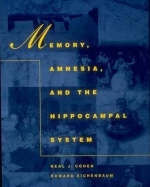
Memory, Amnesia, and the Hippocampal System
Seiten
1995
MIT Press (Verlag)
9780262531320 (ISBN)
MIT Press (Verlag)
9780262531320 (ISBN)
- Titel ist leider vergriffen;
keine Neuauflage - Artikel merken
This work offers a cognitive neuroscience theory of memory that accounts for memory impairment shown in human and animal models of amnesia. It specifies the functional role played by the hippocampal system in memory, and aims to provide further understanding of the componential structure of memory.
In this sweeping synthesis, Neal J. Cohen and Howard Eichenbaum bring together converging findings from neuropsychology, neuroscience, and cognitive science that provide the critical clues and constraints for developing a more comprehensive understanding of memory. Specifically, they offer a cognitive neuroscience theory of memory that accounts for the nature of memory impairment exhibited in human amnesia and animal models of amnesia, that specifies the functional role played by the hippocampal system in memory, and that provides further understanding of the componential structure of memory.The authors' central thesis is that the hippocampal system mediates a capacity for declarative memory, the kind of memory that in humans supports conscious recollection and the explicit and flexible expression of memories. They argue that this capacity emerges from a representation of critical relations among items in memory, and that such a relational representation supports the ability to make inferences and generalizations from memory, and to manipulate and flexibly express memory in countless ways. In articulating such a description of the fundamental nature of declarative representation and of the mnemonic capabilities to which it gives rise, the authors' theory constitutes a major extension and elaboration of the earlier procedural-declarative account of memory.Support for this view is taken from a variety of experimental studies of amnesia in humans, nonhuman primates, and rodents. Additional support is drawn from observations concerning the neuroanatomy and neurophysiology of the hippocampal system. The data taken from divergent literatures are shown to converge on the central theme of hippocampal involvement in declarative memory across species and across behavioral paradigms.
In this sweeping synthesis, Neal J. Cohen and Howard Eichenbaum bring together converging findings from neuropsychology, neuroscience, and cognitive science that provide the critical clues and constraints for developing a more comprehensive understanding of memory. Specifically, they offer a cognitive neuroscience theory of memory that accounts for the nature of memory impairment exhibited in human amnesia and animal models of amnesia, that specifies the functional role played by the hippocampal system in memory, and that provides further understanding of the componential structure of memory.The authors' central thesis is that the hippocampal system mediates a capacity for declarative memory, the kind of memory that in humans supports conscious recollection and the explicit and flexible expression of memories. They argue that this capacity emerges from a representation of critical relations among items in memory, and that such a relational representation supports the ability to make inferences and generalizations from memory, and to manipulate and flexibly express memory in countless ways. In articulating such a description of the fundamental nature of declarative representation and of the mnemonic capabilities to which it gives rise, the authors' theory constitutes a major extension and elaboration of the earlier procedural-declarative account of memory.Support for this view is taken from a variety of experimental studies of amnesia in humans, nonhuman primates, and rodents. Additional support is drawn from observations concerning the neuroanatomy and neurophysiology of the hippocampal system. The data taken from divergent literatures are shown to converge on the central theme of hippocampal involvement in declarative memory across species and across behavioral paradigms.
Neal J. Cohen is Assistant Professor in the Amnesia Research Laboratory at Beckman Institute for Advanced Science and Technology, and in the Department of Psychology at the University of Illinois. Howard Eichenbaum is Professor of Biological Sciences at Wellesley College.
| Reihe/Serie | A Bradford Book |
|---|---|
| Verlagsort | Cambridge, Mass. |
| Sprache | englisch |
| Maße | 178 x 229 mm |
| Gewicht | 590 g |
| Themenwelt | Geisteswissenschaften ► Psychologie ► Allgemeine Psychologie |
| Geisteswissenschaften ► Psychologie ► Biopsychologie / Neurowissenschaften | |
| Geisteswissenschaften ► Psychologie ► Klinische Psychologie | |
| Geisteswissenschaften ► Psychologie ► Verhaltenstherapie | |
| Medizin / Pharmazie ► Medizinische Fachgebiete ► Neurologie | |
| ISBN-13 | 9780262531320 / 9780262531320 |
| Zustand | Neuware |
| Informationen gemäß Produktsicherheitsverordnung (GPSR) | |
| Haben Sie eine Frage zum Produkt? |
Mehr entdecken
aus dem Bereich

aus dem Bereich
Lernen, Emotion, Motivation, Gedächtnis
Buch | Softcover (2025)
Beltz (Verlag)
CHF 39,20
Wahrnehmung, Aufmerksamkeit, Denken, Sprache
Buch | Softcover (2025)
Julius Beltz (Verlag)
CHF 39,20


