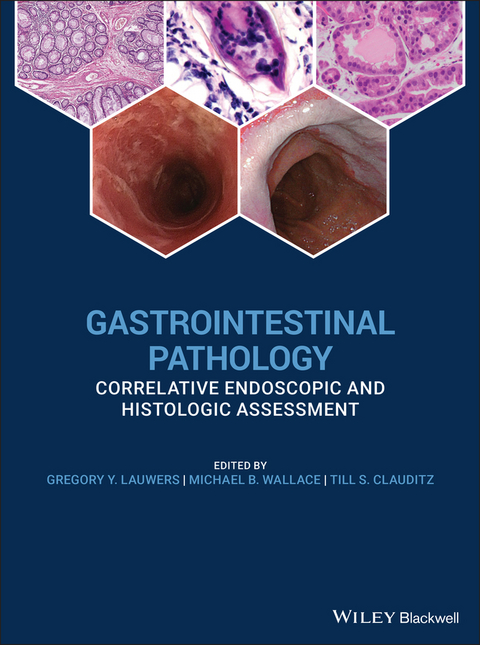
Gastrointestinal Pathology (eBook)
John Wiley & Sons (Verlag)
978-1-119-07303-1 (ISBN)
An illustrated guide to best practices when performing and assessing biopsies for GI conditions of all kinds
Accurate diagnosis of GI conditions necessarily entails both the careful taking of biopsies and the informed analysis of tissue material. With that being so, gastroenterologists and GI pathologists alike must have a solid understanding of the techniques, handling requirements, and diagnostic characteristics involved if they are to collaborate effectively. Gastrointestinal Pathology has been designed to provide a clinically focussed and richly illustrated guide to real-world scenarios faced by practicing GI specialists, offering step-by-step instruction and professional advice on the correct diagnosis of all major GI conditions. This essential new book includes:
- Full-color illustrations throughout
- Complete details of biopsy samples required to diagnose specific conditions
- Reviews of differential diagnoses
- Clinical management clues based on pathologic findings
Featuring information to improve the practice of all gastroenterologists and GI pathologists, Gastrointestinal Pathology is a practical and every-day resource for the precise diagnosis of a wide range of GI conditions.
Gregory Y. Lauwers, MD,?is the Director of the Gastrointestinal Pathology Service at the H. Lee Moffitt Cancer and Research institute. He is also Professor in the Departments of Pathology & Cell Biology and Oncologic Sciences at the University of South Florida in Tampa, USA.
Michael B. Wallace, MD, is the Fred C. Andersen Professor of Medicine at Mayo Clinic and Chief of Gastroenterology at Sheik Shakhbout Medical City (SSMC) in partnership with Mayo Clinic, Abu Dhabi, U.A.E.
Till S. Clauditz, MD, is Associate Professor and Head of GI-Pathology, Dept. of Pathology, at the University Medical Center Hamburg-Eppendorf, Germany.
An illustrated guide to best practices when performing and assessing biopsies for GI conditions of all kinds Accurate diagnosis of GI conditions necessarily entails both the careful taking of biopsies and the informed analysis of tissue material. With that being so, gastroenterologists and GI pathologists alike must have a solid understanding of the techniques, handling requirements, and diagnostic characteristics involved if they are to collaborate effectively. Gastrointestinal Pathology has been designed to provide a clinically focussed and richly illustrated guide to real-world scenarios faced by practicing GI specialists, offering step-by-step instruction and professional advice on the correct diagnosis of all major GI conditions. This essential new book includes: Full-color illustrations throughout Complete details of biopsy samples required to diagnose specific conditions Reviews of differential diagnoses Clinical management clues based on pathologic findings Featuring information to improve the practice of all gastroenterologists and GI pathologists, Gastrointestinal Pathology is a practical and every-day resource for the precise diagnosis of a wide range of GI conditions.
The Editors: Gregory Y. Lauwers, MD, is the Director of the Gastrointestinal Pathology Service at the H. Lee Moffitt Cancer and Research institute. He is also Professor in the Departments of Pathology & Cell Biology and Oncologic Sciences at the University of South Florida in Tampa, USA. Michael B. Wallace, MD, is the Fred C. Andersen Professor of Medicine at Mayo Clinic and Chief of Gastroenterology at Sheik Shakhbout Medical City (SSMC) in partnership with Mayo Clinic, Abu Dhabi, U.A.E. Till S. Clauditz, MD, is Associate Professor and Head of GI-Pathology, Dept. of Pathology, at the University Medical Center Hamburg-Eppendorf, Germany.
List of Contributors vii
1 General Principles of Biopsy Diagnosis of GI Disorders 1
Herbert C. Wolfen, Michael B. Wallace, Naohisa Yahaghi and Yutaka Saito
2 Esophagus Inflammatory Conditions 11
Anthony R. Mattia, Gregory Y. Lauwers, Michael B. Wallace and Till S. Clauditz
3 Epithelial Metaplastic, Polypoid, and Neoplastic Conditions of the Esophagus 35
Till S. Clauditz, Gregory Y. Lauwers, Michael B. Wallace and Anthony R. Mattia
4 Inflammatory Disorders of the Stomach 73
Till S. Clauditz , Michael B. Wallace and Gregory Y. Lauwers
5 Polyps of the Stomach 99
K. Kim, Till S. Clauditz, Jun Haeng Lee and Gregory Y. Lauwers
6 Gastric Neoplastic Conditions: Precursor Lesions and Early Gastric Cancer 125
Till S. Clauditz and Gregory Y. Lauwers
Gastric Neoplastic Conditions: Lymphoid Lesions of the Stomach 142
Mounir Trimeche and Laurence de Leval
7 Inflammatory and Miscellaneous Conditions of the Small Intestine 161
Ian Brown and Michael B. Wallace
8 Polyps of the Small Intestine 195
Ian Brown and Michael B. Wallace
9 Epithelial and Nonepithelial Neoplasms of the Small Intestine 209
Ian Brown, Michael B. Wallace and Till S. Clauditz
10 Inflammatory Conditions of the Colon 235
Tze Sheng Khor, Till S. Claudtiz, Bence Kovári, Gregory Y. Lauwers, Michael B. Wallace and Priyanthi Kumarasinghe
11 Polyps of the Large Intestine 307
Christophe Rosty, Michael B. Wallace and Till S. Clauditz
12 Epithelial Neoplasms of the Large Bowel 321
Christophe Rosty, Michael B. Wallace and Till S. Clauditz
13 Inflammatory Conditions of the Anus 337
Thomas Arnason and Michael B. Wallace
14 Polyps and Neoplastic Lesions of the Anus 349
Thomas Arnason, Michael B. Wallace and Till S. Clauditz
Index 369
1
General Principles of Biopsy Diagnosis of GI Disorders
Herbert C. Wolfen1, Michael B. Wallace1, Naohisa Yahaghi2 and Yutaka Saito3
1 Mayo Clinic, Jacksonville, Florida, USA
2 Keio University Cancer Center, Tokyo, Japan
3 National Cancer Center, Tokyo Japan
Tissue sampling of the gastrointestinal tract at the time of endoscopy is the cornerstone of many gastrointestinal diagnoses. The development of a flexible endoscope and the subsequent ability to directly acquire tissue under optical guidance has been one of the most important advancements in the field of gastroenterology throughout its history. Although tissue sampling can be performed through nonendoscopic devices, the ability to directly correlate precise locations and target biopsies to specific areas of disease is critical to our ability to diagnose and further understand gastrointestinal pathology. Many of the advancements in our understanding of the basic pathology and molecular biology of gastrointestinal disease can be directly attributed to our ability to acquire tissue for histological, molecular, and genetic analyses. An excellent example is our deep understanding of the molecular pathology of colorectal cancer development from normal colonic epithelium to adenoma to colorectal cancer, a discovery made possible because of colonoscopic access to precursor lesions such as adenomatous polyps and early cancers.
In this chapter, we will review general principles of tissue acquisition at the time of endoscopy including the following topics:
- Endoscopic equipment for obtaining tissue including endoscopic accessory channels, biopsy forceps, snare devices, needle aspiration and cytology brush.
- General principles of optimal sampling technique.
- Methods of tissue preparation in the endoscopy laboratory to optimize diagnostic accuracy.
- The role of endoscopic ultrasound (EUS)‐guided fine‐needle aspiration cytology.
Endoscopic Equipment for Tissue Sampling
Modern endoscopic equipment can be divided in two general categories: the endoscope that allows access to the gastrointestinal tract and accessory devices that are typically passed through the working channel of the endoscope to directly acquire tissue, including biopsy forceps, snares, fine‐needle aspiration devices, and cytology brushes. Recent developments in tissue sampling include devices that are capable of wide‐field, often definitive, endoscopic resection of early neoplasia and invasive carcinoma.
A modern endoscope is a remarkably robust and versatile instrument including a light source, optical lenses with a video capture device, image processing, and display equipment, and importantly for the purposes of tissue acquisition, an accessory channel ranging from 1 to 6 mm (typically 3–4 mm), which allows passage of devices for mechanical collection of tissue (Figures 1.1 and 1.2).
There is a general trade‐off between the diameter of the instrument and the ease and comfort with which it can be passed through the natural orifices of the body such as the mouth and anus. In general the larger the outer diameter, the larger the accessory channel is to accommodate larger instruments for tissue acquisition. A fundamental limitation of most flexible endoscopes, as opposed to surgical instruments, is that all accessories pass through a single access point of the endoscope. As compared to surgical instruments with multiple access points, the endoscopic devices do not typically allow triangulation to acquire a large bulk tissue or resect entire organs. For this reason, most tissue is sampled through pinch forceps, needle aspiration, or wire loop snare devices. More recently, electrosurgical needles and other cutting tools have been developed, which have allowed wide‐field resection of tissues of virtually any diameter (Figure 1.3).
Figure 1.1 Endoscope with control handle and tip. The tip contains a light source, imaging window, and accessory channel through which various tissue acquisition devices can be passed.
Figure 1.2 Endoscopic processor, which converts the light captured from the endoscope tip into a visible image for display.
Source: Olympus America, Inc. With permission.
Figure 1.3 (a) Tools for performing endoscopic resection including endoscopic submucosal dissection (ESD).
Source: Zeon Medical.
(b) Standard and insulated tip electrocautery knives for incision and dissection.
Source: © 2017 Korean Society of Gastrointestinal Endoscopy.
(c) CO2 insufflator for luminal distension, which is preferred to air given rapid reabsorption.
Source: Olympus.
(d) Distal attachment hood to facilitate maintaining view within the submucosal space.
Source: Fujifilm medical.
(e) Injection fluid (hyaluronic acid; Mucoup [Johnson and Johnson]) for submucosal lifting.
Source: Gut and Liver.
Pinch Biopsy Forceps
The flexible pinch biopsy forceps have been one of the most versatile of all instruments for tissue acquisition. These typically involve a flexible steel cable and lever device with two sharp‐edged cups, which can be opened and closed to acquire tissue (Figure 1.4).
Standard endoscopic sampling typically acquires tissue from the mucosa and occasionally a submucosal depth of the intestinal wall; however, large‐capacity forceps as well as multiple sampling including “bite on bite” allow sampling of the deeper layers. Pinch biopsy forceps come in multiple sizes from very small instruments such as a pediatric forceps, which can be passed through very small working channels. Recent development of very tiny forceps makes it possible to pass them through special endoscopes into the bile or pancreas duct and to pinch biopsy outside of the traditional gastrointestinal lumen (Figure 1.5).
Studies comparing jumbo forceps to standard forceps have generally not shown significant advantages of larger capacity forceps. A limitation of most forceps is the inability to sample tissue in the submucosa routinely. This is highlighted in studies looking for Barrett's esophagus after the surface epithelium has been ablated. Biopsy forceps can remove tissue with mechanical closure alone or with electrocautery (“hot biopsy”) although the use of hot biopsy has diminished significantly due to increased risks of complication and tissue damage in the biopsy specimen.
Figure 1.4 Endoscopic biopsy forceps in the open position. The needle‐like pin in the center holds the tissue in place so one to two samples can be obtained per pass.
Figure 1.5 Micro biopsy forceps <1 mm in diameter, which can be passed through specialized endoscopes into the bile duct, pancreas duct, or via 19‐gauge needles for extraluminal tissue sampling.
Source: Boston Scientific Corporation with permission.
Figure 1.6 Endoscopic snare for polypectomy. The wire loop is extended in the open position outside the plastic sheath. When closed, the wire loop is strangulated and resects the polyp tissue.
Figure 1.7 Endoscopic cytology brush. Note the abrasive brush extended beyond the protective plastic sheath.
Endoscopic Snare Devices
Endoscopic snare devices have also been widely used for resection of polypoid as well as flat lesions throughout the gastrointestinal tract. They have been remarkably versatile and effective over the past four decades. Endoscopic snares typically involve a metallic wire, which may braided or monofilament (Figure 1.6).
A wire loop is generally constrained within a small caliber plastic catheter. At the distal end of the catheter, the wire loop can be opened to various sizes to grasp and resect polyps of different sizes. Typical sizes include loops 5–30 mm in diameter. There are numerous different shapes including oval, hexagonal, and asymmetric “duck bill.” Snares also come in various degrees of stiffness, which allow resection of lesions of many shapes and sizes. Tissue can be resected with mechanical closure alone (so‐called “cold snare”) or with mechanical plus electrosurgical cutting (“hot snare”). Recent studies suggest that cold snare is associated with lower risk of bleeding and bowel wall injury.
Endoscopic Brush Cytology
Abrasive brush cytology has been used in many different fields of tissue sampling. Typical endoscopic brush is constrained within a plastic catheter similar to endoscopic snares (Figure 1.7).
After passing through the accessory channel of the endoscope, the abrasive brush is exposed and rubbed against the area of tissue sampling. This is most commonly applied to obtain specimens for microbiology, particularly fungal specimens. These have also been widely applied in the biliary tract for sampling of suspicious biliary strictures. More recent advances include a highly abrasive wide‐area tissue sampling system that has been recently studied and Barrett's esophagus as an alternative to pinch forceps, as well as nonendoscopic abrasive sponge...
| Erscheint lt. Verlag | 22.4.2021 |
|---|---|
| Mitarbeit |
Stellvertretende Herausgeber: Till S. Clauditz |
| Sprache | englisch |
| Themenwelt | Medizin / Pharmazie ► Allgemeines / Lexika |
| Medizin / Pharmazie ► Medizinische Fachgebiete ► Chirurgie | |
| Medizinische Fachgebiete ► Innere Medizin ► Gastroenterologie | |
| Schlagworte | clinical guide gastroenterology • endoscopic presentation GI • examining biopsies • Gastroenterologie • Gastroenterologie u. Hepatologie • gastroenterologist • gastroenterology • Gastroenterology & Hepatology • Gastrointestinal surgery • handle biopsy specimens • histopathologic figures • Magen-Darm-Chirurgie • Medical Science • Medizin • microscopic interpretation • pathognomonic characteristics • pathologist • Pathology Reporting |
| ISBN-10 | 1-119-07303-0 / 1119073030 |
| ISBN-13 | 978-1-119-07303-1 / 9781119073031 |
| Informationen gemäß Produktsicherheitsverordnung (GPSR) | |
| Haben Sie eine Frage zum Produkt? |
 EPUB (Adobe DRM)
Kopierschutz: Adobe-DRM
Adobe-DRM ist ein Kopierschutz, der das eBook vor Mißbrauch schützen soll. Dabei wird das eBook bereits beim Download auf Ihre persönliche Adobe-ID autorisiert. Lesen können Sie das eBook dann nur auf den Geräten, welche ebenfalls auf Ihre Adobe-ID registriert sind.
Details zum Adobe-DRM
Dateiformat: EPUB (Electronic Publication)
EPUB ist ein offener Standard für eBooks und eignet sich besonders zur Darstellung von Belletristik und Sachbüchern. Der Fließtext wird dynamisch an die Display- und Schriftgröße angepasst. Auch für mobile Lesegeräte ist EPUB daher gut geeignet.
Systemvoraussetzungen:
PC/Mac: Mit einem PC oder Mac können Sie dieses eBook lesen. Sie benötigen eine
eReader: Dieses eBook kann mit (fast) allen eBook-Readern gelesen werden. Mit dem amazon-Kindle ist es aber nicht kompatibel.
Smartphone/Tablet: Egal ob Apple oder Android, dieses eBook können Sie lesen. Sie benötigen eine
Geräteliste und zusätzliche Hinweise
Buying eBooks from abroad
For tax law reasons we can sell eBooks just within Germany and Switzerland. Regrettably we cannot fulfill eBook-orders from other countries.
aus dem Bereich