Evidence in Medicine (eBook)
John Wiley & Sons (Verlag)
978-1-119-79419-6 (ISBN)
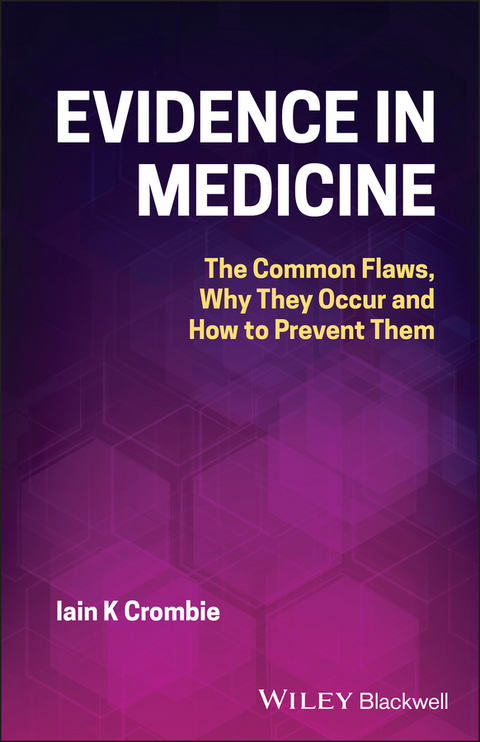
High-quality evidence is the foundation for effective treatment in medicine. As the vast amount of published medical evidence continues to grow, concerns about the quality of many studies are increasing. Evidence in Medicine is a much-needed resource that addresses the 'medical misinformation mess' by assessing the flaws in the research environment. This authoritative text identifies and summarises the many factors that have produced the current problems in medical research, including bias in randomised controlled trials, questionable research practices, falsified data, manipulated findings, and more.
This volume brings together the findings from meta-research studies and systematic reviews to explore the quality of clinical trials and other medical research, explaining the character and consequences of poor-quality medical evidence using clear language and a wealth of supporting references. The text suggests planning strategies to transform the research process and provides an extensive list of the actions that could be taken by researchers, regulators, and other key stakeholders to address defects in medical evidence. This timely volume:
- Enables readers to select reliable studies and recognise misleading research
- Highlights the main types of biased and wasted studies
- Discusses how incentives in the research environment influence the quality of evidence
- Identifies the problems researchers need to guard against in their work
- Describes the scale of poor-quality research and explores why the problems are widespread
- Includes a summary of key findings on poor-quality research and a listing of proposed initiatives to improve research evidence
- Contains extensive citations to references, reviews, commentaries, and landmark studies
Evidence in Medicine is required reading for all researchers who create evidence, funders and publishers of medical research, students who conduct their own research studies, and healthcare practitioners wanting to deliver high-quality, evidence-based care.
Iain Crombie is Emeritus Professor of Public Health at Dundee University, UK. He has published more than 160 research papers as well as books on critical appraisal, research methods, grant applications, and clinical audits. He has extensive experience teaching both undergraduate and postgraduate courses in epidemiology, medical statistics, and research methods.
Iain K Crombie is Emeritus Professor of Public Health at Dundee University, UK. He has published more than 160 research papers as well as books on critical appraisal, research methods, grant applications, and clinical audits. He has extensive experience teaching both undergraduate and postgraduate courses in epidemiology, medical statistics, and research methods.
Preface 4
Aims of this book 5
Chapter 1 The rationale for treatment: a brief history 7
Conclusion 14
References 15
Chapter 2 Sources of bias in randomised controlled trials 18
Method of treatment allocation 18
Problems in measuring the outcome 20
Follow-up and missing outcomes 22
Missing outcome data and intention to treat 23
Other methodological concerns 24
Conclusions 26
References 27
Chapter 3 Wasted and unhelpful trials 34
Wasted Studies 34
Neglected areas of research 35
Unhelpful outcome measures 35
Lack of generalisability 37
Weak and misleading evidence 39
Conclusion 40
References 40
Chapter 4 Can the analysis bias the findings? 46
The p-value problem 46
Questionable research practices 48
Ensuring high quality analysis: the Statistical Analysis Plan 50
Conclusions 51
References 52
Chapter 5 Systematic reviews and Meta-analysis 56
Introduction 56
Identifying relevant trials 57
Extracting trial data 59
The quality of primary trials 61
Pooling effect sizes across trials 62
Other methodological issues 63
Conclusions 65
References 66
Chapter 6 Fabrication, falsification and spin 73
Fabrication 73
Falsification 75
Questionable Research Practices 76
Spin 76
Retractions 78
Discussion 78
References 79
Chapter 7 Why do researchers falsify data or manipulate study findings? 83
The research environment 83
Research oversight 86
Conflict of interest 88
Individual level explanations for research misconduct 90
How honest people rationalise misconduct 91
Discussion 93
References 94
Chapter 8 Developing a strategy to prevent poor quality and misleading research 103
Research environment 103
Research transparency 105
Research oversight 106
Research integrity 107
Essential elements of a transformational strategy 108
Implementing a programme for action 112
References 113
Appendix 1 Summary of the key findings on poor quality research 118
Problems in the design, conduct, analysis and reporting of studies 118
Frequency of data fabrication and falsification 120
The causes of poor quality and misleading research 120
The findings in perspective 121
References 122
Appendix 2 Initiatives to improve the quality of research 123
Change the research environment 123
Improve training 125
Increase research transparency 126
Quality of trial methodology 128
Trial registration 130
Reporting of the methods of systematic reviews 130
Increasing access to and use of reporting guidelines 132
Implement vigorous research oversight 132
Promote research integrity 136
Examples of coordinated initiatives 140
References 141
Index
"Evidence in Medicine: The Common Flaws, Why They Occur and How to Prevent Them will open your eyes to the squishy underbelly of clinical research. Given the numerous pitfalls for the unwary -- and overly ingenious -- investigator, it is no surprise that "possibly 85 percent of clinical research is wasted."' - Journal of Clinical Research Best Practices
CHAPTER 1
The Rationale for Treatment: A Brief History
The development of modern medicine has rightly been described as ‘the greatest benefit to mankind’ [1]. Vaccination, anaesthetics, aseptic surgery, antibiotics, insulin for diabetes and drugs to prevent and treat heart disease form part of a very long list of treatments that have transformed healthcare. These are the fruits of many years of careful clinical investigation supported by extensive research. However, medicine has a checkered history in which ineffective treatments were widely used: as Benjamin Franklin pithily remarked in the eighteenth century, ‘God heals, and the doctor takes the fees’ [2]. Studies of the history of medicine show that the basis on which treatments have been used has varied greatly across the centuries [3]. This chapter explores the rationale behind the use of treatments, and the way this has changed over time. It concludes by describing the progress towards present‐day methods for testing the effectiveness of treatments.
THEORY AS JUSTIFICATION FOR TREATMENT
In ancient times diseases were attributed to supernatural causes, spirits and demons. Treatments involved spells and prayers, or the wearing of amulets, which were intended to drive the malign forces from the patient [4]. Theories gradually evolved towards biological and physical causes of disease, with treatments involving minor surgery and drugs (usually based on plant extracts, minerals and metals). In Western medicine, one of the most influential of these theories was the doctrine of the four humours. It held that good health was enjoyed when four humours (the fluids: blood, phlegm, black bile and yellow bile) were in balance, with an excess of one humour causing disease [5]. Treatment for illness focused on restoring the balance by removing some of the excess humour from the body. This could be achieved by bloodletting (cutting open a vein or by applying a leech), or by losing fluid with a purgative or blistering the skin. This treatment was almost always harmful, although it often appeared to give short‐term relief of the symptoms of acute inflammations [6]. The most notable casualty of bloodletting was George Washington, first president of the United States. He was suffering from a serious upper respiratory tract infection, for which his doctors extracted approximately 2.4 L of blood over about 12 hours. He died 33 hours later, probably from the combination of the infection and the treatment given [5]. When the practice of bloodletting was challenged in the nineteenth century, a leading physician, William Stokes, commented that it was hard to believe ‘that the fathers of British medicine were always in error, and that they were bad observers and mistaken practitioners’ [7]. This cautionary tale of bloodletting suggests that theory and clinical experience may be unreliable guides to the effectiveness of a treatment.
A more recent but widely (mis)used theory was that bed rest was beneficial for a variety of ailments. Its popularity has been traced to a series of lectures in the middle nineteenth century by John Hilton, president of the Royal College of Surgeons [8, 9]. Initially recommended for recovery following orthopaedic procedures [10], it was soon used for conditions including myocardial infarction, pulmonary tuberculosis, rheumatic fever and psychiatric illnesses [9]. Bed rest was particularly popular in pregnancy, where it was recommended for complications such as threatened abortion, hypertension or preterm labour [11]. The theory was that if rest helped to mend broken bones, then it would also heal other organs [9]. The benefits of bed rest were thought to include reduced demands on the heart, conservation of metabolic resources for healing and avoidance of stress [12]. Its use began to be challenged in the middle of the twentieth century, as evidence grew on the adverse effects of bed rest; it is now known to cause impairment of cardiovascular, haematological, musculoskeletal, immune and psychological functions [9, 12]. Bed rest is an example of a treatment based on beliefs about benefit that endured in the face of substantial evidence of harm [8, 11].
TESTING ON A SERIES OF PATIENTS
The transition, from treatments based on theory to the use of evidence derived from empirical studies, was a gradual process. A simple, and common, method was to give a treatment on a series of patients, then observe its impact on disease. A good example is the use of the leaves of the willow tree for inflamed joints, a treatment dating back to the ancient Egyptians [13]. Clinical observation confirmed the benefits: application of a decoction of willow leaves to inflamed skin reduced the swelling. Extracts of willow leaves and bark were also used for fever and pain by the Greeks from the fifth century BCE [14]. An important step in the use of the willow was taken by the Reverend Edward Stone in 1763. He administered a solution of powdered willow bark to 50 patients with fever, judging the treatment a great success [14, 15]. The active ingredient of the willow, salicin, was isolated in the 1820s [13, 15]. This drug was tested by a Dundee physician, T.J. MacLagan, who administered it to a series of patients with acute rheumatism. Not only was the treatment successful, it demonstrated antipyretic, analgesic and anti‐inflammatory effects [15]. Salicin was recognised to be an important drug, but its long‐term use was limited because gastric irritation, nausea and vomiting were common side effects. The pharmaceutical arm of the Bayer company searched for a safer alternative, and successfully modified salicin to produce a new chemical with fewer side effects [13, 15]. That drug, aspirin, is now the most widely used medicine in the world [14].
Another example of evidence from a series of patients is the discovery of insulin for the treatment of diabetes. This was undoubtedly ‘one of the most dramatic events in the history of the treatment of disease’ [16]. Research, in the late nineteenth century, had shown that removal of an animal's pancreas ‘produced severe and fatal diabetes’ [17]. Over the following 30 years many researchers tried to isolate a pancreatic extract that could control blood sugar levels. They had little success, as the extracts had only a transitory effect on blood sugar and caused unacceptable side effects (vomiting, fever and convulsions) [18, 19]. In October 1920 Frederick Banting, a young Canadian doctor, was preparing a lecture on the pancreas [16]. The research he was reading led him to think that the active ingredient was being destroyed by the digestive enzymes in the pancreas, and that this could be prevented by ligating the pancreatic ducts. Banting began the experiments with extracts of the ligated pancreas in May 1921 [17]. By January 1922 a purified extract had been obtained. This proved successful in treating a 14‐year‐old boy, and in February a further six patients were treated with equally favourable results [16]. The discovery was announced in April to international acclaim; the Nobel prize was awarded to Banting, and one of his colleagues, Dr Macleod, in 1923 [16].
COMPARING GROUPS
Case series can provide support for a treatment if, as with insulin, the benefits are immediate and substantial. But observations on a set of patients are often not sufficient to identify whether a treatment is truly effective. Consider the management of gunshot wounds in the sixteenth century. At that time it was believed that the bullet introduced poison into the body, and that cauterising the wound with boiling oil mixed with treacle would detoxify it [20, 21]. The treatment was very unpleasant, but was thought to save lives. Force of circumstances led the French barber‐surgeon, Ambroise Paré, to use a different treatment. During the Italian war of 1536–1538, Paré ran out of oil and instead used a balm of egg yolk, rose oil and turpentine [20]. He observed that the outcomes differed substantially between the two groups: those treated with the hot oil were feverish and in ‘great pain and swelling about the edges of their wounds’, whereas those given the balm were resting comfortably [21]. Further trials of the balm convinced Paré that gunshot wounds were not poisoned and should not be cauterised [20].
The comparison of groups also helped promote a technique for the prevention of smallpox. In the 1700s smallpox was a leading cause of death, with many of those who survived suffering disfigurement and blindness [22]. The available preventive measure was to infect children with puss or scab material from smallpox victims, a process known as variolation. Despite reports that it was beneficial [23], there was widespread concern that variolation might carry a greater risk of dying than allowing people to contract the disease naturally. James Jurin evaluated this in the 1720s, by collecting data on death rates in three groups: those who were diagnosed with smallpox, those at risk of contracting smallpox and those who had been variolated [22, 23]. The results appeared convincing with death rates of 16.5% (diagnosed cases), 8.3% (at risk) and 2.0% (variolated) [23]. Preventing smallpox was a much safer practice than letting nature take...
| Erscheint lt. Verlag | 9.4.2021 |
|---|---|
| Sprache | englisch |
| Themenwelt | Medizin / Pharmazie ► Allgemeines / Lexika |
| Schlagworte | assess medical evidence • assess medical research • clinical trial flaws • clinical trial quality • Evidence-based Health Care • Evidenzbasierte Forschung im Gesundheitswesen • Evidenzbasierte Medizin • <p>medical evidence quality • Medical Professional Development • medical research flaws • medical research meta-analysis </p> • medical research quality • Medical Science • Medical Statistics & Epidemiology • Medizin • Medizinische Statistik u. Epidemiologie • Perspektiven in medizinischen Berufen • randomized trial bias • wasted medical research |
| ISBN-10 | 1-119-79419-6 / 1119794196 |
| ISBN-13 | 978-1-119-79419-6 / 9781119794196 |
| Informationen gemäß Produktsicherheitsverordnung (GPSR) | |
| Haben Sie eine Frage zum Produkt? |
 EPUB (Adobe DRM)
Kopierschutz: Adobe-DRM
Adobe-DRM ist ein Kopierschutz, der das eBook vor Mißbrauch schützen soll. Dabei wird das eBook bereits beim Download auf Ihre persönliche Adobe-ID autorisiert. Lesen können Sie das eBook dann nur auf den Geräten, welche ebenfalls auf Ihre Adobe-ID registriert sind.
Details zum Adobe-DRM
Dateiformat: EPUB (Electronic Publication)
EPUB ist ein offener Standard für eBooks und eignet sich besonders zur Darstellung von Belletristik und Sachbüchern. Der Fließtext wird dynamisch an die Display- und Schriftgröße angepasst. Auch für mobile Lesegeräte ist EPUB daher gut geeignet.
Systemvoraussetzungen:
PC/Mac: Mit einem PC oder Mac können Sie dieses eBook lesen. Sie benötigen eine
eReader: Dieses eBook kann mit (fast) allen eBook-Readern gelesen werden. Mit dem amazon-Kindle ist es aber nicht kompatibel.
Smartphone/Tablet: Egal ob Apple oder Android, dieses eBook können Sie lesen. Sie benötigen eine
Geräteliste und zusätzliche Hinweise
Buying eBooks from abroad
For tax law reasons we can sell eBooks just within Germany and Switzerland. Regrettably we cannot fulfill eBook-orders from other countries.
aus dem Bereich