MRI Registry Review (eBook)
John Wiley & Sons (Verlag)
978-1-119-75795-5 (ISBN)
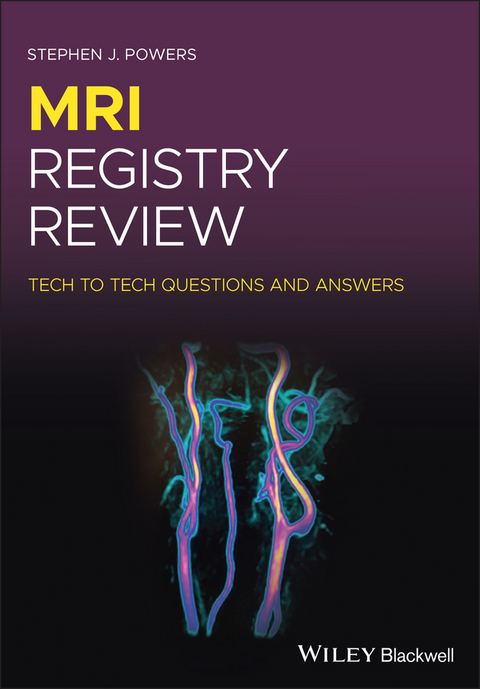
MRI Registry Review: Tech to Tech Questions and Answers is a comprehensive question and answer book designed to help scanning technologists pass their MRI Board certification examinations, particularly the 'Registry' and Continuing Qualifications Requirements (CQR) exams administered by the American Registry of Radiologic Technologists (ARRT). The book provides clear explanations and accurate answers to numerous multiple-choice questions (MCQs) similar to those found in ARRT exams, as well as study tips and additional information on many key topics.
The questions are organized into four sections aligned with ARRT content specifications, covering patient care during an MRI, the physical principles of MRI, data acquisition, and imaging procedures. Written for MRI students and working technologists alike, the book is the perfect complement to MRI Physics: Tech to Tech Questions and Answers- the author's guide that explains difficult MRI concepts and topics with a clear and straightforward approach. Offering a wide variety of questions and succinct yet thorough explanations, this valuable study and review guide:
- Covers the topics technologists need to know in order to pass ARRT exams
- Offers exam preparation and test-taking suggestions and advice
- Groups questions together by topic to allow readers to focus on specific areas needing more attention
- Includes tables, figures, cross-vendor terminology lists, and illustrations that reinforce key points and demonstrate application to practice
- Links sections to corresponding chapters in the companion MRI Physics: Tech to Tech Explanations
MRI Registry Review: Tech to Tech Questions and Answers is an indispensable study tool for students and trainees preparing for the ARRT or equivalent advanced MRI placement exams, as well as for technologists needing to re-certify or take CQR exams.
Stephen J. Powers, BSTR (R), (CT), (MR) has more than 20 years of classroom, lecture and clinical instructor experience. He is currently an MR Technologist for South Coast Hospital Systems in the USA, and former MRI Clinical Applications Specialist for General Electric Health Care. Stephen is the author of MRI Physics: Tech to Tech Explanations.
Stephen J. Powers, BSTR (R), (CT), (MR) has more than 20 years of classroom, lecture and clinical instructor experience. He is currently an MR Technologist for South Coast Hospital Systems in the USA, and former MRI Clinical Applications Specialist for General Electric Health Care. Stephen is the author of MRI Physics: Tech to Tech Explanations.
About the Author vii
Acknowledgements Viii
1 Patient Interactions and Management 1
Below are artist renditions of the anatomical position: 31
Section 1 Patient Interactions and Management Answers 31
Enlarged Pictures 43
2 Parameters, Image Formation, Data Acquisition 45
Section 2: Parameters, Image Formation, Data Acquisition: Answers 93
Section 2 Question 41-54 96
Section 2: Enlarged Illustrations 107
Section 2 Questions 41-54 108
Chapter 2: Parameters, Image Formation, Data Acquisition 109
3 Pulse Sequences and MRI Math 113
Use the factors listed below for Questions 200-203 154
Section 3 MR Pulse Sequences and MR Math Answers 177
4 Procedures 192
Image Artifacts 275
Remember, Choose the Answer Most Correct 275
Artifacts 293
Miscellaneous Questions: 297
Helpful Anatomy: The Basil Ganglia 307
Helpful Anatomy: T2 Axials of Basil Ganglia 308
Helpful Anatomy: T1 Sagittal of Brain Stem 308
Other Helpful Anatomy: The Brachial Plexus 309
The Boney Pelvis 310
The Cranial Nerves: O O O T T A F A G V A H 311
Cranial Nerve: Study 312
T1 and T2 Contrast Differences in the Brain 312
Answers 313
MRI Math 339
Glossary 350
Index 375
1
Patient Interactions and Management
This section will concentrate on the many aspects of Patient Care including: patient monitoring, safety, and some legal/ethical aspects of taking care of a patient. There are/will be approximately 30 questions on the subject of patient care. The breakdown is listed below.
- Ethics + Legal ≈ 4
- Screening/Safety ≈ 11
- Patient assessment/Monitoring ≈ 6
- Communication skills ≈ 5
- Infection control ≈ 4 (a.k.a. aseptic technique)
Answers will be provided at the end of each section. There will be some discussions/explanations as to the how’s/why’s/what’s for select questions. Also, I will point out/explain why some of the choices were not the correct answer. This is another way of learning. Remember, it’s ok to fail here at home so you don’t fail at the testing site.
- Informed consent consists of all the following except?
- Age and ability to understand statements◻
- Right to stop and refuse further imaging treatment◻
- Alternate imaging methods◻
- Patients have all rights to bring suit◻
- What is the FDA safe Gauss line limit?
- 0.5 Gauss◻
- 5 Gauss◻
- 50 Gauss◻
- 5 T◻
- A systolic blood pressure of below 100 is a sign of?
- Hypertension◻
- Hyperglycemia◻
- Cardiac arrest◻
- Hypotension◻
- What is libel?
- Chance for a mistake◻
- A true statement made to purposely defame a person’s reputation◻
- A false statement made to purposely defame a person’s reputation◻
- A new kind of oral contrast◻
- Res Ipsa Loquitur means “It speaks for itself”. It implies that:
- There was a breach in duty harm resulting◻
- The results are in question◻
- A principle that the occurrence of an accident implies that negligence caused the incident◻
- A and C◻
- What are the signs of cardiac arrest?
- No pulse◻
- Cyanosis◻
- Patient is unresponsive◻
- All the above◻
- What are the contraindications for administering gadolinium?
- There are none◻
- C.O.P.D◻
- Renal impairment◻
- Allergy to iodine◻
- What condition requires the patient to wear a mask?
- There are none◻
- C.O.P.D◻
- Tuberculosis◻
- Pneumonia◻
- A patient on contact precautions requires technologists to wear?
- HazMat suits◻
- Gown, gloves, and mask◻
- Gown and gloves◻
- Eye protection◻
- True or False: All patients require at least visual and verbal monitoring.
- What is the preferred method to R/O metallic foreign body?
- Hi resolution CT◻
- P/A and lateral X‐ray views of the orbits◻
- Panorex views of the orbits◻
- Visual exam by the radiologist◻
- What is the accepted practice for administering gadolinium to a nursing mother?
- Gadolinium is not excreted thru breast milk◻
- Pump and dump for the next 24 hours◻
- Don’t give them gadolinium◻
- All the above◻
- What instrument is used to take a patient blood pressure?
- Laryngoscope◻
- Pulse Ox◻
- Sphygmomanometer◻
- Osteotome◻
- What is a potential effect is emesis?
- Hives◻
- Hypertension◻
- Jaundice◻
- Dehydration◻
- A patient on respiratory precautions requires technologists to wear?
- HazMat suits◻
- Gown, gloves, and mask◻
- Gown and gloves◻
- Eye protection◻
- The localization light can possibly cause eye damage. True or False?
- Why does the I.V. bag need to be above the heart at all times?
- Avoid infection◻
- Avoid blood back flow◻
- Avoid air bubbles◻
- B and C◻
- Which is not a concern during a quench?
- Combustion◻
- Frost bite◻
- Room pressure increases◻
- Asphyxiation◻
- Who needs to be monitored?
- Only sedated patients◻
- The elderly◻
- Pediatric◻
- All patients◻
- RF irradiation is expressed as SAR. SAR is measured in:
- kilowatts/min◻
- W/g◻
- W/kg◻
- What’s/kg◻
- A patient with high BUN and creatinine values may have what condition?
- Renal infection◻
- Renal artery stenosis◻
- Renal insufficiency◻
- Renal cysts◻
- True or False: Gadolinium will not cross a non‐intact BBB.
- Several factors influence the patient’s ability to dissipate heat including all but:
- Ambient room temperature◻
- Coil type◻
- Altitude◻
- RF amplitude◻
- Which sequence has the highest amount of time‐varying magnetic fields?
- Gradient recalled◻
- Spin echo◻
- Fast spin echo◻
- Echo planar◻
- Which sequence has the highest amount of RF applied to the patient?
- Turbo spin echo◻
- Gradient echo◻
- Spin echo◻
- MRA◻
- Individuals with pacemakers should remain outside the ________ fringe field line?
- 5.0 Gauss◻
- 50 Gauss◻
- 2.0 Gauss◻
- 0.5 Gauss◻
- FDA limits for heating due to RF is limited to:
- 0.5 °C in normal mode◻
- 1.0 °C in first mode◻
- 1.5 °C in either mode◻
- A and B◻
- True or False: Resistive magnets should be quenched if a heavy object is drawn into it.
- The attractive force that a ferrous object will see 5 feet from the bore depends on:
- Size of the object◻
- Field strength◻
- Metallic properties of object◻
- All the above◻
- 5 Gauss is also known as:
- 0.5 mT◻
- 5 mT◻
- They don’t convert◻
- 0.05 mT◻
- True or False: Objects closest to isocenter are more likely to heat from RF exposure.
- Who obtains informed consent?
- R.N◻
- R.T.R◻
- M.D. or D.O.◻
- Unit Secretary◻
- Why do sedated patient need to be...
| Erscheint lt. Verlag | 31.3.2021 |
|---|---|
| Sprache | englisch |
| Themenwelt | Medizin / Pharmazie ► Allgemeines / Lexika |
| Medizin / Pharmazie ► Gesundheitsfachberufe | |
| Medizinische Fachgebiete ► Radiologie / Bildgebende Verfahren ► Radiologie | |
| Schlagworte | ARRT CQR exam • ARRT exam prep • ARRT exam questions • ARRT mcqs • ARRT registry exam • ARRT test • Computertomographie • Computertomographie (MRI) • Gesundheits- u. Sozialwesen • Health & Social Care • Medical Science • Medizin • MRI • MRI board exam • MRI exam mcqs • MRI student guide • MRI technologist exam prep • MRI technologist exam review • MRI technologist guide • MRI trainee guide • Radiographie • radiography • Radiologie • Radiologie u. Bildgebende Verfahren • Radiology & Imaging |
| ISBN-10 | 1-119-75795-9 / 1119757959 |
| ISBN-13 | 978-1-119-75795-5 / 9781119757955 |
| Informationen gemäß Produktsicherheitsverordnung (GPSR) | |
| Haben Sie eine Frage zum Produkt? |
 EPUB (Adobe DRM)
Kopierschutz: Adobe-DRM
Adobe-DRM ist ein Kopierschutz, der das eBook vor Mißbrauch schützen soll. Dabei wird das eBook bereits beim Download auf Ihre persönliche Adobe-ID autorisiert. Lesen können Sie das eBook dann nur auf den Geräten, welche ebenfalls auf Ihre Adobe-ID registriert sind.
Details zum Adobe-DRM
Dateiformat: EPUB (Electronic Publication)
EPUB ist ein offener Standard für eBooks und eignet sich besonders zur Darstellung von Belletristik und Sachbüchern. Der Fließtext wird dynamisch an die Display- und Schriftgröße angepasst. Auch für mobile Lesegeräte ist EPUB daher gut geeignet.
Systemvoraussetzungen:
PC/Mac: Mit einem PC oder Mac können Sie dieses eBook lesen. Sie benötigen eine
eReader: Dieses eBook kann mit (fast) allen eBook-Readern gelesen werden. Mit dem amazon-Kindle ist es aber nicht kompatibel.
Smartphone/Tablet: Egal ob Apple oder Android, dieses eBook können Sie lesen. Sie benötigen eine
Geräteliste und zusätzliche Hinweise
Buying eBooks from abroad
For tax law reasons we can sell eBooks just within Germany and Switzerland. Regrettably we cannot fulfill eBook-orders from other countries.
aus dem Bereich